

Depolarization of Retina measured by an Imaging Mueller Matrix Retinal Polarimeter PowerPoint PPT Presentation
1 / 1
Title: Depolarization of Retina measured by an Imaging Mueller Matrix Retinal Polarimeter
1
Depolarization of Retinameasured by an Imaging
Mueller Matrix Retinal Polarimeter
Wai-Sze Tiffany Lam ,Russell Chipman, Greg Smith,
Ann Elsner University of Arizona College of
Optical Sciences, Indiana University School of
Optometry
Purpose
Retinal Depolarization Images
Results
Depolarization Index
Irradiance
To study the depolarization of the retina using a
Scanning Laser Polarization Ophthalmoscope which
is capable of measuring a full Mueller Matrix of
the retina. The depolarization of the retina
might provide another way of early diagnostic of
eye diseases such as age-related macular
degeneration and diabetic retinopathy.
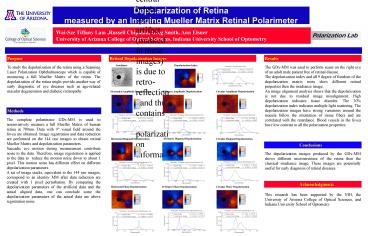
The GDx-MM was used to perform scans on the right
eye of an adult male patient free of retinal
disease. The depolarization index and all 9
degree of freedom of the depolarization matrix
roots show different retinal properties then the
irradiance image. An image alignment analysis
shows that the depolarization is not due to
residual image misalignment. High depolarization
indicates tissue disorder. The 30 depolarization
index indicates multiple light scattering. The
depolarization images have strong variations
around the macula follow the orientation of
tissue fibers and are correlated with the
retardance. Blood vessels in the fovea have low
contrast in all the polarization properties.
The central bright spot artifact (masked in these
images) is due to retro-reflection, and thus
contains no polarization information.
Horizontal Amplitude Depolarization
45 Degree Amplitude Depolarization
Circular Amplitude Depolarization
Methods
The complete polarimeter GDx-MM is used to
noninvasively measure a full Mueller Matrix of
human retina at 780nm. Data with 9 visual field
around the fovea are obtained. Image registration
and data reduction are performed on the 144 raw
images to obtain retinal Mueller Matrix and
depolarization parameters. Saccadic eye motion
during measurement contribute noise to the data.
Therefore, image registration is applied to the
data to reduce the motion noise down to about 1
pixel. This motion noise has different effect on
different depolarization parameters. A set of
image stacks, equivalent to the 144 raw images,
correspond to an identity MM after data reduction
are created with 1 pixel perturbation. By
comparing the depolarization parameters of the
artificial data and the actual aligned data, one
can conclude some the depolarization parameters
of the actual data are above registration noise.
45 Degree Diagonal Depolarization
Horizontal Diagonal Depolarization
Circular Diagonal Depolarization
Conclusions
The depolarization images produced by the GDx-MM
shows different microstructure of the retina then
the classical irradiance image. These images are
potentially useful for early diagnosis of retinal
diseases.
Acknowledgments
Horizontal Phase Depolarization
45 Degree Phase Depolarization
Circular Phase Depolarization
This research has been supported by the NIH, the
University of Arizona College of Optical
Sciences, and Indiana University School of
Optometry
Recommended

