

Lightspeed Shopify Integration PowerPoint PPT Presentation
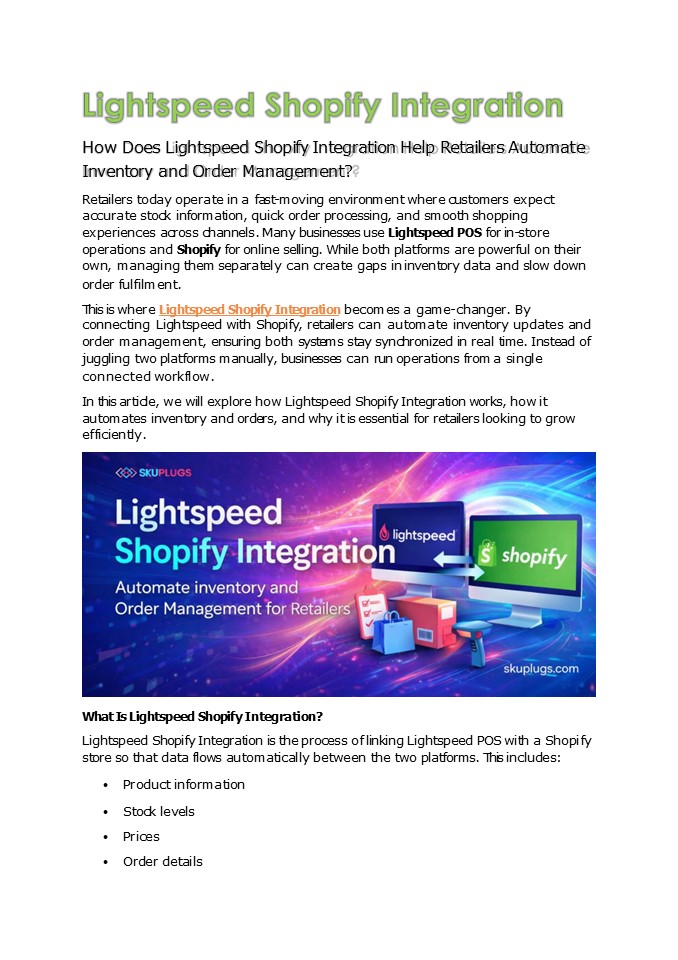
Title: Lightspeed Shopify Integration
1
How Does Lightspeed Shopify Integration Help
Retailers Automate Inventory and Order
Management? Retailers today operate in a
fast-moving environment where customers expect
accurate stock information, quick order
processing, and smooth shopping experiences
across channels. Many businesses use Lightspeed
POS for in-store operations and Shopify for
online selling. While both platforms are powerful
on their own, managing them separately can create
gaps in inventory data and slow down order
fulfilment. This is where Lightspeed Shopify
Integration becomes a game-changer. By connecting
Lightspeed with Shopify, retailers can automate
inventory updates and order management, ensuring
both systems stay synchronized in real time.
Instead of juggling two platforms manually,
businesses can run operations from a
single connected workflow. In this article, we
will explore how Lightspeed Shopify Integration
works, how it automates inventory and orders, and
why it is essential for retailers looking to grow
efficiently.
- What Is Lightspeed Shopify Integration?
- Lightspeed Shopify Integration is the process of
linking Lightspeed POS with a Shopify store so
that data flows automatically between the two
platforms. This includes - Product information
- Stock levels
- Prices
- Order details
2
- Once integrated, Lightspeed and Shopify function
like a unified system. Any sale made in-store
through Lightspeed updates the stock in Shopify,
and any sale made on Shopify updates the
inventory in Lightspeed. Orders placed online are
automatically imported into Lightspeed for
processing. - This connection removes the need for double entry
and ensures consistent data across channels. - Why Automation Is Critical for Modern Retail
- Retailers managing inventory and orders manually
often face challenges such as - Selling products that are already out of stock
- Delayed order fulfillment
- Inconsistent stock data
- Time wasted on manual updates
- Customer complaints and returns
- Automation solves these issues by keeping systems
aligned without constant human effort. With
Lightspeed Shopify Integration, businesses gain
speed, accuracy, and reliability in daily
operations. - How Lightspeed Shopify Integration Automates
Inventory Management Real-Time Inventory
Synchronization - One of the main advantages of Lightspeed Shopify
Integration is real-time stock synchronization.
When a product is sold in-store through
Lightspeed, the inventory - count is instantly updated in Shopify. Similarly,
when a product is sold on Shopify, the quantity
in Lightspeed is adjusted automatically. - This real-time update ensures that customers
always see accurate product availability,
reducing the risk of overselling and order
cancellations. - Centralized Inventory Control
- Instead of managing stock separately in
Lightspeed and Shopify, retailers can control
inventory from one central system. This allows
them to - Monitor stock levels easily
- Identify low-stock items
- Track best-selling products
3
- updated every time a sale occurs. Proper SKU
matching prevents errors such as stock being
deducted from the wrong product or duplicate
listings. - How Lightspeed Shopify Integration Automates
Order Management Automatic Order Import - When a customer places an order on the Shopify
store, the order details are automatically sent
to Lightspeed. This includes - Customer name and contact details
- Product information
- Quantity and price
- Shipping address
- There is no need for staff to manually enter
orders into Lightspeed, saving time and reducing
the risk of mistakes. - Faster Order Processing
- Because orders appear directly in Lightspeed,
staff can process them using the same workflow as
in-store orders. This speeds up picking, packing,
and shipping and keeps operations consistent
across channels. - Order Status Synchronization
- When an order is completed or shipped in
Lightspeed, the status can be reflected back in
Shopify. Customers receive accurate updates, and
businesses avoid - confusion caused by mismatched order information.
- Key Benefits of Lightspeed Shopify Integration
Reduced Manual Work - Manual data entry takes time and increases the
chance of errors. Integration automates
repetitive tasks such as stock updates and order
syncing, allowing teams to focus on customer
service and business growth. - Improved Accuracy
- Automation ensures that stock levels and order
data remain consistent across platforms. This
reduces cancellations, returns, and operational
issues. - Better Customer Experience
- Customers benefit from accurate product
availability, quicker order fulfillment, and
reliable delivery updates. A smooth backend
system creates a positive shopping experience.
4
- Who Should Use Lightspeed Shopify Integration?
- Lightspeed Shopify Integration is suitable for
- Retailers with both physical stores and online
shops - Small and medium-sized businesses
- Growing eCommerce brands
- Multichannel sellers
- Businesses looking for automation
- Whether you run a boutique or a large retail
operation, integration helps maintain control
while expanding sales channels. - Core Features of Lightspeed Shopify Integration
Inventory Sync - Stock levels are updated automatically between
Lightspeed and Shopify. - Order Sync
- Shopify orders are imported into Lightspeed
without manual entry. - Product Data Sync
- Product names, SKUs, and prices remain consistent
across platforms. - Real-Time Updates
- Any change in one system is reflected instantly
in the other. - Centralized Management
- Retailers manage inventory and orders from a
single connected system. - Challenges Without Integration
5
- Identifying top-selling products
- Understanding customer demand
- Managing seasonal stock
- Creating targeted promotions
- Accurate data supports better planning and higher
profitability. - The Role of Automation in Omnichannel Retail
- Customers today expect seamless experiences
whether they shop online or in-store. Automation
enables businesses to meet these expectations by - Keeping stock aligned across channels
- Unifying order processing
- Reducing delays
- Improving consistency
- Lightspeed Shopify Integration makes omnichannel
retail easier and more reliable. - How Retailers Can Implement Lightspeed Shopify
Integration - Implementation typically involves using an
integration solution that connects Lightspeed
with Shopify. A proper setup includes - Product synchronization
- SKU mapping
- Inventory rules
- Order flow configuration
- Testing and monitoring
6
Q1 What is Lightspeed Shopify Integration? A1
It connects Lightspeed POS with Shopify to sync
inventory and orders automatically. Q2 Does
Lightspeed Shopify Integration update stock in
real time? A2 Yes, stock levels are updated
instantly across both platforms. Q3 Can Shopify
orders appear in Lightspeed automatically? A3
Yes, Shopify orders are imported directly into
Lightspeed for processing. Q4 Does integration
reduce manual work for retailers? A4 Yes, it
automates inventory updates and order entry to
save time and prevent errors. Q5 Is Lightspeed
Shopify Integration suitable for small
businesses? A5 Yes, it is ideal for small and
growing businesses managing both in-store and
online sales. Conclusion Lightspeed Shopify
Integration plays an important role in helping
retailers automate inventory and order
management. By synchronizing stock and orders in
real time, it eliminates manual work, reduces
errors, and creates a smooth operational
flow. Retailers gain better control over
inventory, faster order processing, and improved
customer satisfaction. In todays competitive
retail environment, automation is no longer
optional. Connecting Lightspeed with Shopify
allows businesses to scale confidently
while maintaining accuracy and efficiency. With
the right integration solution in place,
retailers can focus on growth instead of daily
system management. SKUPlugs provides a reliable
and efficient way to implement Lightspeed Shopify
Integration, helping retailers streamline
operations and build a future-ready retail
business.
Recommended

