

Benefits and Career Impact of RCDD Certification PowerPoint PPT Presentation
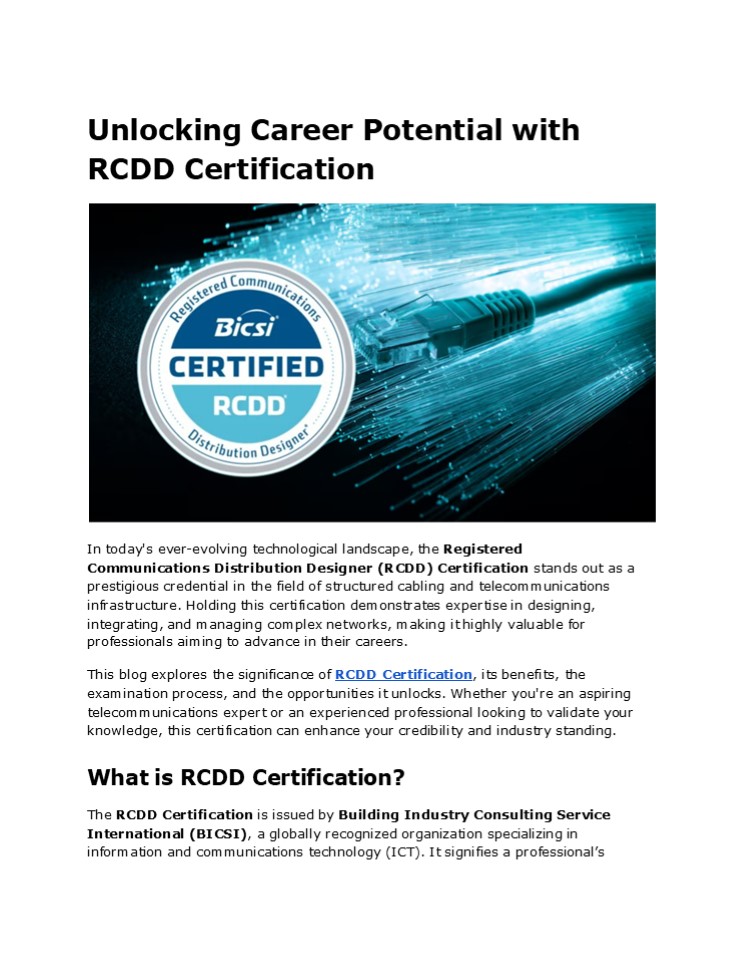
Title: Benefits and Career Impact of RCDD Certification
1
Unlocking Career Potential with RCDD Certification
In today's ever-evolving technological landscape,
the Registered Communications Distribution
Designer (RCDD) Certification stands out as a
prestigious credential in the field of structured
cabling and telecommunications infrastructure.
Holding this certification demonstrates expertise
in designing, integrating, and managing complex
networks, making it highly valuable for
professionals aiming to advance in their
careers. This blog explores the significance of
RCDD Certification, its benefits, the examination
process, and the opportunities it unlocks.
Whether you're an aspiring telecommunications
expert or an experienced professional looking to
validate your knowledge, this certification can
enhance your credibility and industry
standing. What is RCDD Certification? The RCDD
Certification is issued by Building Industry
Consulting Service International (BICSI), a
globally recognized organization specializing in
information and communications technology (ICT).
It signifies a professionals
2
- ability to design and implement
telecommunications and cabling infrastructure for
commercial buildings, data centers, and
industrial facilities. - Professionals who earn the RCDD designation are
acknowledged as industry leaders capable of
developing advanced ICT solutions, ensuring
efficiency, security, and compliance with
international standards. - Why Pursue RCDD Certification?
- Earning an RCDD Certification offers numerous
benefits, including - Professional Recognition
- Holding an RCDD Certification enhances your
credibility and demonstrates your expertise in
structured cabling systems. - Career Advancement
- Many organizations require RCDD-certified
professionals for designing network systems,
increasing job opportunities and earning
potential. - Global Acceptance
- Since BICSI is internationally recognized, RCDD
Certification allows professionals to work in
various regions across the globe. - Industry Compliance
- With rapid advancements in technology, compliance
with industry standards is crucial.
RCDD-certified individuals ensure adherence to
best practices. - Competitive Edge
- In a competitive job market, having an RCDD
Certification can differentiate you from other
professionals and open doors to higher-paying
positions.
- Key Benefits of RCDD Certification
- Professional Credibility
- The RCDD designation immediately enhances your
professional image. It signals to employers and
clients that you have in-depth knowledge of ICT
system design and adhere to industry best
practices. - Higher Earning Potential
3
- Certified professionals tend to earn more than
their non-certified counterparts. According to
industry surveys, RCDD holders often command
salaries 1020 higher due to their specialized
expertise and leadership capabilities. - Expanded Career Opportunities
- Whether you're aiming for a senior design role, a
consultant position, or moving into project
management, the RCDD credential opens doors. Many
government and corporate contracts specifically
require or prefer RCDD-certified personnel for
infrastructure projects. - Global Recognition
- RCDD Certification is recognized worldwide. If
youre considering working abroad or with
multinational companies, having an RCDD
designation gives you a competitive edge. - Increased Knowledge and Skills
- Preparing for the RCDD exam requires a deep dive
into industry standards, including the ANSI/BICSI
002 and BICSIs Telecommunications Distribution
Methods Manual (TDMM). You'll come out of the
process better equipped to tackle real-world
challenges. - How to Obtain RCDD Certification?
- Achieving RCDD Certification requires dedication
and a deep understanding of - ICT infrastructure design. Below are the key
steps - Meet Eligibility Requirements
- Candidates must have extensive experience in
structured cabling design. BICSI typically
requires a minimum of five years of experience or
equivalent education in telecommunications and
network infrastructure. - Prepare for the Exam
4
- Project management principles
- Compliance with industry regulations
- Aspiring candidates should study BICSI's
Telecommunications Distribution Methods Manual
(TDMM), which serves as the primary reference for
the exam. - Register for the Exam
- Candidates must apply through the BICSI website,
pay the examination fee, and schedule their exam
at an authorized testing center. - Take the Exam
- The RCDD Certification exam consists of
multiple-choice questions assessing technical
knowledge and practical application. - Maintain Certification
- Once obtained, professionals must renew their
RCDD Certification every three years by earning
continuing education credits and staying updated
with industry developments. - Job Opportunities for RCDD-Certified
Professionals - Professionals with an RCDD Certification can
pursue various roles, including - Telecommunications Infrastructure Designer
- Network Engineer
- Data Center Planner
5
- Join a Study Group Collaborating with peers can
improve understanding and exam preparedness. - Take Practice Exams Mock tests help familiarize
candidates with the exam format. - Attend BICSI Training Programs These courses
provide hands-on - experience and expert guidance.
- Stay Updated on Industry Trends Continuous
learning ensures alignment with emerging
technologies. - Conclusion
- The RCDD Certification is much more than a
titleits a professional milestone that
validates your expertise, opens up new career
paths, and demonstrates a high level of
competence in ICT infrastructure design. Whether
you're aiming to lead major cabling projects,
consult on smart building technology, or elevate
your professional standing, RCDD certification is
a smart, strategic move. - As the world grows more connected and the demand
for reliable, scalable infrastructure continues
to rise, RCDD professionals will be at the
forefront of innovation. If youre serious about
a long-term career in the ICT industry, theres
no better time to invest in becoming
RCDD-certified.
Recommended

