

Key Facts About Sedation Dentistry PowerPoint PPT Presentation
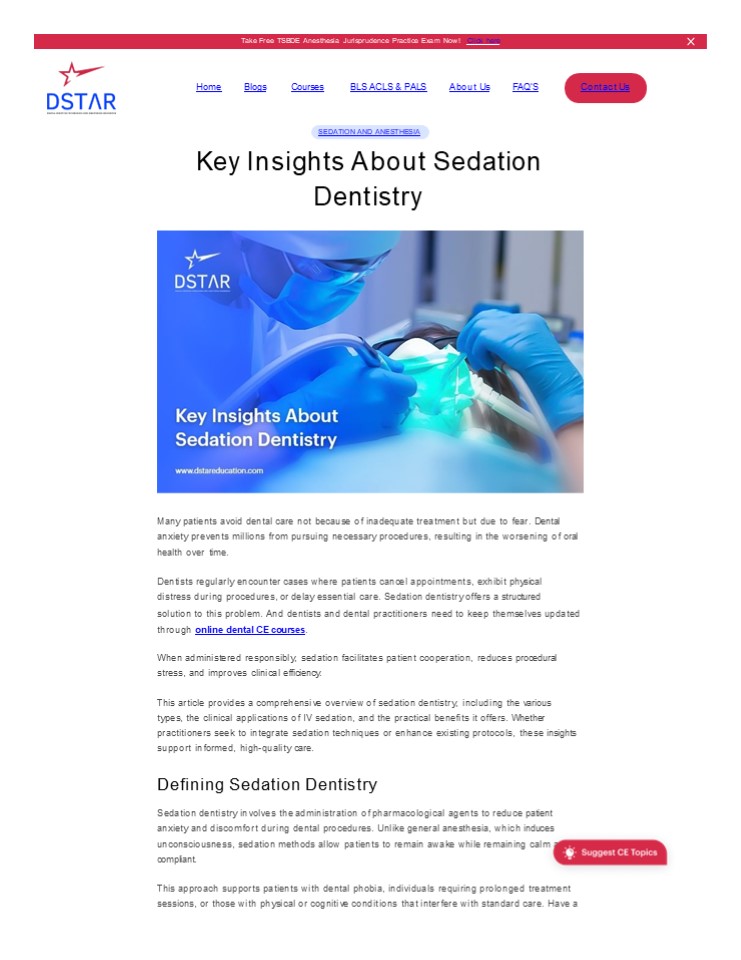
Title: Key Facts About Sedation Dentistry
1
Take Free TSBDE Anesthesia Jurisprudence Practice
Exam Now! Click here
Home
Blogs
Courses
BLS ACLS PALS
About Us
FAQS
Contact Us
SEDATION AND ANESTHESIA
Key Insights About Sedation Dentistry
Many patients avoid dental care not because of
inadequate treatment but due to fear. Dental
anxiety prevents millions from pursuing necessary
procedures, resulting in the worsening of oral
health over time. Dentists regularly encounter
cases where patients cancel appointments, exhibit
physical distress during procedures, or delay
essential care. Sedation dentistry offers a
structured solution to this problem. And dentists
and dental practitioners need to keep themselves
updated through online dental CE courses. When
administered responsibly, sedation facilitates
patient cooperation, reduces procedural stress,
and improves clinical efficiency. This article
provides a comprehensive overview of sedation
dentistry, including the various types, the
clinical applications of IV sedation, and the
practical benefits it offers. Whether
practitioners seek to integrate sedation
techniques or enhance existing protocols, these
insights support informed, high-quality care.
Defining Sedation Dentistry
Sedation dentistry involves the administration of
pharmacological agents to reduce patient anxiety
and discomfort during dental procedures. Unlike
general anesthesia, which induces
unconsciousness, sedation methods allow patients
to remain awake while remaining calm and
compliant. This approach supports patients with
dental phobia, individuals requiring prolonged
treatment sessions, or those with physical or
cognitive conditions that interfere with standard
care. Have a
2
look at our dental sedation courses.
Types of Sedation Dentistry
Clinicians must evaluate the sedation method best
suited to each patient. The following outlines
the principal forms used in dental
practice Oral Sedation (Oral Benzodiazepines) Pa
tients receive an oral sedative, typically a
benzodiazepine, prior to treatment. This method
decreases anxiety and increases procedural
compliance. Clear preoperative instructions
regarding dosage, fasting, and supervision are
critical to ensure both safety and
efficacy. Intravenous (IV) Sedation IV sedation
involves the direct delivery of sedative
medication into the patients bloodstream. It
allows for immediate onset and real-time dosage
adjustment, making it appropriate for individuals
with significant anxiety or complex treatment
needs. Patients often retain limited or no memory
of the procedure, which can reduce anticipatory
anxiety and support long-term treatment
adherence. You need to be updated with IV
Sedation Course for Dentists, which enables
dentists to provide a higher level of care to
patients who might otherwise experience anxiety
or pain during complex dental procedures. Inhalat
ion Sedation (Nitrous Oxide) Nitrous oxide
produces a light level of sedation characterized
by reduced anxiety and increased relaxation,
while maintaining full consciousness. Its rapid
elimination permits patients to safely resume
normal activities shortly after treatment
completion. General Anesthesia General
anesthesia induces complete unconsciousness and
is reserved for cases involving patients with
special needs or highly invasive surgical
interventions. A qualified anesthesiologist must
manage this form of sedation in a hospital or
surgical setting equipped for comprehensive
monitoring.
Clinical Benefits of Sedation Dentistry
When properly implemented, sedation dentistry
offers measurable advantages for both patients
and dental professionals Reduction of Anxiety
and Fear Sedation mitigates psychological
distress, allowing patients to approach treatment
without fear. This reduction in anxiety leads to
increased appointment adherence and improved
overall cooperation. Execution of Multiple
Procedures in One Visit Sedation enables dentists
to complete several procedures during a single
session without overwhelming the patient. This
operational efficiency enhances patient
satisfaction and simplifies treatment
planning. Control of the Gag Reflex Patients
with a pronounced gag reflex often experience
difficulties during procedures. Sedation reduces
involuntary muscular response, thereby improving
accessibility and procedural accuracy. Enhanced
Pain Tolerance Although local anesthesia provides
targeted pain control, sedation enhances overall
comfort by dulling pain perception and fostering
emotional detachment from physical sensations.
3
Safety Protocols in Sedation Dentistry
Effective sedation requires strict adherence to
safety protocols. You can get this through online
dental sedation courses. Proper planning and
monitoring reduce risk and promote patients
trust. Comprehensive Patient Evaluation A
complete medical history must be obtained prior
to administering sedation. Dentists must assess
current medications, preexisting conditions, and
potential drug interactions to select the safest
method. Continuous Physiological
Monitoring During all sedated procedures,
practitioners must monitor oxygen saturation,
blood pressure, and heart rate. Real-time data
facilitates immediate response to any deviations
from normal values.
Clear Recovery Guidelines
Patients must receive thorough instructions
regarding post-sedation care. Those receiving
oral or IV sedation require a responsible escort
following the procedure. Post-operative guidance
ensures safe recovery and minimizes complications.
Conclusion
Sedation dentistry transforms the patient
experience by making treatment accessible,
tolerable, and effective for individuals who
would otherwise avoid care. By understanding the
various dental sedation techniques, adhering to
rigorous safety standards, and communicating effec
tively with patients, dental professionals
deliver care with precision and compassion. A
strong command of sedation techniques not only
improves clinical outcomes but also establishes
long-term trust between dentist and patient.
References
- A1 Dental. (n.d.). How Safe Is Sedation
Dentistry? What You Should Know. - HYPERLINK https//a1dental.com.au/how-safe-is-
sedation-dentistry-what-you-should- know - Henderson Mill Dental Care. (n.d.). Why Sedation
Dentistry in Atlanta Is the Key to a Comfortable
Dental Experience. - HYPERLINK https//hendersonmilldentalcare.com
/why-sedation-dentistry-in-atlanta-is-the- - key-to-a-comfortable-dental-experience
- Glacier Peak Dentistry. (n.d.). Important Facts
You Should Know About Sedation Dentistry.
HYPERLINK https//glacierpeakdentistry.com/i
mportant-facts-you-should-know-about-
sedation-dentistry - Bellflower Dental Group. (n.d.). Discover
Essential Facts About Sedation Dentistry in
Bellflower, CA. - HYPERLINK https//www.bellflowerdentalgroup.c
om/dentistry-blog/discover-essential- - facts-about-sedation-dentistry-in-bellflower-ca
- Family Dentist Chandler. (n.d.). Is Sedation
Dentistry Safe? What You Should Know Before Your
Appointment. - HYPERLINK https//familydentistchandler.com/i
s-sedation-dentistry-safe-what-you-should- - know-before-your-appointment
- Advanced Dental TMJ. (n.d.). Sedation Dentistry.
SHARE
4
Continue Reading
SEDATION AND ANESTHESIA
OFFICE MANAGEMENT
CAD/CAM
5 Techniques for Retaining Dental Staff
The Role of Continuing Education in Dental
Practice Excellence
Airway Adjuncts
Get Started
Sign up to renew your sedation license
or obtain CDE today! Our goal is to provide
interesting and useful CDE. DSTAR offers valuable
resources, a wealth of educational tools,
informative topics, and ongoing support to our
clients.
View All Courses
Home
Courses
BLS-ACLS-PALS
About Us
Blogs
FAQs
Contact Us
PACE Approved CE Provider
Subscribe to Our Newsletter
Email us at
Call us at
info_at_dstareducation.com
(970) 715-1967
Enter Your Email Address
2025 DSTAR. All Rights Reserved. Privacy Policy
Terms ConditionAgency Partner Interactive
Web Design Development Agency
Recommended

