

Common IV Sedation Drugs Used in Dentistry PowerPoint PPT Presentation
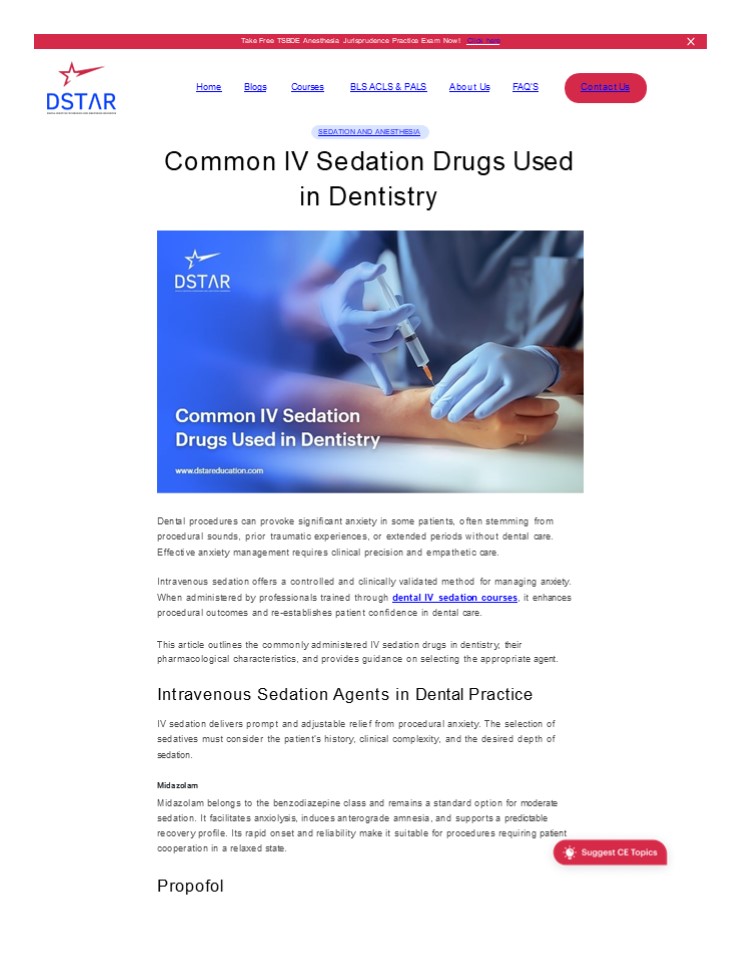
Title: Common IV Sedation Drugs Used in Dentistry
1
Take Free TSBDE Anesthesia Jurisprudence Practice
Exam Now! Click here
Home
Blogs
Courses
BLS ACLS PALS
About Us
FAQS
Contact Us
SEDATION AND ANESTHESIA
Common IV Sedation Drugs Used in Dentistry
Dental procedures can provoke significant anxiety
in some patients, often stemming from procedural
sounds, prior traumatic experiences, or extended
periods without dental care. Effective anxiety
management requires clinical precision and
empathetic care. Intravenous sedation offers a
controlled and clinically validated method for
managing anxiety. When administered by
professionals trained through dental IV sedation
courses, it enhances procedural outcomes and
re-establishes patient confidence in dental
care. This article outlines the commonly
administered IV sedation drugs in dentistry,
their pharmacological characteristics, and
provides guidance on selecting the appropriate
agent.
Intravenous Sedation Agents in Dental Practice
IV sedation delivers prompt and adjustable relief
from procedural anxiety. The selection of
sedatives must consider the patients history,
clinical complexity, and the desired depth of
sedation. Midazolam Midazolam belongs to the
benzodiazepine class and remains a standard
option for moderate sedation. It facilitates
anxiolysis, induces anterograde amnesia, and
supports a predictable recovery profile. Its
rapid onset and reliability make it suitable for
procedures requiring patient cooperation in a
relaxed state.
Propofol
2
Propofol induces a deeper level of sedation
appropriate for prolonged or invasive
procedures. However, in Texas, this medication is
not approved for administration by general
sedation dentists and must be administered
exclusively by dental anesthesiologists. It lacks
analgesic effects therefore, concurrent
administration of local anesthetics is necessary.
Its short half-life supports faster recovery. Due
to its narrow therapeutic index, it requires
continuous monitoring and specialized expertise
throughout the procedure.
Ketamine
Ketamine remains a useful option in certain
dental cases, particularly for patients with
complex medical histories. It delivers both
analgesia and sedation without significantly
suppressing respiration. It demonstrates
cardiovascular stability, making it suitable for
patients with cardiac risk factors. However, some
patients may experience dissociative effects such
as hallucinations. Proper pre-screening and
post-procedure observation mitigate these
concerns.
Dexmedetomidine
Dexmedetomidine is increasingly utilized due to
its sedation profile that mimics natural sleep
physiology. It enables clinicians to engage with
the patient during procedures, which can be
advantageous for certain treatments. However, it
may induce bradycardia and respiratory
depression, necessitating precise titration and
continuous monitoring.
Local Anesthetics in Dental Sedation
While IV sedation addresses anxiety, local
anesthetics ensure pain management during dental
interventions. The following agents represent
widely accepted options in dental anesthesia.
Lidocaine
Lidocaine delivers a consistent, rapid onset and
pairs effectively with epinephrine to extend
duration and control bleeding. Its dependability
makes it a preferred choice for various dental
applications.
Articaine
Articaine exhibits enhanced bone penetration and
is particularly effective in maxillary
procedures. Though it exhibits a shorter duration
of action, its potency supports efficient
procedural execution.
Mepivacaine
Mepivacaine functions well without
vasoconstrictors, making it suitable for patients
with cardiovascular sensitivities. Its rapid
action and moderate duration effectively
accommodate shorter procedures.
Bupivacaine
Bupivacaine offers extended postoperative
analgesia, making it ideal for cases requiring
long- term pain control. Although it has a slower
onset, it maintains comfort well beyond the
clinical setting.
Clinical Considerations for IV Sedation
3
Safe and effective IV sedation depends on
clinical judgment, thorough preparation, dental
sedation courses, and continuous assessment
throughout the treatment process. Conduct a
Comprehensive Medical Assessment A complete
review of the patients medical history is
mandatory. Evaluate current medications,
allergies, and chronic conditions to prevent drug
interactions and identify sedation
risks. Implement Continuous Monitoring
Protocols Monitor vital signs using pulse
oximetry, blood pressure cuffs, and
electrocardiography. Real- time observation
enables the immediate identification of
physiological changes that require
intervention. Maintain Professional Training and
Certification Administering IV sedation demands
appropriate certification and ongoing education.
Clinicians must remain proficient in emergency
response protocols and sedation safety standards
to provide optimal patient care.
Conclusion
Intravenous sedation dentistry transforms the
care experience for anxious patients. When
clinicians possess a comprehensive understanding
of each agents pharmacodynamics, therapeutic
advantages, and limitations, they enhance both
procedural efficacy and patient experience. From
midazolam to bupivacaine, each drug plays a
precise role in enhancing patient comfort and
procedural success. Competence in sedation
techniques extends beyond technical execution it
reestablishes trust in dental care and promotes
long-term patient health.
References
- San Francisco Oral Surgery. (n.d.). 4 Common IV
Sedation Drugs Used in Dentistry. - Rocky Mountain Perio Implant. (n.d.). IV
Sedation Drugs Dentists Use. - Colgate Oral Health Center. (n.d.). 4 Conscious
Sedation Drugs Used in Dentistry. - Danbury Dental Care. (n.d.). IV Sedation
Dentistry What Drugs Are Used? - Becker, D. E., Reed, K. L. (2012). Local
anesthetics Review of pharmacological
considerations. Anesthesia Progress, 59(2),
90101.
FAQs
What Drugs Are Used for Dental Anesthesia? Dental
anesthesia commonly uses drugs like Lidocaine,
Articaine, and Mepivacaine to numb the area and
block pain. These ensure a painless, stress-free
dental experience for patients. What Drug Is
Used for IV Sedation in Dentistry? The most
commonly used drug for IV sedation in dentistry
is Midazolam. It provides quick- acting, calming
effects, helping patients relax during dental
procedures without full unconsciousness.
SHARE
4
Continue Reading
CERTIFICATIONS
CERTIFICATIONS
GENERAL
Why Every Dentist Needs Basic Life Support
Certification
Comprehensive Guide to BLS vs ACLS vs PALS
Certifications at DSTAR Education
Holiday Greetings and Year-End Compliance Tips
for Your Dental Practice
Get Started
Sign up to renew your sedation license
or obtain CDE today! Our goal is to provide
interesting and useful CDE. DSTAR offers valuable
resources, a wealth of educational tools,
informative topics, and ongoing support to our
clients.
View All Courses
Home
Courses
BLS-ACLS-PALS
About Us
Blogs
FAQs
Contact Us
PACE Approved CE Provider
Subscribe to Our Newsletter
Email us at
Call us at
info_at_dstareducation.com
(970) 715-1967
Enter Your Email Address
5
2025 DSTAR. All Rights Reserved. Privacy Policy
Terms ConditionAgency Partner Interactive
Web Design Development Agency
Recommended

