

Trump Stalks Greenland & Panama Canal PowerPoint PPT Presentation
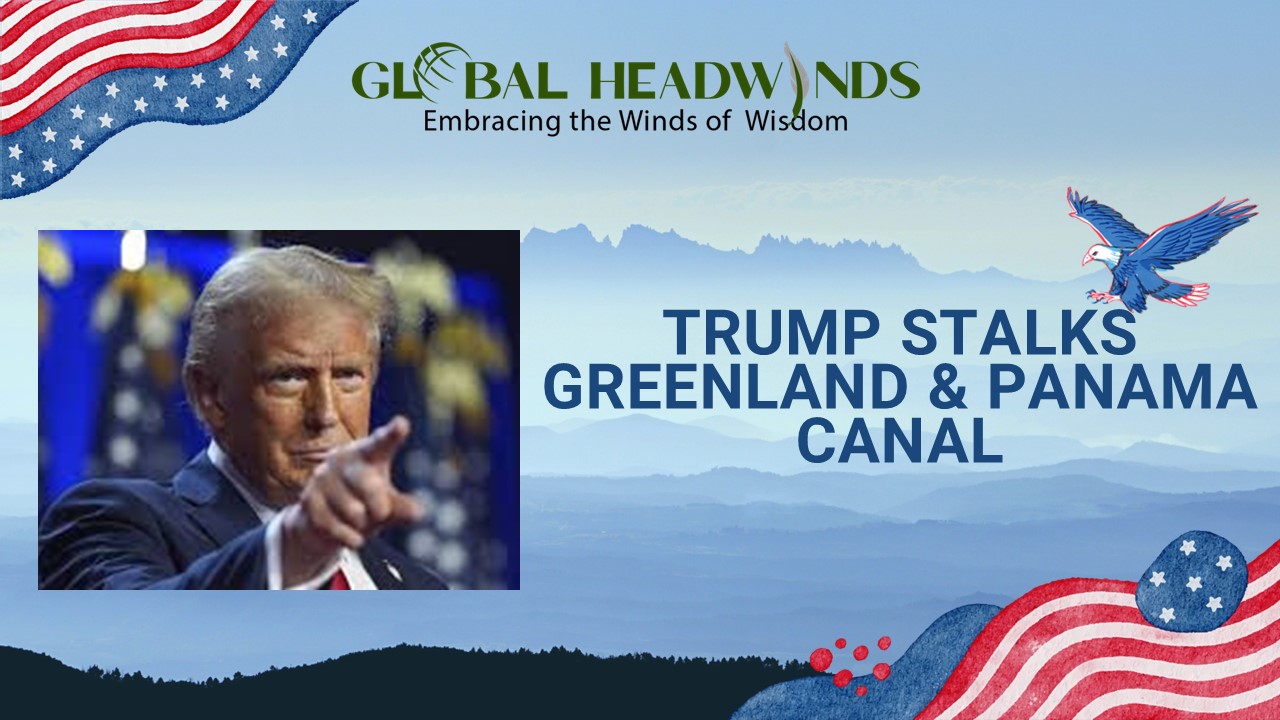
Title: Trump Stalks Greenland & Panama Canal
1
TRUMP STALKS GREENLAND PANAMA CANAL
2
Introduction
Recent remarks by U.S. President-elect Donald
Trump, particularly regarding his interest in
Greenland and the Panama Canal, have sparked
global intrigue and concern. Additionally, his
offhand suggestion to the Canadian Prime Minister
about the possibility of Canada becoming the 51st
U.S. state, although not as widely taken
seriously, has added fuel to the fire. These
statements raise a key question Is the United
States, under Trumps leadership, preparing to
embark on a new phase of territorial
expansionism? While these claims have drawn
skepticism from many, they also offer insight
into a broader strategy grounded in U.S. history
and geopolitical interests. This essay will
explore the historical context of these
assertions, the motivations behind them, and the
potential implications for international
relations in a shifting global landscape.
3
Historical Context and Strategic Importance of
Greenland
The notion of the U.S. asserting control over
Greenland is not a novel one. Historically, the
U.S. has had strategic interests in the
territory, which has been under Denmarks
administration for decades. During the Cold War,
Greenland was a key military outpost for NATO,
with its location serving as a defensive barrier
against potential Soviet threats via the Arctic.
The U.S. military has long provided protection to
the island, recognizing its significance as a
chokepoint in the GIUK Gap (Greenland, Iceland,
and the United Kingdom), a strategic zone for
NATO. Moreover, Greenlands relevance has
increased in recent years due to the impact of
climate change. Melting Arctic ice has opened up
previously inaccessible shipping routes,
potentially shortening travel times between the
U.S. and East Asia. This presents a new dimension
to U.S. interests in the region, with global
powers like China eyeing the Arctic for future
trade routes
4
The Panama Canal and Growing Global Competition
While Greenlands significance lies in Arctic
geopolitics, Trumps interest in the Panama Canal
stems from different strategic concerns,
particularly with regard to global trade and
Chinas increasing influence in the region. The
Panama Canal has long been a critical waterway
for international commerce, connecting the
Atlantic and Pacific Oceans. However, climate
change has created new challenges for its
operation, including reduced rainfall and lower
water levels, which affect the canals ability to
accommodate larger ships. This has led to
increased waiting times and transportation costs,
further complicating the efficient movement of
goods.
5
Global Implications of U.S. Expansionism
The potential U.S. claims on Greenland and the
Panama Canal come at a time when global
competition for resources, trade routes, and
geopolitical power is intensifying. The U.S.,
particularly under Trumps leadership, may view
these territorial claims as necessary steps to
protect its national interests in an increasingly
competitive world. The U.S.-China rivalry is an
essential backdrop for these developments. As
China seeks to expand its economic and
geopolitical influence in key regions like the
Arctic and Latin America, the U.S. may view
actions like the proposed control of Greenland
and the Panama Canal as crucial in maintaining
its global dominance. The potential for these
territories to become pawns in the larger
geopolitical chess game between the U.S. and
China could have significant implications for
global stability and trade dynamics in the years
to come.
6
Conclusion
In conclusion, Donald Trumps recent statements
about Greenland, the Panama Canal, and even
Canada reflect broader ambitions rooted in U.S.
history and contemporary geopolitical challenges.
While these claims may initially seem outlandish,
they align with the U.S.s long-standing interest
in securing strategic locations for military and
economic purposes. The U.S. under Trump appears
to be preparing to assert itself more
aggressively in the face of growing global
competition, particularly from China. Whether
these ambitions will materialize into concrete
actions remains uncertain, but the world is
undoubtedly watching as the U.S. navigates a new
phase of geopolitical maneuvering. As the
U.S.-China rivalry intensifies, the potential for
further geopolitical fireworks seems all but
certain, and the world will have to adapt to a
shifting global order where U.S. expansionism,
even in its modern form, may be a key factor in
shaping future international relations.
7
Thank You!
For such more blogs visit
Website- globalheadwinds.com
Facebook- facebook.com
Instagram- instagram.com/global_head_winds
Youtube- youtube.com
Recommended

