

Download Econometric Causality and Structural Equation Modeling (Richm PowerPoint PPT Presentation
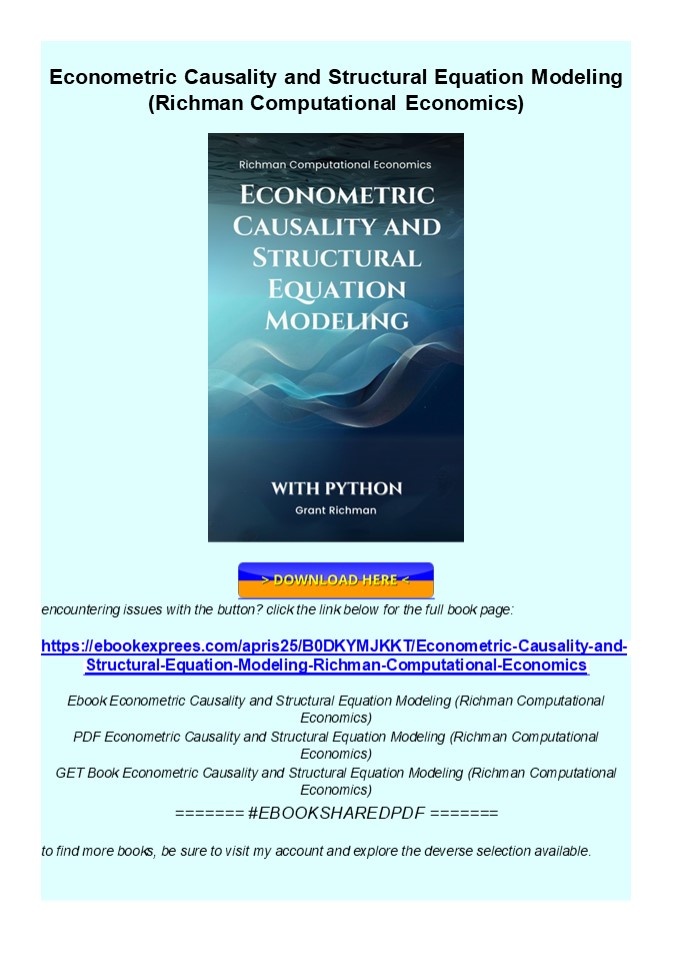
Title: Download Econometric Causality and Structural Equation Modeling (Richm
1
Econometric Causality and Structural Equation
Modeling (Richman Computational
Economics) encountering issues with the button?
click the link below for the full book page
https//ebookexprees.com/apris25/B0DKYMJKKT/Econom
etric-Causality-and-
Structural-Equation-Modeling-Richman-Computational
-Economics Ebook Econometric Causality and
Structural Equation Modeling (Richman
Computational Economics) PDF Econometric
Causality and Structural Equation Modeling
(Richman Computational Economics) GET Book
Econometric Causality and Structural Equation
Modeling (Richman Computational Economics)
EBOOKSHAREDPDF to find more books, be
sure to visit my account and explore the deverse
selection available.
2
Explore a detailed and structured approach to
understanding econometric causality and
structural equation modeling (SEM). This book
offers a rich exploration of both essential
principles and advanced methodologies used in
modern econometrics. From beginners to seasoned
analysts, gain insights into the practical
application of a wide array of econometric tools,
all illustrated with Python code that aids in
your learning process.Key FeaturesComprehensive
guide bridging econometric theory and practical
application.Step-by-step tutorials employing
Python to decipher complex statistical
concepts.Real-world examples illustrating each
concept for tangible learning experiences.In-depth
exploration of both foundational and cutting-
edge developments in SEM.What You Will
LearnUnderstand the foundations of causality in
econometrics, delving into its key principles and
concepts.Get acquainted with the basic components
of SEM, such as latent variables, observed
variables, and path diagrams.Master the Ordinary
Least Squares (OLS) method and its application in
causal inference.Identify conditions for model
identification, focusing on rank and order
conditions.Learn to formulate path models and
determine direct and indirect causal
relationships.Differentiate between recursive and
loop models in SEM.Employ maximum likelihood
estimation techniques to infer SEM parameters
accurately.Address endogeneity using advanced
instrumental variable techniques.Detect and
manage leverage points and influential
observations in SEM.Compare and contrast common
cause frameworks with SEM representations.Estimate
systems of equations using approaches like 2SLS
and 3SLS.Analyze variance-covariance structures
within SEM to manage measurement errors.Model
latent variable trajectories over time with
latent growth models.Implement cross-lagged panel
models to uncover longitudinally cross-lagged
effects.Conduct mediation analysis to trace
mediating variables and causal pathways.Engage
error correction models for capturing temporal
dynamics and deviations.Delve into factor
analysis to explore the impact of latent factors
in SEM.Integrate time series data in dynamic SEM
modeling.Employ techniques to handle and estimate
missing data in SEM models.Utilize Bayesian
estimation to gauge parameter uncertainty in
SEM.Incorporate nonlinear relationships to enrich
SEM modeling.Assess model fit indices to evaluate
and interpret SEM effectiveness.
Recommended

