

Asia-Pacific MVNO Market | 2028 Growth Analysis & Forecast PowerPoint PPT Presentation
Title: Asia-Pacific MVNO Market | 2028 Growth Analysis & Forecast
1
Top 3 Emerging Opportunities in the Asia-Pacific
MVNO Market in 2028 The Asia-Pacific Mobile
Virtual Network Operator (MVNO) market is rapidly
emerging as a hotbed for innovation and
investment. As the region experiences a digital
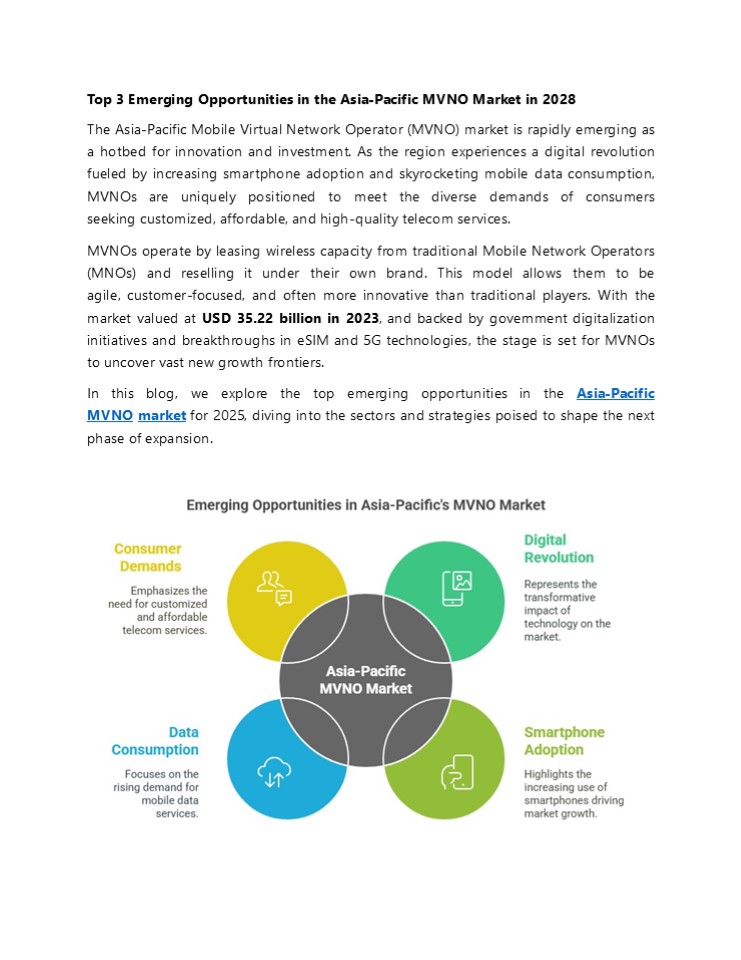
revolution fueled by increasing smartphone
adoption and skyrocketing mobile data
consumption, MVNOs are uniquely positioned to
meet the diverse demands of consumers
seeking customized, affordable, and high-quality
telecom services. MVNOs operate by leasing
wireless capacity from traditional Mobile Network
Operators (MNOs) and reselling it under
their own brand. This model allows them to
be agile, customer-focused, and often more
innovative than traditional players. With the
market valued at USD 35.22 billion in 2023, and
backed by government digitalization initiatives
and breakthroughs in eSIM and 5G technologies,
the stage is set for MVNOs to uncover vast new
growth frontiers. In this blog, we explore
the top emerging opportunities in the
Asia-Pacific MVNO market for 2025, diving into
the sectors and strategies poised to shape the
next phase of expansion.
2
- Current Market Status
- The Asia-Pacific MVNO market has shown remarkable
growth, reaching a valuation of USD 35.22 billion
in 2023. This momentum is expected to continue
due to a confluence of favorable factors - Smartphone Penetration With billions of
users and growing, the smartphone market is a
key enabler for MVNOs to reach digital-first
consumers. - Mobile Data Boom Increasing consumption of
mobile datadriven by video streaming, online
gaming, and remote workis pushing demand for
flexible data packages. - 5G Rollout The gradual deployment of 5G
infrastructure across countries like China,
South Korea, Japan, and Australia presents a
significant upsell opportunity for MVNOs. - eSIM Technology eSIM adoption allows for
easier switching between carriers, which
directly benefits MVNOs in capturing churned
customers from major operators. - Regulatory Support Governments across the
region are facilitating digital transformation
with supportive telecom policies, spectrum
auctions, and startup- friendly environments. - Major players such as Circles.Life
(Singapore), Amaysim (Australia), and Rakuten
Mobile (Japan) have made notable headway,
leveraging digital-first models and innovative
pricing to disrupt the telecom status quo. - List of Emerging Opportunities
- Localized MVNOs for Niche Segments
- There is increasing demand for MVNO services
targeting specific communities or user segments.
These can include - Expat and immigrant populations (e.g., in
Malaysia, Singapore) - Students and low-income workers requiring
budget-friendly plans - Senior citizens who need simplified services
3
- Localized MVNOs can customize content, language,
and pricing models to appeal directly to these
groups. For example, India's growing migrant
population in metro areas could be a prime target
for MVNOs offering multilingual customer support
and low-cost calling plans to home countries. - IoT-Focused MVNOs
- As Asia-Pacific sees rapid adoption of smart
devices, industrial automation, and connected
vehicles, theres an opportunity to build MVNOs
specifically for IoT connectivity. - Case Study In South Korea, companies are
exploring B2B MVNOs that provide secure,
low-latency connections for smart factories. - Growth Sectors Healthcare wearables, logistics
tracking, smart homes, and utility metering - These MVNOs can partner with manufacturers
and city planners to deliver tailored
network solutions that go beyond consumer
markets. - Digital-Only MVNOs Leveraging eSIMs
- With rising smartphone sophistication and
growing comfort with app-based services, - digital-only MVNOs are a huge opportunity.
- No physical stores All interactions, from SIM
activation to billing, are app-based. - Instant activation with eSIM technology, ideal
for international travelers or digital nomads. - Future Potential Countries like Japan and South
Korea, where tech-savvy users dominate, are ripe
for eSIM-exclusive brands. - These MVNOs can scale rapidly, reduce costs, and
offer hyper-personalized serviceskey
differentiators in crowded markets. - (Visual suggestion A bar graph comparing user
adoption rates of traditional SIM vs eSIM in key
Asia-Pacific markets like China, Japan, and
Australia from 20212025)
4
- While the potential is immense, MVNOs in
the Asia-Pacific region also face several
challenges - High Initial Setup Costs Licensing,
interconnection, and back-end system setup can be
costly without volume guarantees. - Limited Access to Infrastructure MNOs may impose
restrictive wholesale rates or offer limited
bandwidth to MVNOs. - Brand Recognition Issues Gaining customer
trust in a market dominated by established
telcos can be tough. - Regulatory Complexity Varies across
countriessome markets like China have stricter
entry norms, while others like Australia are more
open. - Solutions
- Form strategic partnerships with MNOs for
favorable terms and network sharing. - Invest in marketing and digital branding to
establish consumer trust. - Start small in favorable regulatory
environments and expand regionally once
stable. - Actionable Insights
- To thrive in the Asia-Pacific MVNO landscape,
businesses must adopt agile, tech-driven
strategies - Focus on Differentiation Whether it's a niche
demographic, innovative service, or unbeatable
pricingMVNOs must carve out a clear USP. - Leverage Technology Embrace automation,
AI-powered customer service, and real-time
analytics to streamline operations and enhance
user experience. - Build Strategic Alliances Collaborate with
local telecom operators, tech firms, and even
retail brands to scale quickly and gain trust. - Adapt to Regional Dynamics Customize
offerings per countrylanguage, culture,
pricing, and regulations all vary widely across
Asia-Pacific.
5
Conclusion The Asia-Pacific MVNO market is
entering a golden era, valued at over USD 35
billion and growing steadily. With 5G, eSIM, and
digital consumption trends aligning, emerging
opportunities are abundantespecially in
niche localization, IoT specialization, and
digital-only service models. Businesses that act
swiftly, innovate boldly, and understand regional
nuances will be well- positioned to ride this
wave. The time to enter the MVNO arena in
Asia-Pacific is now dont miss out on the
momentum. Read my other blogs in APAC
Sterile Medical Packaging Market Trends and
Opportunities
Recommended

