

Plant Biotechnology Market Analysis: Key Players and Emerging Technologies PowerPoint PPT Presentation
Title: Plant Biotechnology Market Analysis: Key Players and Emerging Technologies
1
Plant Biotechnology Market Analysis Key Players
and Emerging Technologies
The plant biotechnology market is expected to be
valued at USD 51.73 billion in 2025 and is
projected to grow to USD 76.79 billion by 2030,
reflecting a compound annual growth rate (CAGR)
of 8.2 during the forecast period. Plant
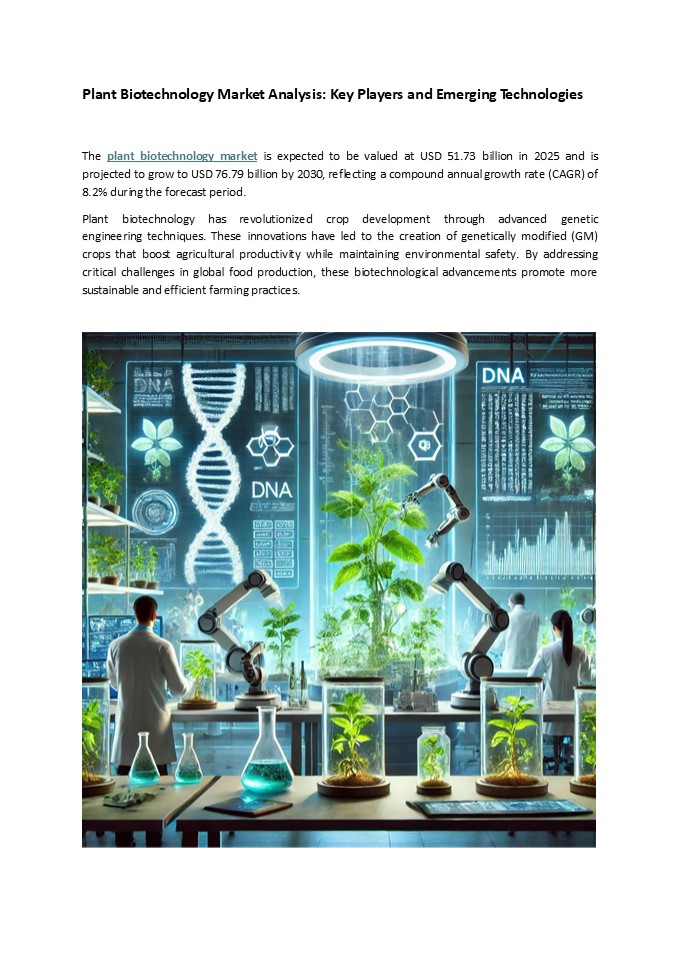
biotechnology has revolutionized crop
development through advanced genetic
engineering techniques. These innovations have
led to the creation of genetically modified (GM)
crops that boost agricultural productivity while
maintaining environmental safety. By addressing
critical challenges in global food production,
these biotechnological advancements promote more
sustainable and efficient farming practices.
2
- The future of agriculture is being shaped by
three core pillars sustainability, scientific
innovation, and the urgent need to
support a habitable planet. Beyond
improving food production, modern
biotechnological tools are reshaping agriculture
at a broader level. They offer the promise of a
more resilient and sustainable agricultural
system by translating cutting-edge research
into practical solutions that meet global
nutritional needs. - Download PDF Brochure
- https//www.marketsandmarkets.com/pdfdownloadNew.a
sp?id225105561 - What is Plant Biotechnology?
- Plant biotechnology refers to the application of
modern techniques and scientific methods to
improve the genetic makeup of plants. This field
harnesses genetic engineering, molecular biology,
and other advanced tools to develop plants with
desirable traits such as increased resistance to
pests, improved nutritional content, and enhanced
tolerance to harsh environmental conditions.
These innovations not only help increase
agricultural productivity but also contribute to
sustainable farming practices. - Plant Biotechnology Market Growth Drivers
- Rising Demand for Food Security The global
population is growing at an unprecedented rate,
and with it comes the challenge of feeding
billions of people. Plant biotechnology
plays a critical role in meeting the increasing
demand for food by producing crops that can
withstand pests, diseases, and environmental
stresses such as drought. Biotech crops such as
genetically modified (GM) corn, soybeans, and
rice have already shown impressive yields,
helping to ensure food security in many regions. - Climate Change and Environmental
Sustainability With the changing climate,
traditional agricultural practices are
becoming less effective. Plant biotechnology
offers solutions to create crops that can
thrive under variable environmental
conditions, including droughts, floods, and
extreme temperatures. Additionally,
biotechnological advancements can reduce the
environmental impact of farming by reducing
the need for chemical pesticides and
fertilizers. - RD Investment and Technological Advancements The
ongoing investment in research and development
(RD) is propelling innovation in plant
biotechnology. Advances in gene editing
technologies such as CRISPR-Cas9 have
significantly improved the efficiency and
precision of plant genetic modification. This,
in turn, is making it possible to create
crops with highly specific traits in less time
and with fewer regulatory hurdles.
- Request Sample Pages
- https//www.marketsandmarkets.com/requestsampleNew
.asp?id225105561 - Plant Biotechnology Market Trends
- Growing Adoption of Genetically Modified (GM)
Crops Genetically modified crops are at the
forefront of plant biotechnology. These
crops have been engineered to possess
traits that
make them more resistant to pests, diseases, and
environmental conditions. As the benefits
3
- of GM crops become more apparent, adoption rates
are increasing in countries across North America,
Latin America, and parts of Asia. - Gene Editing Technologies on the Rise The
CRISPR-Cas9 gene editing tool is rapidly gaining
traction in plant biotechnology. This technology
allows scientists to make precise modifications
to a plants DNA, resulting in more accurate and
efficient breeding processes. This has opened new
possibilities for creating plants with enhanced
nutritional value, disease resistance, and yield
potential. - Sustainable and Organic Agriculture As
consumers become more conscious of the
environmental impact of their food choices,
there is an increasing demand for sustainably
produced crops. Plant biotechnology is playing a
significant role in this trend by developing
crops that require fewer chemical inputs,
are more water-efficient, and have a lower
environmental footprint. - Partnerships and Collaborations Companies
and research institutions are
forming partnerships to accelerate the
development and commercialization of plant
biotechnology products. Collaborative efforts
between biotech firms, academic institutions, and
government agencies are helping to bring
innovative solutions to market more efficiently.
- Make an Inquiry
- https//www.marketsandmarkets.com/Enquiry_Before_B
uyingNew.asp?id225105561 - Plant Biotechnology Market Opportunities
- Development of Drought-Resistant Crops With
climate change causing more frequent and
severe droughts, the development of
drought-resistant crops is one of the most
promising opportunities in the plant
biotechnology market. These crops can help
ensure stable food supplies even in regions
prone to water scarcity, improving food
security in drought-prone areas. - Biofortification and Nutritional Enhancement
Biotechnology is helping to improve the
nutritional content of crops. Through
biofortification, crops can be engineered to
contain higher levels of vitamins, minerals,
and other essential nutrients. This has the
potential to address global issues like
malnutrition and micronutrient
deficiencies, particularly in developing
countries. - Agroforestry and Bioenergy Plant biotechnology
can also play a significant role in agroforestry
and bioenergy production. By improving
the growth rates and carbon
sequestration capabilities of plants used in
bioenergy, biotechnology can contribute to the
development of renewable energy sources.
Additionally, trees and plants engineered for
agroforestry systems can help restore degraded
lands and improve biodiversity. - Customization for Local Markets As the plant
biotechnology market expands, there will be an
increasing demand for tailored solutions that
meet the specific needs of different
regions.
Whether its creating crops that thrive in local
soils or developing varieties with specific
disease
4
resistance, biotechnology offers the flexibility
to customize agricultural solutions for diverse
environments.
- Leading Plant Biotechnology Companies
- The report profiles key players such as BASF SE
(Germany), Bayer AG (Germany), Corteva
Agroscience (US), Syngenta AG (Switzerland),
FMC Corporation (US), UPL (India), Sumitomo
Chemical Co. Ltd. (Japan), Nufarm
(Australia), KWS SAAT SE Co. KGAA
(Germany), Pro Farm Group (US), Limagrain
(France), STK Bio AG Technologies (Israel),
Vestaron Corporation (US), Certis USA LLC (US),
and DLF Seeds (Denmark). - Plant Biotechnology Market Segmentation
- This research report categorizes the plant
biotechnology market based on technology type,
product, crop type, end-user, and region. - By Technology Type
- Genetic Engineering
- Marker Assissted Breeding
- Genome Editing
- Tissue Culture
- Synthetic Biology
- By Product
- By Region
- North America
- Europe
- Asia Pacific
- South America
- Rest of the World (RoW)
For more information _at_ https//www.reportsnreports
.com/blog/plant-biotechnology-market-
analysis-key-players-and-emerging-technologies/
Recommended

