

Choosing the Right Format for Your Document Needs PowerPoint PPT Presentation
Title: Choosing the Right Format for Your Document Needs
1
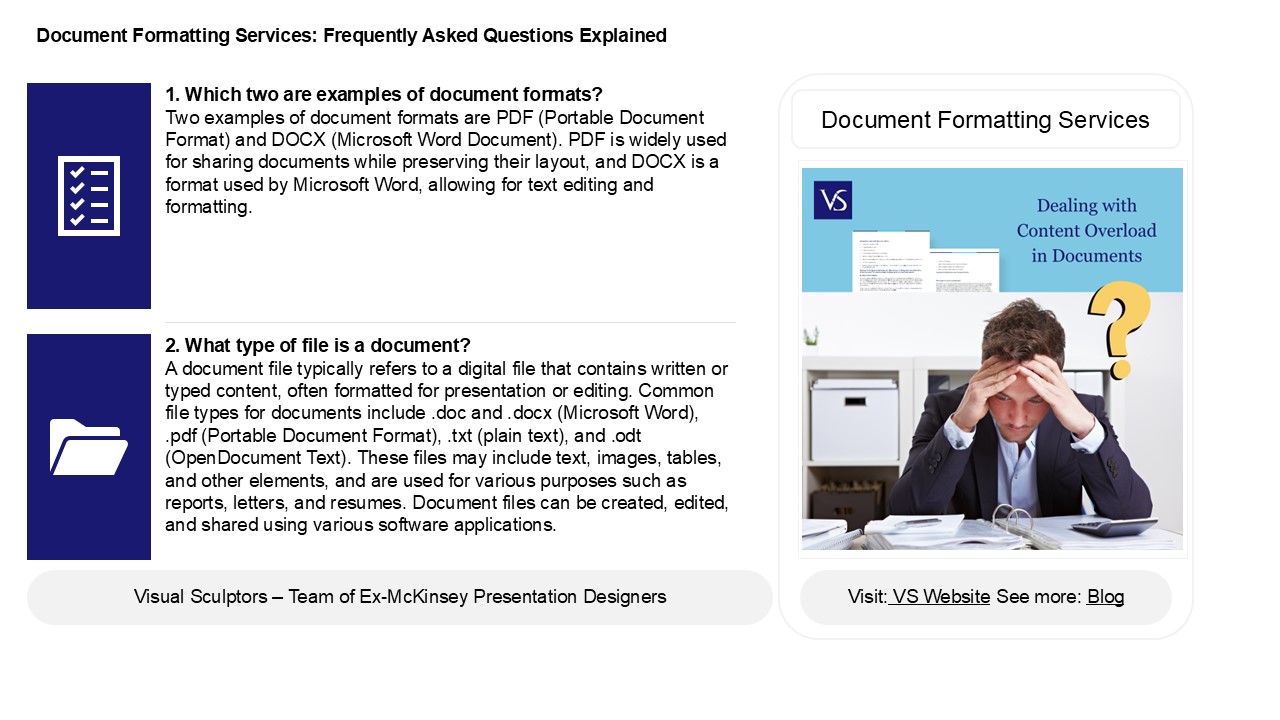
Document Formatting Services Frequently Asked
Questions Explained
1. Which two are examples of document formats?
Two examples of document formats are PDF
(Portable Document Format) and DOCX (Microsoft
Word Document). PDF is widely used for sharing
documents while preserving their layout, and DOCX
is a format used by Microsoft Word, allowing for
text editing and formatting.
Document Formatting Services
2. What type of file is a document? A document
file typically refers to a digital file that
contains written or typed content, often
formatted for presentation or editing. Common
file types for documents include .doc and .docx
(Microsoft Word), .pdf (Portable Document
Format), .txt (plain text), and .odt
(OpenDocument Text). These files may include
text, images, tables, and other elements, and are
used for various purposes such as reports,
letters, and resumes. Document files can be
created, edited, and shared using various
software applications.
2
Document Formatting Services Frequently Asked
Questions Explained
3. How to format a MS Word document? To format a
Microsoft Word document, start by setting the
document's layout via the "Layout" tab, adjusting
margins, orientation, and size. Use the "Home"
tab to select font styles, sizes, and colors.
Apply paragraph settings for alignment, line
spacing, and indentation. For headings, utilize
the "Styles" section to ensure consistency.
Insert page numbers and headers/footers through
the "Insert" tab. Use bullet points or numbered
lists for organization. Finally, check spelling
and grammar with the "Review" tab. Save your
document frequently to prevent data loss.
4. What is the standard document format? The
standard document format is typically PDF
(Portable Document Format), widely used for its
consistency across devices and platforms. It
preserves formatting, fonts, and images, ensuring
that documents appear the same regardless of the
software used to view them. Other common formats
include DOCX (Microsoft Word), TXT (plain text),
and RTF (Rich Text Format), each serving specific
purposes. For web documents, HTML is standard.
The choice of format often depends on the
intended use, such as editing, sharing, or
printing.
5. What is the purpose of the file formatting?
File formatting serves to organize and structure
data within a file, enabling specific
applications to read, interpret, and process the
information correctly. It determines how data is
stored, accessed, and presented, ensuring
compatibility across different systems and
software. Proper formatting helps maintain data
integrity, allows for efficient storage, and
facilitates file sharing and collaboration.
Common formats include text files (e.g., .txt),
images (e.g., .jpg), and documents (e.g., .docx),
each designed for types of content and use cases.
Overall, effective file formatting enhances
usability and productivity in digital
environments.
Recommended

