

Sustainable Farming: How Digital Tools Are Revolutionizing Eco-Friendly Practices PowerPoint PPT Presentation
Title: Sustainable Farming: How Digital Tools Are Revolutionizing Eco-Friendly Practices
1
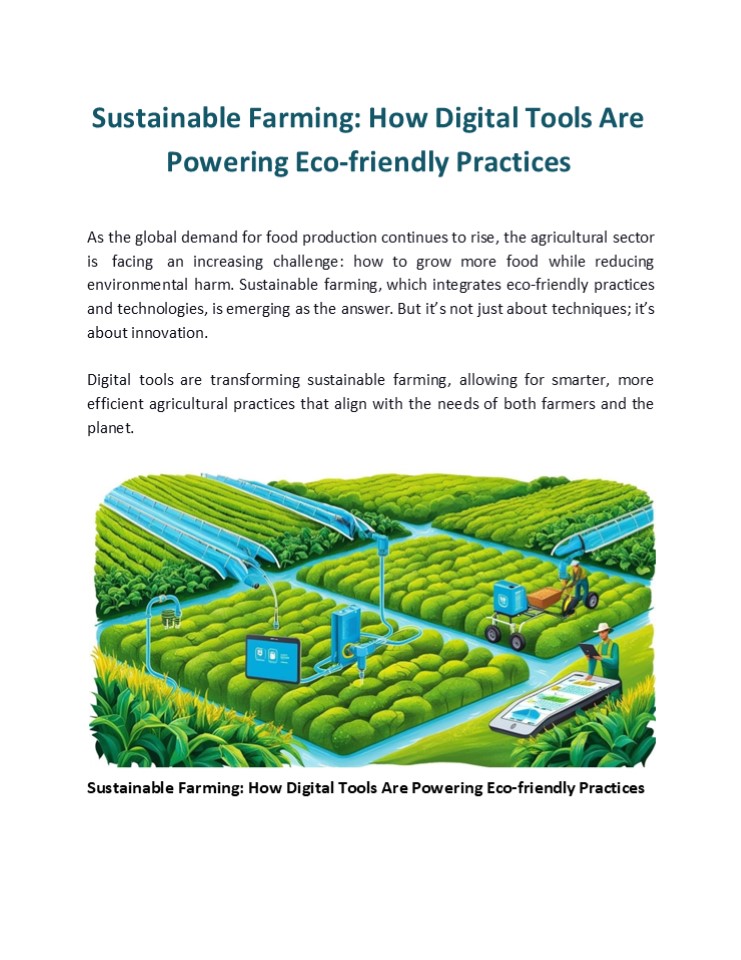
Sustainable Farming How Digital Tools Are
Powering Eco-friendly Practices
- As the global demand for food production
continues to rise, the agricultural sector is
facing an increasing challenge how to grow more
food while reducing environmental harm.
Sustainable farming, which integrates
eco-friendly practices and technologies, is
emerging as the answer. But its not just about
techniques its about innovation. - Digital tools are transforming sustainable
farming, allowing for smarter, more efficient
agricultural practices that align with the needs
of both farmers and the planet.
Sustainable Farming How Digital Tools Are
Powering Eco-friendly Practices
2
The Rise of Sustainable Farming Sustainable
farming focuses on methods that protect the
environment, support local economies, and ensure
the well-being of farming communities. It
embraces practices like crop rotation, reduced
pesticide use, organic farming, and water
conservation. However, modern challenges such as
climate change, resource depletion, and a growing
population demand more than traditional
methods. This is where digital tools come
into play. Technologies such as artificial
intelligence (AI), satellite imagery, drones, and
data analytics are revolutionizing how farming is
done, enabling sustainable practices at a scale
and efficiency never seen before. Digital Tools
Transforming Sustainable Agriculture 1.
Precision Agriculture Digital technologies are
used in precision agriculture to maximize the use
of agricultural inputs such as herbicides,
fertilizers, and water. By using data from
sensors, GPS, and drones, farmers can manage
their fields down to the square meter. With this
degree of accuracy, waste is decreased, crop
output is increased, and the environmental effect
is reduced. A report by MarketsandMarkets
projects that the global precision farming market
will reach 21.9 billion by 2031, growing at a
compound annual growth rate (CAGR) of 10.7 from
2023 to 2031. This growth highlights the
increasing adoption of precision tools by farmers
aiming to improve both profitability and
sustainability.
3
- Data Analytics for Sustainable Decision-making
- Data is the backbone of modern agriculture. Large
volumes of data are being gathered by farmers
from a variety of sources, including satellites,
drones, weather stations, and soil sensors. These
data sets allow for in-depth analysis, helping
farmers make informed decisions about planting
schedules, irrigation needs, and crop health. - The use of machine learning and AI can predict
potential issues like pest outbreaks or droughts,
allowing farmers to act proactively. For
instance, a study from the Food and Agriculture
Organization (FAO) notes that digital tools can
improve water use efficiency in agriculture by up
to 25, thus directly contributing to sustainable
water management. - IoT-based Smart Farming
- The Internet of Things (IoT) has given rise to
"smart farms," where interconnected devices
collect and transmit real-time data. Farmers can
monitor everything from soil moisture to
livestock health, ensuring more sustainable
resource use. IoT-based irrigation systems,
for example, can automatically adjust water
distribution based on real-time soil conditions,
reducing water wastage. - The global smart farming market is expected to
grow from 16.2 billion in 2023 to - 25.4 billion by 2028, with a CAGR of 9.4,
according to MarketsandMarkets. This trend
highlights the increasing reliance on IoT for
enhancing farming sustainability. - Drones for Sustainable Monitoring
- Drones are emerging as a game-changer in
agriculture. They offer an efficient and
eco-friendly way to monitor large farming areas
without disrupting the soil or wildlife. Equipped
with high-resolution cameras and sensors, drones
provide real-time aerial data on crop health,
soil conditions, and pest infestations.
4
- The use of drones reduces the need for on-field
inspections, lowering carbon emissions from
machinery. According to a survey by Global Market
Insights, the demand for precision farming
and sustainable monitoring will propel the
agricultural drone industry to reach 1 billion
by 2024. - Key Benefits of Digital Tools in Sustainable
Farming - Reduced Resource Use By accurately assessing the
needs of crops and livestock, digital tools
ensure that water, fertilizers, and pesticides
are used efficiently. This leads to less wastage
and minimizes the pollution of nearby ecosystems. - Enhanced Crop Yield Technologies like AI
and IoT help farmers make data-driven decisions,
resulting in better crop health and higher
yields. According to a study by McKinsey, the
adoption of AI in agriculture could increase farm
productivity by up to 20. - Improved Soil Health Precision agriculture
technologies help maintain the balance of
nutrients in the soil, ensuring long-term soil
fertility. Healthy soil is critical for
sustainable farming as it reduces the need for
synthetic inputs and enhances biodiversity. - Climate Change Mitigation Agriculture both
impacts and is affected by climate change.
Digital tools allow farmers to minimize their
carbon footprint by reducing emissions from
machinery, managing energy use, and optimizing
resource inputs. According to a report by the
World Bank, sustainable farming practices enabled
by digital technologies can reduce greenhouse gas
emissions by up to 25. - Biodiversity Conservation Through data-driven
pest management and reduced chemical use, farmers
can better protect local ecosystems. This leads
to a more balanced biodiversity, which is
essential for long-term farm productivity and
environmental health.
5
- Challenges To Digital Adoption In Sustainable
Farming - While the benefits of digital tools in
sustainable farming are clear, several challenges
need to be addressed for widespread adoption. - Cost of Technology
- Digital tools and technology are difficult for
many small-scale farmers to afford, especially in
developing nations. The initial cost of
implementing precision agriculture, IoT systems,
and AI-powered platforms can be prohibitively
high. Governments and international organizations
must work together to provide subsidies, grants,
and affordable solutions for farmers in these
regions. - Digital Literacy
- The success of digital farming tools depends on
farmers ability to use and understand these
technologies. Digital literacy remains a
significant barrier, especially among older
farmers and those in rural areas with limited
access to education and training. Investing in
digital training programs is essential to ensure
that farmers can leverage these tools
effectively. - Connectivity Issues
- Reliable internet access is crucial for the
functioning of IoT devices and data-driven
platforms. However, many rural areas,
particularly in developing countries, still lack
robust internet infrastructure. Addressing
connectivity issues is vital to ensuring that
farmers everywhere can benefit from digital
farming solutions.
6
The Future of Sustainable Farming The future of
agriculture is undeniably digital. As the worlds
population is expected to reach 10 billion by
2050, the pressure to produce more food with
fewer resources will continue to grow.
Sustainable farming, powered by digital tools,
offers a path forward. According to the FAO,
adopting sustainable farming practices could
increase global food production by up to 58
without expanding agricultural land, thereby
conserving forests and natural habitats. In
addition, government policies and incentives are
increasingly supporting the shift toward
sustainable farming. The use of digital
technologies to enhance environmentally friendly
farming practices is being promoted by the
U.S. Department of Agriculture's (USDA)
climate-smart agriculture programs and the
European Union's Common Agricultural Policy
(CAP). Conclusion The integration of digital
tools into sustainable farming is more than just
a trend its a necessity. As global challenges
like climate change and resource scarcity
intensify, farmers must embrace innovative
technologies to meet the growing demand for food
while protecting the environment. Companies like
EnFuse Solutions are at the forefront of this
transformation, providing the data-driven
insights needed to power eco-friendly
agricultural practices. By adopting digital
tools, farmers can not only boost their
productivity but also become stewards of the
environment, ensuring a sustainable future
for generations to come. Read more Bridging The
Gap How Technology Is Empowering Smallholder
Farmers
Recommended

