

Sinaia 18 Visiting Peles Castle11 PowerPoint PPT Presentation
Title: Sinaia 18 Visiting Peles Castle11
1
RoMANIA
Sinaia
18
Visiting Pele? Castle
11
2
Pele? Castle is a Neo-Renaissance castle in the
Carpathian Mountains, near Sinaia, in Romania.
This castle was used as a summer residence by the
kings of Romania, built at the wish of the first
Romanian king, Carol I (1866-1914). The castle
was featured in the 2009 film The Brothers Bloom,
in the Netflix original film A Christmas Prince
and also in the 2011 Hallmark Channel movie A
Princess for Christmas and 2018's Royal
Matchmaker
3
The last room that can be visited on the ground
floor is the Theatre Hall. Built in 1883, of
moderate proportions, with a capacity of 60
stalls, the hall uses for the interior decoration
elements characteristic of the Louis XIV style.
The walls covered with white paneling and
wallpaper of golden, silk damask, the big
medallion from the center of the ceiling and the
frieze of panels, as well as the colonnades and
the pilasters with rich golden ornamen-tation,
reflect to a certain extent the luxury and the
richness of this style of sumptuous classical
inspiration
4
Sala de Teatru (The Playhouse) is decorated
in Louis XIV style, with sixty seats and a Royal
Box. Architectural decoration and mural paintings
are signed by Gustav Klimt (1862-1918) a
fifteen-metre frieze, and Franz Matsch
(1861-1942) the big medallion on ceiling
5
(No Transcript)
6
The Royal Box
7
(No Transcript)
8
Robert Lixandru
The walls covered with white paneling and
wallpaper of golden, silk damask
9
(No Transcript)
10
(No Transcript)
11
The big medallion from the center of the ceiling
The Poet and Poetry, an allegorical painting by
Matsch, (A version of the work can be found in
the Gustav Klimt sketch that is part of a
collection in Lugano)
12
The Muse has the facial features of Queen
Elisabeta of Romania
13
(No Transcript)
14
The Poet and Poetry, Franz Matsch (1861-1942)
15
The decoration of the upper walls of the Theatre
Room has the title Musen, Masken, Allegorien und
Emblemen (Muses, Masks, Allegories and Emblems).
The eight panels in oil on thick canvas, using
the Gobelintechnick, were painted by Gustav
Klimt and depict the Muses Thalia, Melpomene,
Terpsichore and Calliope. The mythological
figures alternate with the insignia of Apollo
(the lyre) and Dionysus (the double flute and
grotesque masks). On the wall in the back of the
room allegorical images of Spring and Summer
16
(No Transcript)
17
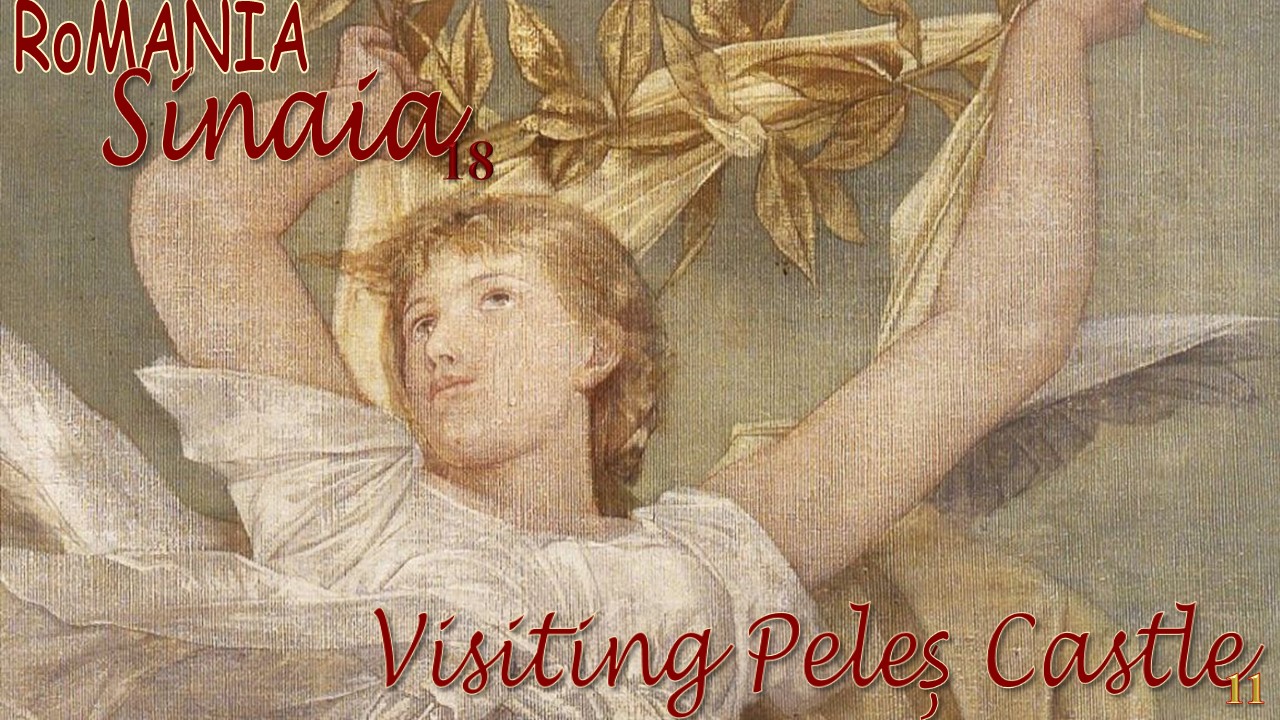
This allegorical image (a girl holding a laurel
wreath) has its origin in the sketch Gustav Klimt
made for the curtain of the Liberec Theatre in
Bohemia (1882-1883)
18
(No Transcript)
19
This allegorical image of Summer (50x100cm)
20
(No Transcript)
21
(No Transcript)
22
Melpomene The depiction of the Muse of Tragedy
resembles the painting Legend that hangs in the
Vienna Museum of History. The two putti who hold
up the medallion, together with the background of
vines, are a reminder of the Muses origins (the
music and dance of the Dionysian festivals)
23
(No Transcript)
24
The mask, flowers and double flute are attributes
of Dionysus An aulos or tibia (Latin) was
an ancient Greek wind instrument, depicted often
in art
25
Masca, flori si dublu aulos
26
(No Transcript)
27
(No Transcript)
28
Calliope Muse of epic poetry
29
(No Transcript)
30
Calliope, eldest of the Muses, was the daughter
of Zeus and Mnemosyne. The Muse of epic poetry,
she was the mother of Orpheus and the keeper of
the Castalian spring on Mount Parnassus, which
was sacred to Apollo
31
(No Transcript)
32
Terpsichore and Calliope, a panel housed in the
guest suite on the second floor of the castle, is
signed and dated G. Klimt/1884. The frieze was
originally intended as an integral part of the
decorative ensemble in the Theatre Room but the
composition was much larger than the space set
aside for it In 1904, painter Franz Vodak made a
smaller copy of the work, which was inserted into
the empty cartouche
33
Terpsichore, Muse of Music and ballet In Greek
mythology Terpsichore ("delight in dancing") is
one of the nine Muses and is goddess of dance and
chorus. She lends her name to the word
"terpsichorean" which means "of or relating to
dance"
34
(No Transcript)
35
(No Transcript)
36
Thalia The Muse of comedy is depicted within a
circular cartouche, with an inscription giving
her identity. The medallion is flanked by two
putti with the attributes of music, in an
attitude that suggests calm and joy
37
(No Transcript)
38
The lyre is an attribute of the god Apollo, the
god of daytime, light and the arts and the chorus
leader of the Muses
39
(No Transcript)
40
Female figure (Ariadne?)
41
(No Transcript)
42
(No Transcript)
43
(No Transcript)
44
(No Transcript)
45
Exhibition at Pele? Museum 2012
46
The exhibition included works of young Viennese
painters Gustav Klimt, Ernst Klimt and Franz
Matsch, done at the request of King Carol I. The
works currently hosted at the Peles castle were
completed between 1883 and 1886 in the
Kunstler-Compagnie studio
47
Kunstler-Compagnie was a painting studio active
between 1879 and 1892. The studio served
decorative works of private and public buildings
inside and outside the Austro-Hungarian empire
48
(No Transcript)
49
(No Transcript)
50
(No Transcript)
51
(No Transcript)
52
The Pele? castle is the most important host of
Gustav Klimts works in Romania. These can be
grouped under three categories the kings
Ancestors Gallery of the Pele? Castle, including
the kings ancestors from the Hohenzollern House
copies of well known works and original works
which are on display in the castles Theater Hall
or can be seen on the ceiling of the Honor Stairs
53
Franz Matsch (1861-1942) The kings ancestors
from the Hohenzollern House
Ernst Klimt Young general in armor Copy of Anton
van Dyck (1599-1641)
54
Gustav Klimt (1862-1918) The kings ancestors
from the Hohenzollern House
55
Ernst Klimt Art and Science 350 x 260 cm
56
(No Transcript)
57
(No Transcript)
58
(No Transcript)
59
Text Internet Dr. Ruxanda Beldiman Pictures
Internet Sanda Foisoreanu
Daniela Iacob All copyrights belong to
their respective owners Presentation Sanda
Foisoreanu
2019
Sound Radu Lupu - Franz Schubert -
Impromptu No3 in G-flat major, Op90 D 899
Recommended

