

Why Winding-up Petitions Are Making Headlines Again? PowerPoint PPT Presentation
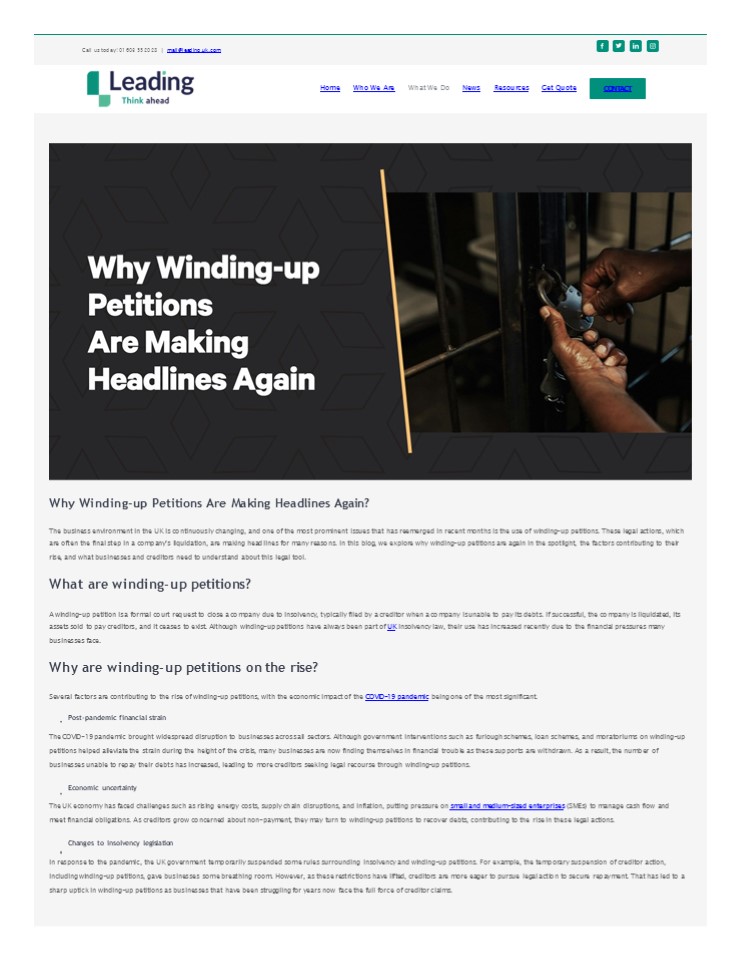
Title: Why Winding-up Petitions Are Making Headlines Again?
1
Call us today! 01603 552028 mail_at_leading.uk.com
Home
Who We Are
What We Do
News
Resources
Get Quote
CONTACT
Why Winding-up Petitions Are Making Headlines
Again?
The business environment in the UK is
continuously changing, and one of the most
prominent issues that has reemerged in recent
months is the use of winding-up petitions. These
legal actions, which are often the final step in
a companys liquidation, are making headlines for
many reasons. In this blog, we explore why
winding-up petitions are again in the spotlight,
the factors contributing to their rise, and what
businesses and creditors need to understand about
this legal tool.
What are winding-up petitions?
A winding-up petition is a formal court request
to close a company due to insolvency, typically
filed by a creditor when a company is unable to
pay its debts. If successful, the company is
liquidated, its assets sold to pay creditors, and
it ceases to exist. Although winding-up petitions
have always been part of UK insolvency law, their
use has increased recently due to the financial
pressures many businesses face.
Why are winding-up petitions on the rise?
Several factors are contributing to the rise of
winding-up petitions, with the economic impact of
the COVID-19 pandemic being one of the most
significant. Post-pandemic financial strain The
COVID-19 pandemic brought widespread disruption
to businesses across all sectors. Although
government interventions such as furlough
schemes, loan schemes, and moratoriums on
winding-up petitions helped alleviate the strain
during the height of the crisis, many businesses
are now finding themselves in financial trouble
as these supports are withdrawn. As a result, the
number of businesses unable to repay their debts
has increased, leading to more creditors seeking
legal recourse through winding-up
petitions. Economic uncertainty The UK economy
has faced challenges such as rising energy costs,
supply chain disruptions, and inflation, putting
pressure on small and medium-sized enterprises
(SMEs) to manage cash flow and meet financial
obligations. As creditors grow concerned about
non-payment, they may turn to winding-up
petitions to recover debts, contributing to the
rise in these legal actions. Changes to
insolvency legislation In response to the
pandemic, the UK government temporarily suspended
some rules surrounding insolvency and winding-up
petitions. For example, the temporary suspension
of creditor action, including winding-up
petitions, gave businesses some breathing room.
However, as these restrictions have lifted,
creditors are more eager to pursue legal action
to secure repayment. That has led to a sharp
uptick in winding-up petitions as businesses that
have been struggling for years now face the full
force of creditor claims.
2
The role of creditors in winding-up petitions
Creditors play a central role in winding-up
petitions, as they often initiate these legal
actions. A winding-up petition is generally filed
by a creditor when a company owes money that it
cant repay within a reasonable period. Unpaid
debts One of the main reasons creditors may issue
a winding-up petition is non-payment. If a
company fails to pay a debt within 21 days after
receiving a statutory demand (a formal payment
request), the creditor may apply for a winding-up
order. In many cases, the companys inability to
settle its debts has reached a point where
creditors feel they have no other option but to
pursue liquidation. Pressure on businesses In a
competitive business environment, creditors are
often under pressure to recover outstanding debts
quickly, especially when dealing with large sums.
A winding-up petition is used to force a company
into liquidation, ensuring that creditors have
the best chance of recovering what theyre owed.
However, its worth noting that issuing a
winding-up petition is a drastic step, as it can
have significant long-term consequences for the
business in question.
The impact of winding-up petitions on businesses
Filing a winding-up petition can have serious
consequences for a company. When the court issues
a winding-up order, it can result in their assets
being seized and liquidated to pay off creditors,
leading to the end of the business. There are
several critical aspects of the winding-up
petition process that businesses must
understand Reputation damage The public nature
of a winding-up petition can severely damage a
companys reputation. Once filed, it becomes a
matter of public record, meaning that the
companys financial difficulties are widely
known. This can erode trust with suppliers,
customers, and investors, making it even harder
for the business to recover, even if it
ultimately avoids liquidation. Business
operations Once a winding-up petition is filed,
the companys bank accounts may be frozen, and it
could lose control over its assets. That means it
may be unable to conduct day-to-day operations,
leading to a loss of business and, in some cases,
employee layoffs. Even if the petition is
withdrawn, the disruption caused by the process
can be enough to push many businesses to the
brink of collapse. Legal and financial costs The
process of defending against a winding-up
petition can be costly and time-consuming. Legal
fees, court costs, and the potential for
additional debt from creditors can quickly build
up. In many cases, businesses may find that
defending against a winding-up petition only
delays the inevitable, as they cannot resolve the
underlying financial issues.
How to avoid a winding-up petition?
For businesses facing financial difficulties,
its important to act quickly to avoid a
winding-up petition. Early intervention can make
a big difference in finding a solution that
protects the companys future. Get professional
advice If youre facing the possibility of a
winding-up petition, its essential to consult
with a licensed insolvency practitioner. These
professionals can help assess your financial
situation and advise on the best course of
action, whether thats negotiating with
creditors, entering into a company voluntary
arrangement (CVA), or considering other
insolvency solutions. Communicate with
creditors Open communication with creditors can
sometimes prevent a winding-up petition from
being issued. Many creditors are willing to
negotiate payment plans or settle debts for less
than the full amount if they believe the company
is genuinely trying to resolve its financial
issues. Consider alternative restructuring
options In some cases, restructuring the
business or selling off non-essential assets may
provide a way to avoid liquidation. An
experienced insolvency practitioner can help you
explore these options.
Get in touch
If youre facing a winding-up petition or need
help with business debt, were here to help. Our
experts can guide you through insolvency and
protect your business. Call 0800 246 1845 or
email mail_at_leading.uk.com for a confidential
consultation today. Dont wait take the first
step towards a solution for your business.
By Viv1 February 25th, 2025 licensed
insolvency Comments Off
Share This Story, Choose Your Platform!
Related Posts
3
Cash Flow Insolvency vs. Balance Sheet
Insolvency January 17th, 2025
Top Signs Your Business May Face Insolvency in
2025 December 31st, 2024
Future of Insolvency in the UK Predictions and
Expert Opinions November 5th, 2024
HELPING CLIENTS ACROSS THE UK
OFFICES
For Business Rescue and Insolvency ... Call Today!
Norwich Borehamwoood
CONTACT
MEMBER OF
Contact us Sitemap
Copyright 2025 Leading Business Services Ltd.
All Rights Reserved Terms of Use Privacy
Cookie
Recommended

