

Fatty Tumor Lipoma Removal Made Easy: Expert Tips PowerPoint PPT Presentation
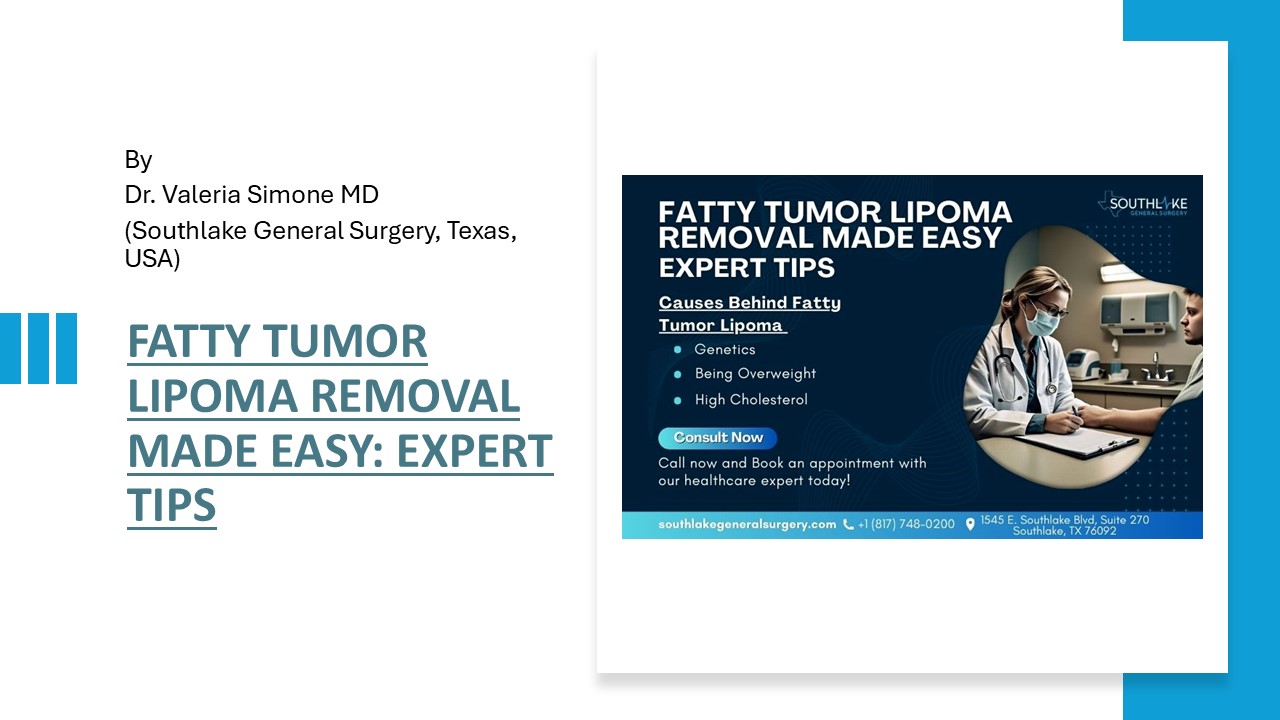
Title: Fatty Tumor Lipoma Removal Made Easy: Expert Tips
1
FATTY TUMOR LIPOMA REMOVAL MADE EASY EXPERT TIPS
- By
- Dr. Valeria Simone MD
- (Southlake General Surgery, Texas, USA)
2
Overview
- Fatty tumor lipoma is common and non-cancerous.
They are made of fat cells and feel like soft
lumps under the skin. Even though they are
usually harmless, some people might find them
unattractive or feel uncomfortable. This can make
individuals think about having them removed.
3
Key Highlights
- Lipomas are harmless, slowly growing tumors made
of fat cells. They usually feel soft and can move
under their skin. - Even though they are mostly safe, lipomas can
cause discomfort or look unattractive. This may
lead people to look for ways to remove them. - Dr. Valeria Simone is a trusted surgeon in Texas
who focuses on lipoma removal. She offers methods
like liposuction and other less invasive
surgeries. - It is important to understand what causes
lipomas. This includes genetics, lifestyle
choices, and some health conditions. Knowing this
helps to find the best treatment. - Getting a professional diagnosis and treatment
from a skilled medical expert is important for
safe and effective lipoma removal.
4
Understanding Lipoma The Basics
- A lipoma is a small, harmless lump made of fat
tissue that forms under the skin. It usually does
not hurt and moves easily when you touch it. Most
lipomas are small, but their growth can be
affected by genes, lifestyle, and health. Knowing
about these factors is important for diagnosing
and treating them.
5
What is Lipoma?
- A lipoma is a type of lump that forms from extra
fat tissue. Theres no need to worry about the
word tumor. Lipomas are benign. This means they
are not cancerous and usually do not cause harm.
They are the most common kind of soft tissue
tumor. People of all ages, both young and old,
can get them. - Lipomas grow slowly and usually do not hurt. They
feel soft and squishy when you touch them under
your skin. Typically, they are small, like a pea,
or a few centimeters wide. However, sometimes
they can become much larger. - Lipomas and cancerous tumors like liposarcoma are
not the same. Though both are called tumors,
lipomas do not spread to other parts of the body.
In contrast, liposarcoma is a type of cancer that
comes from fat cells.
6
Common Misconceptions About Fatty Tumor Lipoma
- There are several myths about the cause of
lipomas. A common belief is that being overweight
leads to them. While gaining weight can cause old
lipomas to grow larger, it does not create new
ones. Lipomas are harmless tumors and are not
simply extra fat that comes from being obese. - Another myth is that lipomas are just a skin
problem. In reality, they come from fat cells in
the layer beneath the skin. This layer is called
the subcutaneous layer. Lipomas may look like
lumps, but they do not come from the skin itself. - Lastly, some people believe that all lipomas do
not hurt. Most lipomas are painless, but some
situations, like Madelungs disease, can cause
painful lipomas. This happens often around the
neck and shoulders. It is important to recognize
these cases to get the right diagnosis and
treatment.
7
Identifying Lipoma Signs and Symptoms
- To find a lipoma early, look for its common
signs. A lipoma is soft, can be moved around,
grows slowly, and often doesnt hurt. Bigger
lipomas might press on nerves, which can be
uncomfortable. - You usually see them where theres more fat under
the skin, like on the shoulders, back, neck,
arms, and thighs. If you feel a lump with these
signs, talk to a healthcare provider for a
checkup.
8
Typical Locations and How They Feel
- Lipomas usually grow in areas with subcutaneous
fat. This is the layer of fat right under the
skin. You often see them on the upper back,
shoulders, arms, buttocks, and upper thighs. They
can appear in various locations across the body.
However, they are not as common in places that
have very little fat. - A lipoma feels soft and a bit rubbery when you
touch it, like dough. - You can usually move them a little with gentle
finger pressure. They sit in the fat layer, which
lets them shift slightly. - Lipomas can sometimes grow bigger and go deeper.
This may affect nearby nerves or muscles and can
cause pain or discomfort. A physical exam can
help find any pressure on the surrounding
tissues. If you feel this way, you should consult
a healthcare provider.
9
When Should You Be Concerned?
- Lipomas are growths made of fat cells that are
not harmful. However, if they start to grow
quickly or feel hard, you should get medical
advice. Its important to watch for changes in a
lipomas texture if it does not move, or if it
causes you pain. - Deep lipomas can impact internal organs and
muscles. When this happens, they might show
various symptoms and need special tests. Its
important to carefully tell the difference
between shallow and deep lipomas. - If you have concerns about lipomas, talk to a
doctor. - A healthcare professional can give you the right
diagnosis. - They can also check for other health issues.
- A doctor will guide you on what to do next.
- Its best not to try to diagnose yourself for
your safety.
10
The Causes Behind Fatty Tumor Lipoma Formation
- The exact cause of lipomas is not fully known,
but both genes and the environment seem to help
them grow. If someone in your family has had
lipomas, you might be more likely to get them
too. - Things like being overweight, high cholesterol,
and not being active can also increase the
chances. Additionally, health problems such as
diabetes and liver disease can raise the risk of
getting lipomas.
11
Genetic Predisposition and Risk Factors of Fatty
Tumor Lipoma
- Many signs show that genetics might lead to
lipomas in several people. If your family has had
lipomas before, you might have a higher chance of
getting them as well. - Genetics is important in how lipomas develop.
- Some conditions, like Madelungs disease and
Gardner syndrome, have strong ties to genetics. - Knowing about these genetic links can help people
understand their risks. - There are other risk factors too. Alcohol use
disorder and a high-fat diet might lead to the
development of lipomas. However, more studies are
needed to prove these links.
12
Lifestyle Factors Influencing Lipoma Development
- Genetics is important in how lipomas form. But
lifestyle choices may also help them grow.
Researchers are studying how different habits
relate to lipoma development. We need more
evidence to make clear connections, but some
links are being explored. - Researchers are looking at obesity as a possible
reason for lipomas. While it may not be a direct
cause, having extra fat might increase the chance
of abnormal fat cells growing. This could lead to
lipomas. - Other habits, like what you eat and how much you
exercise, are also being studied. There isnt
clear proof that these habits cause lipomas.
Still, having a balanced diet and regular
exercise is good for your health. It may also
have an impact on the development of lipomas.
13
Professional Diagnosis Dr. Valeria Simones
Approach
- Dr. Valeria Simone is a top general surgeon in
Texas who focuses on lipoma removal. She performs
a careful diagnosis that starts with a physical
examination. She also talks in detail about the
patients medical history. - If the case is complex, she may suggest further
tests like ultrasounds, MRI scans, or CT scans.
These tests help to understand the size,
location, and tissues around the lipoma.
14
Initial Consultation and Assessment
- The journey to understanding and treating your
lipoma starts with a thorough first consultation.
Dr. Simone pays attention to you as a patient.
She listens to your concerns and gathers
information about your medical history. She will
inquire about your familys history with lipomas,
any previous surgeries, and your general health. - Dr. Simone does a careful physical examination of
the lipoma. She checks its size, shape, texture,
and where it is located. - She also looks at nearby areas to see if there is
any pain or trouble with movement. - If the lipoma is larger or deeper, Dr. Simone may
recommend extra tests. These tests could use
advanced imaging, like a CT scan. This helps get
a better view of the lipoma. It also helps in
making the correct diagnosis and choosing the
best treatment plan.
15
Advanced Diagnostic Tools and Techniques
- When Dr. Simone wants to see the lipoma better,
he uses special tools to get a clear image. Some
important imaging methods are - MRI scan It shows clear images of soft tissues.
This helps find out the size of the lipoma and
where it is compared to other structures. - CT scan This is often used to look at the bones.
It also gives important details about the lipoma.
It helps tell it apart from other growths and
finds any strange features. - Ultrasound This method uses sound waves and does
not hurt you. It is great for checking lipomas
close to the skin. It shows how deep they are and
their link with nearby blood vessels and nerves.
16
Treatment Options Available in Texas, USA
- Dr. Valeria Simone provides lipoma removal
treatments that meet the unique needs and wishes
of each patient. She offers a variety of options.
You can choose minimally invasive surgery for
faster healing. - There are also non-surgical options like
liposuction. The choice depends on the size,
location of the lipoma, and the patients health.
17
Minimally Invasive Surgery Techniques
- Minimally invasive surgery is a good choice for
lipoma removal. It has several benefits compared
to open surgery. These benefits include less pain
and a faster recovery time. There are several
common methods used for this type of surgery. - Excision Dr. Simone makes a small cut above the
lipoma to take it out carefully. After that, he
stitches the cut which creates a small scar. This
way works well for smaller and lighter lipomas. - Endoscopic removal If the lipomas are larger or
deeper, Dr. Simone might recommend using an
endoscope. This is a tube with a camera. It goes
through a small cut to help remove the lipoma and
protect nearby tissues.
18
Non-Surgical Treatments and Their Effectiveness
- In addition to less invasive surgery, there are
non-surgical ways like liposuction. This method
can help take out lipomas in some cases.
Liposuction is popular for shaping the body. It
can also remove smaller lipomas, especially in
areas where a small scar matters. - To remove a lipoma, the process starts with a
small incision. - A thin tube, called a cannula, is used to break
down and suction out the fatty tissue. - This method is effective for removing most of the
lipoma. - Still, it might not remove every fat cell. This
means there is a small chance that the lipoma can
return. - How well these non-surgical treatments work
depends on several factors. This includes the
size and location of the lipoma and details about
the patient. During the consultation, Dr. Simone
checks these points. She wants to find out if
liposuction is the best choice for good results.
19
Preparing for Lipoma Removal Surgery
- Getting ready for lipoma removal surgery can help
the surgery go better and make recovery easier.
Dr. Simone gives specific instructions to follow
before the surgery. These may include doing tests
or changing your medications. - If you talk about any worries you have about the
surgery, anesthesia, or care after the surgery,
it can help you feel more at ease during the
entire process.
20
Steps to Take Before Your Procedure
- Before getting a lipoma removed, its important
to follow several steps to ensure the surgery
goes well. Your surgeon will give you detailed
guidance to follow. However, some steps are
similar for everyone. - Lets explore more Fatty Tumor Lipoma Expert
Removal Tips - Southlake General Surgery
21
Make an Appointment
- To address your concerns about fatty tumors, or
lipomas, schedule an appointment with Dr. Valeria
Simone, MD. She is an expert surgeon at Southlake
General Surgery in Texas, USA. You can call 1
(817) 748-0200 to discuss the best options for
lipoma removal. You can also make an online
appointment with us. - Dr. Simone has a lot of practice in surgical
excision and lipoma removal. You will receive a
professional approach that fits your needs. Get
advice from a medical expert like Dr. Simone to
help you make smart choices about your health.
22
- Medically Reviewed By Dr. Valeria Simone MD
- Board-certified General Surgeon at Southlake
General Surgery, Texas, USA. - Follow us on Facebook and YouTube.
- Source Fatty Tumor Lipoma Expert Removal Tips -
Southlake General Surgery - LipomaRemoval FattyTumorTreatment
LipomaSurgery SkinLumpRemoval ExpertHealthTips
SouthlakeGeneralSurgery DrValeriaSimoneMD
23
THANK YOU!
SOUTHLAKE GENERAL SURGERY
1545 E. Southlake Blvd, Suite 270 Southlake, TX
EMAIL info_at_southlakegeneralsurgery.com
VISIT US AT www.southlakegeneralsurgery.com
Recommended

