

Eco-Friendly Products: Sustainable Swaps and Path Forward PowerPoint PPT Presentation
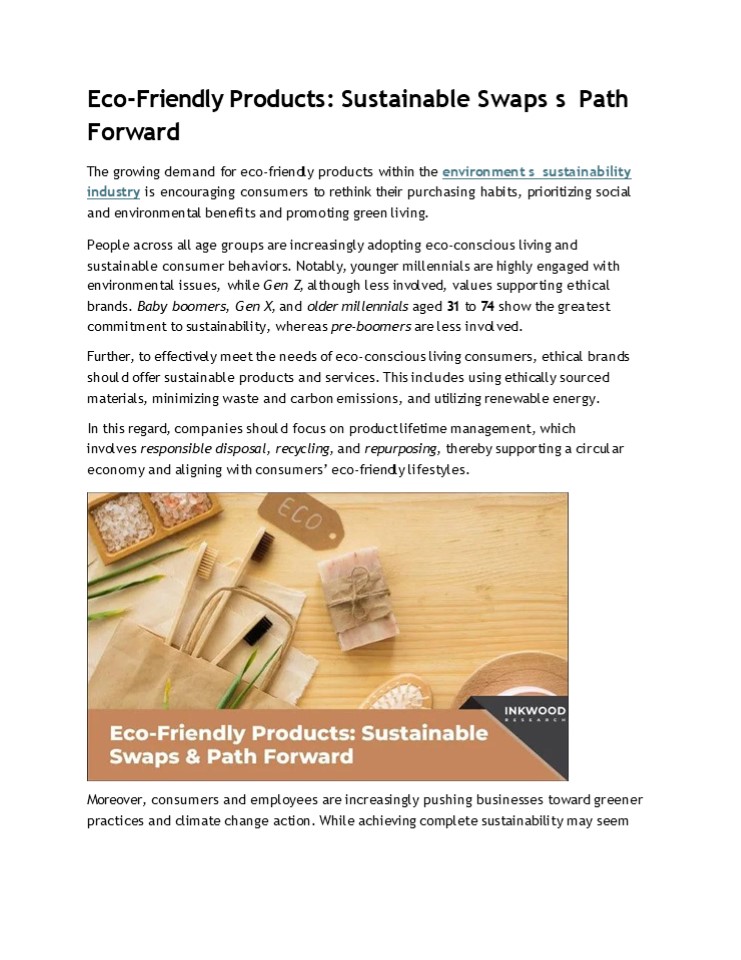
Title: Eco-Friendly Products: Sustainable Swaps and Path Forward
1
Eco-Friendly Products Sustainable Swaps s Path
Forward The growing demand for eco-friendly
products within the environment s sustainability
industry is encouraging consumers to rethink
their purchasing habits, prioritizing social and
environmental benefits and promoting green
living. People across all age groups are
increasingly adopting eco-conscious living
and sustainable consumer behaviors. Notably,
younger millennials are highly engaged
with environmental issues, while Gen Z, although
less involved, values supporting ethical brands.
Baby boomers, Gen X, and older millennials aged
31 to 74 show the greatest commitment to
sustainability, whereas pre-boomers are less
involved. Further, to effectively meet the needs
of eco-conscious living consumers, ethical brands
should offer sustainable products and services.
This includes using ethically sourced materials,
minimizing waste and carbon emissions, and
utilizing renewable energy. In this regard,
companies should focus on product lifetime
management, which involves responsible disposal,
recycling, and repurposing, thereby supporting a
circular economy and aligning with consumers
eco-friendly lifestyles.
Moreover, consumers and employees are
increasingly pushing businesses toward greener
practices and climate change action. While
achieving complete sustainability may seem
2
formidable, businesses can still make a
substantial impact by progressing in the right
direction. Essentials of Eco-Friendly
Products Eco-friendly products include a diverse
range of items, such as reusable shopping bags,
stainless steel water bottles, energy-efficient
appliances, and natural or organic skincare
products. These environmentally friendly product
items are designed to minimize environmental
impact throughout their lifecycle, from
production to disposal. Eco-friendly products are
further defined as those that do not harm the
environment during their manufacture, use, or
disposal. Essentially, these environmentally
friendly products help preserve the environment
by significantly reducing pollution. They may be
made from recycled materials or new, sustainably
sourced materials. The term eco-friendly is
typically applied to products based on the
materials used and their marketing, packaging,
and usage. While eco-friendly and
environmentally friendly are often used
interchangeably, they have distinct
meanings. Eco-friendly products are sustainable,
meaning they do not deplete natural resources or
hinder future generations ability to meet their
needs. Environmentally friendly products, on the
other hand, are those that cause minimal harm to
the environment. A product that is both
eco-friendly and environmentally friendly is
usually designed to be recyclable
or biodegradable, promoting a circular economy
and reducing landfill waste. Furthermore,
sustainable sourcing, which includes evaluating
social, ethical, and environmental performance
during supplier selection, is a crucial aspect of
sustainability. This involves choosing goods and
services made from recycled or remanufactured mate
rials and adhering to green purchasing
guidelines. By making these informed choices,
consumers can substantially contribute to
promoting sustainability. What are the
Environmental Benefits of Choosing Eco-Friendly
Products? The rising demand for eco-friendly
products is a testament to the growing
environmental consciousness among people. These
products, designed with the intention of
minimizing their negative impact on the
environment, are a hopeful signal for
sustainability and carbon footprint reduction.
They are crafted using sustainable resources and
environmentally friendly production techniques,
offering a promising path towards a greener
future. Besides obvious sources like disposable
bottles, plastic is also prevalent in less
noticeable items such as toothpaste packaging and
shampoo bottles, which, when discarded, contribute
to environmental harm. Additionally, common
items like furniture and cleaning products may
contain harmful chemicals that pose health risks.
In contrast, eco-friendly
3
products made from natural components offer a
safer alternative for both people and
animals. The energy consumption of eco-friendly
products is lower overall since they are made to
be energy-efficient. Energy-efficient appliances,
for instance, use less electricity, contributing
to carbon footprint reduction and utility costs.
Purchasing energy-efficient products allows the
consumer to save money over time while
simultaneously making a positive impact on the
environment. By opting for eco-friendly products,
consumers do more than make a purchase
they support companies dedicated to sustainable
business practices. These companies often embrace
ethical practices, fair trade, and efforts to
reduce carbon emissions. Through their choices,
consumers can encourage other businesses to adopt
similar sustainable practices, thereby
contributing to environmental preservation. Using
eco-friendly products goes beyond being a mere
trendits a vital step towards building a more
sustainable future. (Source) How does
Eco-Friendly Packaging Contribute to a Circular
Economy? The demand for environmentally friendly
products is rising as people become more aware of
their impact on the environment. These goods are
made with less harm to the environment in mind
they frequently use eco-friendly components,
energy-saving techniques, and waste-minimizing
features. In this regard, single-use packaging is
one of the biggest causes of environmental waste.
As a result, packaging for environmentally
friendly products is frequently recyclable,
compostable, or reusable. Currently, ethical
brands are utilizing packaging composed of glass,
metal, and biodegradable plastics. In addition to
lowering the quantity of waste dumped in
landfills, these materials support a circular
economy by allowing packaging to be recycled or
reused to create new goods. How are Sustainable
Products Supporting an Eco-Friendly
Lifestyle? Energy-efficient appliances, such as
LED light bulbs, and energy star-rated
appliances, such as refrigerators and smart
thermostats, are designed to consume less
electricity, thereby promoting carbon footprint
reduction. These eco-friendly products
help consumers save on energy bills while also
contributing to carbon footprint reductions.
The popularity of smart home technology is
further driving the trend toward more efficient
and environmentally conscious living
spaces. Additionally, products made from organic
and natural ingredients are gaining traction,
particularly in the food and personal care
industries. Organic products are cultivated
4
without synthetic pesticides or fertilizers,
making them safer for both the environment and
consumers. Natural and organic skincare and hair
care products, such as shampoos and lotions, use
non-toxic ingredients like plant-based extracts.
This approach helps reduce water pollution and
minimizes harm to wildlife. Sustainable fashion
is also transforming the apparel industry,
focusing on reducing waste, pollution, and
unethical labor practices. Eco-friendly fashion
brands use materials like organic cotton, bamboo,
and recycled material clothing to create stylish
clothing that leaves a smaller environmental
footprint. For example, the activewear brand
Pangaia considers its impact throughout the
entire supply chain of its comfy activewear line,
from using innovative materials like recycled
cotton and renewable PLNTFIBER thereby aiding in
carbon footprint reduction. The rise of the slow
fashion movement also encourages consumers to
purchase higher-quality items that last longer,
reducing the demand for fast fashion and its
associated waste. Moreover, the zero-waste
movement is gaining momentum, with more people
seeking products that minimize or eliminate
waste. Examples include reusable bags for
shopping, stainless steel water bottles, and
silicone food storage containers. In essence,
Flip s Tumble sells a number of eco-friendly
alternatives to plastic bags, like its product
bags, which can be reused over and over. They
conveniently fit into the pockets of the brands
other products, like its collapsible tote bags.
These products are designed to replace single-use
items, helping consumers reduce their
environmental impact and contribute to a more
sustainable lifestyle. Therefore, incorporating
these environmentally friendly products into
daily life contributes to reducing carbon
footprints and supports the expanding market for
sustainable goods. As awareness grows, an
increasing number of consumers are expected to
seek products that align with their values,
fostering innovation and further broadening the
range of eco-friendly product options
available. What Role do Certifications Play in
Verifying Eco-Friendly Products? Identifying
authentic eco-friendly products can be
challenging, as many companies use greenwashing
in marketing tactics that may not reflect true
environmental sustainability. However, consumers
can rely on various labels and certifications to
ensure that the products they purchase meet
rigorous environmental and ethical
standards. Labels and certifications such as
Energy Star, Fair Trade, USDA Organic, FSC
(Forest Stewardship Council), and EPEAT play a
crucial role in identifying genuine eco-friendly
products. These labels provide consumers with a
trustworthy indication that the products they are
purchasing meet specific environmental, social,
and sustainability
5
standards. Energy Star, for example, certifies
electronic products that meet energy efficiency
guidelines, helping reduce greenhouse gas
emissions. Fair Trade certification further
ensures that products are made under fair labor
conditions and that producers receive a fair
price, often including environmental
sustainability in farming practices. USDA Organic
label also certifies that agricultural products
are produced without synthetic pesticides,
fertilizers, or GMOs, ensuring that they are both
environmentally friendly and health-conscious. Lik
ewise, the FSC certificate guarantees that wood
and paper products come from responsibly managed
forests that provide environmental, social, and
economic benefits. Furthermore, EPEAT evaluates
electronic products on criteria such as energy
efficiency, recyclability, and the reduction of
toxic materials, ensuring that these products
minimize their environmental impact. Hence, by
seeking out these labels, consumers can make
informed choices that support ethical brands and
products contributing to sustainability and
environmental conservation. Each certification
plays a distinct role, ranging from promoting
energy efficiency and organic farming to ensuring
fair labor practices, sustainable company
practices, and responsible forest
management. What Challenges are Hindering the
Adoption of Eco-Friendly Products? While
eco-friendly products are becoming increasingly
popular, they face several challenges that can
affect their adoption and effectiveness. These
challenges include cost, availability, and the
risk of greenwashing, and identifying false
eco-friendly claims. One of the primary
challenges associated with eco-friendly products
is their cost. Often, these products are more
expensive than their conventional counterparts.
This is due to several factors, including the use
of sustainable materials, ethical labor
practices, and smaller production scales. For
instance, organic cotton products or bamboo
products may cost more to produce than those made
from conventional cotton due to the lack of
chemical fertilizers and pesticides used in their
cultivation. In addition, certifications such as
Fair Trade or USDA Organic label requires
rigorous compliance and frequent audits, adding
to the overall cost. As a result, consumers might
hesitate to purchase eco-friendly products,
especially if they are on a budget, limiting the
market reach of these products. Eco-friendly
product availability can also pose a significant
challenge. Although these products are
increasingly found in urban areas and online
markets, they may be scarce in rural or less
developed regions. Limited accessibility of
sustainable product options can
6
hinder widespread adoption, as consumers in these
areas might struggle to find eco- friendly
choices. Even where eco-friendly products are
available, the selection may be narrower compared
to conventional alternatives, which can deter
consumers from making environmentally conscious
purchases. Another major concern is greenwashing
in marketing, where companies falsely market
their products as eco-friendly without meeting
genuine sustainability standards. This deceptive
practice can mislead consumers, causing them to
buy products that are not truly environmentally
friendly. Greenwashing in marketing undermines
consumer trust and hampers the progress of the
eco-friendly products movement. To combat this,
consumers must be vigilant and rely on credible
certifications and labels to ensure that they are
making conscious product choices. As a result,
while eco-friendly products are a positive step
towards sustainability, challenges such as higher
costs, limited accessibility of sustainable
products, and the threat of greenwashing in
marketing can pose significant barriers to their
widespread adoption. Addressing these challenges
through education, policy, and innovation is
important for advancing the eco-friendly product
market and promoting genuine sustainable
practices. How do Eco-Friendly Products
Contribute to a Sustainable Future? Eco-friendly
products are fundamental in advancing a
sustainable future. They offer a range of
benefits, including minimizing environmental
impact, conserving natural resources, and
fostering healthier lifestyles. By selecting
products made from sustainable materials,
produced through eco-conscious processes, and
packaged in recyclable or biodegradable
materials, consumers can effectively bring out
carbon footprint reductions and aid in the
preservation of planet. Additionally,
eco-friendly products often support ethical
practices, such as fair labor conditions and
animal welfare, further enhancing their value in
the global market.
Recommended

