

JCB CT160, CT260 Tandem Roller Service Repair Manual Instant Download PowerPoint PPT Presentation
Title: JCB CT160, CT260 Tandem Roller Service Repair Manual Instant Download
1
Foreword
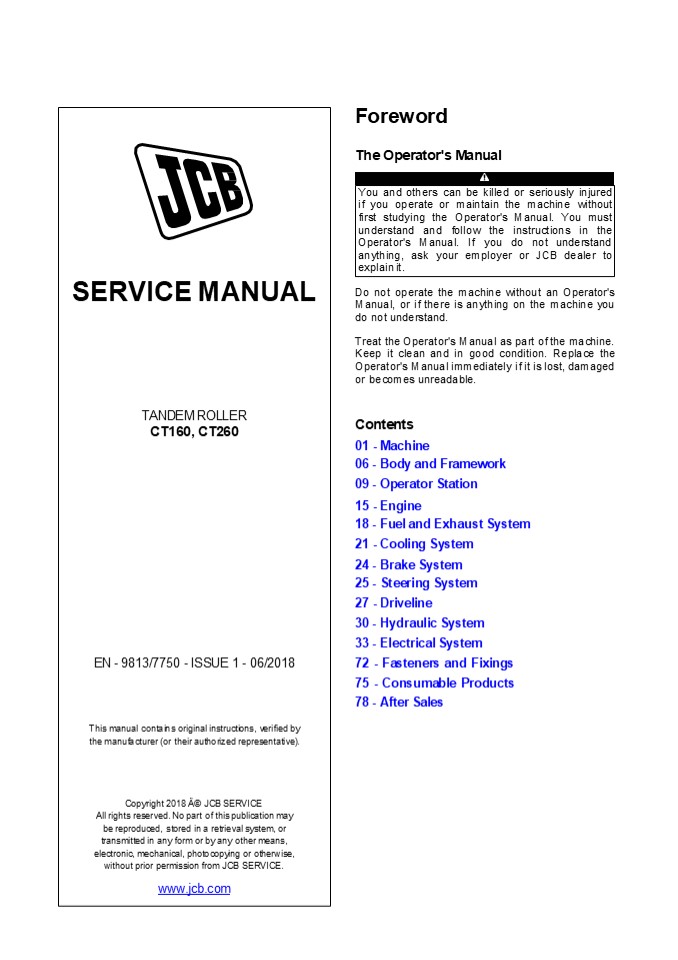
SERVICE MANUAL TANDEM ROLLER CT160,
CT260 EN - 9813/7750 - ISSUE 1 -
06/2018 This manual contains original
instructions, verified by the manufacturer (or
their authorized representative). Copyright
2018 Â JCB SERVICE All rights reserved. No part
of this publication may be reproduced, stored in
a retrieval system, or transmitted in any form or
by any other means, electronic, mechanical,
photocopying or otherwise, without prior
permission from JCB SERVICE. www.jcb.com
The Operator's Manual
You and others can be killed or seriously injured
if you operate or maintain the machine without
first studying the Operator's Manual. You must
understand and follow the instructions in the
Operator's Manual. If you do not understand
anything, ask your employer or JCB dealer to
explain it.
Do not operate the machine without an Operator's
Manual, or if there is anything on the machine
you do not understand.
Treat the Operator's Manual as part of the
machine. Keep it clean and in good condition.
Replace the Operator's Manual immediately if it
is lost, damaged or becomes unreadable.
Contents 01 - Machine 06 - Body and Framework 09
- Operator Station 15 - Engine 18 - Fuel and
Exhaust System 21 - Cooling System 24 - Brake
System 25 - Steering System 27 - Driveline 30 -
Hydraulic System 33 - Electrical System 72 -
Fasteners and Fixings 75 - Consumable Products 78
- After Sales
2
15 - Engine 09 - Bedplate 00 - General
00 - General
Introduction
Introduction .....................................
............... 15-49 Repair .....................
.......................................
15-50 Check (Condition) ..........................
................ 15-50
The bedplate acts as the main strength component
of the engine. it maintains the correct alignment
and supports the weight of the internal
components.
Figure 52.
1
2
- Bedplate
- Crankcase
15 - 49
3
15 - Engine 09 - Bedplate 00 - General
Repair
Check (Condition)
- When the cylinder is worn beyond the allowable
limit, bore and hone it to the specified
dimension. - Refer to PIL 15-00-00.
- Replace the piston and piston rings with
specified oversized. - Dimension 0.25 mm
- Figure 53.
- Measure the inside diameter of the cylinder at
the six positions with a cylinder gauge to find
the maximum and minimum inside diameter. Refer
to Figure 55. - Calculate the difference (Maximum wear)
between the maximum and the minimum inside
diameter. - Make sure that the cylinder inside diameter is
within the specified limits. - Refer to PIL 15-00-00.
- Figure 54.
A B
- Cylinder inside diameter (Before Correction)
- Cylinder inside diameter (Oversize)
- If the wear exceeds the allowable limit, bore and
hone to the oversize dimension. - Check condition of the cylinder wall for
scratches. If deep scratches are found, bore the
cylinder.
15 - 50
4
https//www.ebooklibonline.com Hello dear
friend! Thank you very much for reading. Enter
the link into your browser. The full manual is
available for immediate download. https//www.ebo
oklibonline.com
5
15 - Engine 09 - Bedplate 00 - General
Figure 55. A
D
B
E
C
- Top
- Middle
- Bottom (At cylinder skirt)
- Right angle to piston pin
- Piston pin direction
6
15 - Engine 12 - Crankshaft 00 - General
00 - General
Introduction
Introduction .....................................
............... 15-53 Check (Condition)
..........................................
15-54 Remove and Install .........................
.............. 15-55
Figure 56.
B
A
- Crankcase
- Crankshaft
15 - 53
7
15 - Engine 12 - Crankshaft 00 - General
Check (Condition)
- Make sure that the alignment is within the
specified limits. - Refer to PIL 15-00-00.
- If the measurement exceeds the allowable limit,
replace the crankshaft.
Side Clearance Check
- Set a DTI (Dial Test Indicator) with its tip on
the end of the crankshaft. - Move the crankshaft to the front and rear to
measure the side clearance. - Figure 57.
Oil Clearance between Crankpin and Crankpin
Bearing
- Clean the crankpin and crankpin bearing.
- Put a strip of plastigauge on the centre of the
crankpin. - Do not insert the plastigauge into the crankpin
oil hole. - Install the connecting rod cap.
- Tighten the connecting rod screws to the correct
torque value. - Make sure you do not move the crankshaft while
the connecting rod screws are tightened. - Remove the connecting rod cap.
- Measure the amount of flattening with the scale,
and get the oil clearance. - If the oil clearance exceeds the allowable limit,
replace the crankpin bearing. - Figure 59.
- Make sure that the side clearance is within the
specified limits. - Refer to PIL 15-00-00.
- If the measurement exceeds the allowable limit,
replace the thrust bearings.
- Alignment Check
- Support the crankshaft with V-blocks on the
surface plate at both end journals. - Set a DTI with its tip on the intermediate
journal. - Measure the crankshaft alignment.
- Figure 58.
15 - 54
8
15 - Engine 12 - Crankshaft 00 - General
Remove and Install
Install
- The installation procedure is the opposite of the
removal procedure. Additionally do the following
steps. - Install the main bearing case assembly.
- Clean the oil passage in the main bearing case.
- Apply clean engine oil on the bearings.
- Install the main bearing case assemblies in the
original positions. Make a note that the
diameters of main bearing cases vary, install
them in order of makings (A, B for 3 cylinders
and A, B, C for 4 cylinders) from the gear case
side. - Figure 62.
- K
- J
This procedure is part of the engine disassembly
task. The correct sequence of removal of engine
components is given in the engine disassembly
task. Refer to PIL 15-00-00.
Remove
- Remove the screws from the bearing case cover.
- Remove the bearing case cover.
- Figure 60.
G A B
L
- A Bearing case cover mounting screw (inside)
- B Bearing case cover mounting screw (outside)
- G Top mark 'UP'
- Remove the main bearing case screw.
- Pull out the crankshaft assembly.
- Take care not to damage the crankshaft bearing
1. - Figure 61.
- M
- Main bearing case assembly
- Main bearing case screw
- Alignment number
- Alignment marking
- 2.4. Match the alignment numbers and mark on the
main bearing case. - Figure 63.
H
K
N
J
H Main bearing case screw 6. Remove the main
bearing case assembly.
- Remove the screw 3 (x2) from each main bearing
case. - Remove the main bearing case assembly.
J Main bearing case assembly K Main bearing case
screw N Thrust bearing
15 - 55
9
15 - Engine 12 - Crankshaft 00 - General
- When installing the main bearing case 1 and 2,
face the mark FLYWHEEL to the flywheel. - Install the thrust bearing with its oil groove
facing outward. - Make sure that the main bearing case moves
smoothly after tightening the main bearing case
screw to the specified torque. - Torque 46 50 Nm
- Install the crankshaft sub assembly.
- Clean the oil passage of the crankshaft with
compressed air. - Apply engine oil to the screw.
- Align the screw hole of main bearing case with
the screw hole of cylinder block. - Tighten the screws the correct torque value.
Torque 49 53.9 Nm - Clean the oil passage of the crankshaft with
compressed air. - Install the bearing case covers.
- Install the bearing case gasket and the bearing
case cover gasket with correct directions. - Figure 64.
Figure 65.
P
G
G Top mark 'UP' P Up side 4.3. Apply engine oil
to the oil seal lip. Take care that it does not
roll when installing. 4.4. Tighten the bearing
case cover mounting screws with even force on the
diagonal line. Torque 9.8 11.3 Nm
E
D
C
- F
- Bearing case gasket
- Bearing case cover gasket
- Oil seal
- Bearing case cover
- 4.2. Install the bearing case cover to position
the casting mark UP on it upward.
15 - 56
10
15 - Engine 12 - Crankshaft 03 - Main Bearing
03 - Main Bearing
Introduction
Introduction .....................................
............... 15-57 Check (Condition)
..........................................
15-58 Remove and Install .........................
.............. 15-59
In a piston engine, the main bearings are the
bearings on which the crankshaft rotates.
The bearings hold the crankshaft in place and
prevent the forces created by the piston and
transmitted to the crankshaft by the connecting
rods from dislodging the crankshaft, instead
forcing the crank to convert the reciprocating
movement into rotation. Figure 66. A
B
- Main bearing
- Crankshaft
15 - 57
11
15 - Engine 12 - Crankshaft 03 - Main Bearing
Check (Condition)
- Measure the oil clearance between the crankshaft
journal and crankshaft bearing 2. - Put a strip of plastigauge on the centre of the
journal. - Install the bearing case.
- Tighten the bearing case screws to the specified
torque value. - Remove the bearing case again.
- Measure the amount of the flattening with the
scale and get the oil clearance. - Figure 69.
1. Measure the oil clearance between the
crankshaft journal and crankshaft bearing 1.
1.1. Measure the outside diameter
crankshaft journal with an micrometer. Figure 67.
of the outside
1.2. Measure the inside diameter crankshaft
bearing 1 with an micrometer. Figure 68.
of the inside
- Make sure that the clearance is within the
specified limits. - Refer to PIL 15-00-00.
- If the clearance exceeds the allowable limit,
replace the crankshaft bearing 2. - Make sure that the you do not move the
crankshaft while the bearing case screws are
tightened.
- Calculate the oil clearance.
- Make sure that the clearance is within the
specified limits. - Refer to PIL 15-00-00.
- If the clearance exceeds the allowable limit,
replace the crankshaft bearing 1.
15 - 58
12
15 - Engine 12 - Crankshaft 03 - Main Bearing
- Remove and Install
- Remove
- Remove the crankshaft from the engine.
- Remove the crankshaft bearing with a suitable
crankshaft bearing installation tool. - Refer to PIL 78-93.
- Figure 70.
- A
- C
- B
D
- Dimension A
- Seam
- Crankshaft bearing
- Crankcase
- Install
- Clean a new crankshaft bearing and crankshaft
journal bore. - Apply clean engine oil to the crankshaft bearing
and crankshaft journal bore. - Remove the crankshaft bearing with a suitable
crankshaft bearing installation tool. - Refer to PIL 15-00-00.
- Make sure that the crankshaft seam directs
toward the exhaust manifold side.
15 - 59
13
15 - Engine 15 - Camshaft 00 - General
00 - General
Introduction
Introduction .....................................
............... 15-61 Check (Condition)
.......................................... 15-62
The relationship between the rotation of the
camshaft and the rotation of the crankshaft is of
critical importance.
Since the valves control the flow of the air/fuel
mixture intake and exhaust gases, they must be
opened and closed at the appropriate time during
the stroke of the piston. For this reason, the
camshaft is connected to the crankshaft through a
gear mechanism. When the engine runs the
crankshaft drives the camshaft through the gears.
The camshaft opens and closes the inlet and
exhaust valves through the push rods in time with
the four stroke cycle.
15 - 61
14
15 - Engine 15 - Camshaft 00 - General
Check (Condition)
Figure 72.
- Camshaft Side Clearance
- Set a DTI (Dial Test Indicator) with its tip on
the camshaft. - Move the cam gear from front to rear.
- Measure the side clearance.
- Make sure that the camshaft side clearance is
within the specified limits. - Refer to PIL 15-00-00.
5. If the measurement exceeds the allowable
limit, replace the camshaft stopper. Figure 71.
Cam Height
- Measure the height of the cam at its highest
point with an outside micrometer. - Make sure that the cam height is within the
specified limits. - Refer to PIL 15-00-00.
- If the measurement is less than the allowable
limit, replace the camshaft. - Figure 73.
- Camshaft Alignment
- Support the camshaft with V blocks on the
surface plate at both end journals. - Set a DTI with its tip on the intermediate
journal. - Measure the camshaft alignment.
- Make sure that the camshaft alignment is within
the specified limits. - Refer to PIL 15-00-00.
- If the measurement exceeds the allowable limit,
replace the camshaft. - Oil Clearance of Camshaft Journal
- Measure the camshaft journal outside diameter
with an outside micrometer. - Make sure that the camshaft journal outside
diameter is within the specified limits. - Refer to PIL 15-00-00.
15 - 62
15
15 - Engine 15 - Camshaft 00 - General
Figure 74.
- Measure the crankcase bore inside diameter for
camshaft with a cylinder gauge. - Make sure that the cylinder block bore inside
diameter is within the specified limits. - Refer to PIL 15-00-00.
- Figure 75.
- Calculate the oil clearance.
- Make sure that the oil clearance is within the
specified limits. - Refer to PIL 15-00-00.
- If the oil clearance exceeds the allowable limit,
replace the camshaft.
15 - 63
16
15 - Engine 18 - Engine Belt 00 - General
00 - General
Introduction
Introduction .....................................
............... 15-65 Health and Safety
.......................................... 15-66
A crankshaft pulley is used to drive a FEAD
(Front End Accessory Drive) belt. The belt drives
the coolant pump. Depending on the machine
application, the belt is configured to drive
engine mounted accessories, such as the
alternator, cooling fan and air conditioning
compressor.
Some applications have a second pulley on the
crankshaft which drives a dedicated fan belt. The
belt drives an engine mounted cooling fan.
15 - 65
17
15 - Engine 18 - Engine Belt 00 - General
Health and Safety Turning the Engine Do not try
to turn the engine by pulling the fan or fan
belt. This could cause injury or premature
component failure. WARNING! The engine has
exposed rotating parts. Switch off the engine
before working in the engine compartment. Do not
use the machine with the engine cover
open. Notice A drive belt that is loose can
cause damage to itself and/or other engine parts.
15 - 66
18
15 - Engine 18 - Engine Belt 03 - Drive Belt
03 - Drive Belt
Introduction
Introduction .....................................
............... 15-67 Health and Safety
..........................................
15-68 Check (Condition) ..........................
................ 15-68 Adjust ....................
........................................ 15-69
The crankshaft pulley is used to drive the
coolant pump via a FEAD (Front End Accessory
Drive) belt. In addition to the coolant pump the
drive belt can also be configured to drive the
engine mounted accessories.
The belt is maintained at a constant tension by a
spring loaded tensioner. To achieve the necessary
belt/pulley contact area the belt is routed
around idler wheels as required. The
configuration varies depending on the accessories
installed.
15 - 67
19
15 - Engine 18 - Engine Belt 03 - Drive Belt
Health and Safety Notice A drive belt that is
loose can cause damage to itself and/or other
engine parts.
Check (Condition)
At the recommended service interval, visually
inspect the drive belt for damage.
- Make the machine safe. Refer to PIL 01-03.
- Stop the engine and let it cool down.
- Renew the drive belt if it has cracks or if it is
frayed or has pieces of material missing. - Figure 76.
- B
- A
- C
- Crack in belt
- Missing piece of belt
- Frayed belt
15 - 68
20
15 - Engine 18 - Engine Belt 03 - Drive Belt
Adjust Adjustment is not possible with this
drive belt. A spring loaded tensioning unit
ensures that the FEAD (Front End Accessory Drive)
belt is kept at the correct tension.
15 - 69
21
15 - Engine 18 - Engine Belt 06 - Fan Belt
06 - Fan Belt
Check (Condition)
Check (Condition) ................................
.......... 15-70 Adjust ..........................
.................................. 15-71 Remove
and Install ......................................
. 15-71
- Check the condition of the fan belt for damage.
Refer to Figure 77. - If the fan belt is damaged, replace it.
- Figure 77.
- Check if the fan belt is worn and sunk in the
pulley groove. Refer to Figure 78. - If the fan belt is nearly worn out and deeply
sunk in the pulley groove, replace it. - Figure 78.
15 - 70
22
15 - Engine 18 - Engine Belt 06 - Fan Belt
Adjust
Remove and Install
- Make the machine safe. Refer to PIL 01-03-27.
- Remove the ignition key.
- Apply the approximately specified force with your
finger to belt between the pulleys and measure
the belt deflection. - Force 10 kg
- Make sure that the belt deflection is within the
specified limit. - Dimension 7 9 mm
- If necessary, adjust the belt tension.
- Loosen the alternator mounting bolt.
- Pull out the alternator until the deflection of
the belt is within the specified limits. - If damaged, replace the fan belt. Refer to PIL
15-18-06. - Figure 79.
Remove
- Make the machine safe. Refer to PIL 01-03-27.
- Open the engine compartment cover.
- Remove the alternator. Refer to PIL 15-72-00.
- Remove the fan belt from the engine.
Install
- The installation procedure is the opposite of the
removal procedure. Additionally do the following
step. - Adjust the fan belt tension.
B
C
- A
- Fan belt
- Alternator mounting bolt
- Belt deflection ( 7 9 mm at 10 kg force)
15 - 71
23
Suggest If the above button click is invalid.
Please download this document first, and then
click the above link to download the complete
manual. Thank you so much for reading
24
15 - Engine 18 - Engine Belt 27 - Drive Pulley
- 27 - Drive Pulley
- Remove and Install
- This procedure is part of the engine disassembly
task. The correct sequence of removal of engine
components is given in the engine disassembly
task. - Remove
- Hold the flywheel with a flywheel locking tool.
- Remove the screw from the fan drive pulley.
- Remove the fan drive pulley with a gear puller.
- Install
- The installation procedure is the opposite of the
removal procedure. Additionally do the following
steps. - Align the identification mark on the crankshaft
gear and fan drive pulley. - Figure 80.
A
- A Alignment mark
- Apply engine oil to the screws.
- Tighten the screws to the correct torque value.
Torque 235.4 245.2 Nm
15 - 72
9813/7750-1
15 - 72
25
https//www.ebooklibonline.com Hello dear
friend! Thank you very much for reading. Enter
the link into your browser. The full manual is
available for immediate download. https//www.ebo
oklibonline.com
Recommended

