

New Holland TN60VA Tractor Service Repair Manual Instant Download PowerPoint PPT Presentation
Title: New Holland TN60VA Tractor Service Repair Manual Instant Download
1
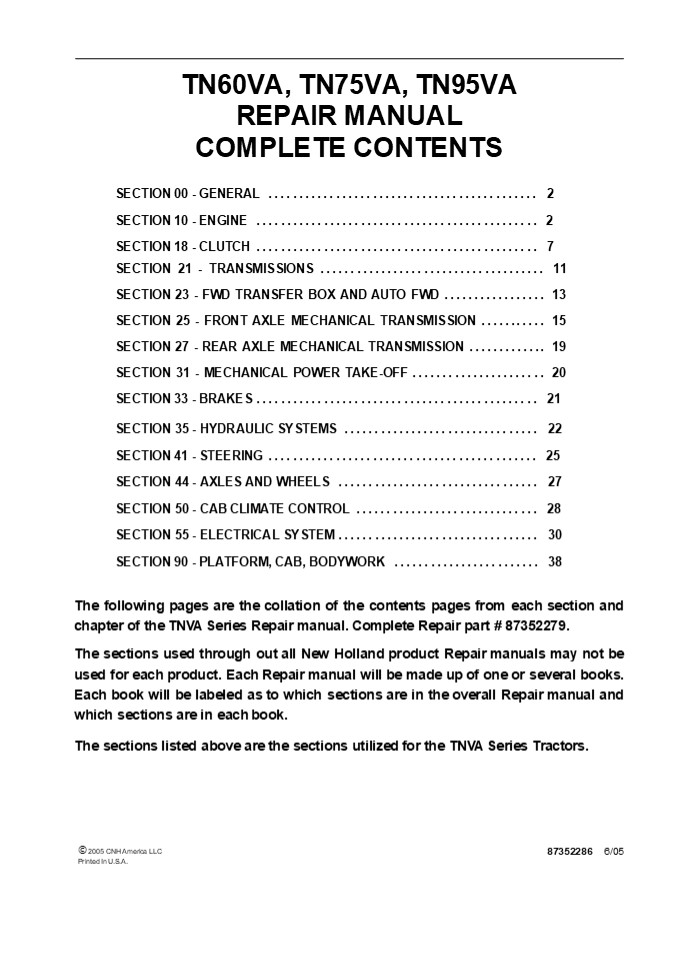
TN60VA, TN75VA, TN95VA REPAIR MANUAL COMPLETE
CONTENTS
SECTION 00 - GENERAL .............................
............... 2 SECTION 10 - ENGINE
..............................................
2 SECTION 18 - CLUTCH ............................
.................. 7 SECTION 21 - TRANSMISSIONS
..................................... 11 SECTION
23 - FWD TRANSFER BOX AND AUTO FWD
................. 13 SECTION 25 - FRONT AXLE
MECHANICAL TRANSMISSION ........... 15 SECTION
27 - REAR AXLE MECHANICAL TRANSMISSION
............. 19 SECTION 31 - MECHANICAL POWER
TAKE-OFF ...................... 20 SECTION 33 -
BRAKES ...........................................
... 21 SECTION 35 - HYDRAULIC SYSTEMS
................................ 22 SECTION 41 -
STEERING .........................................
... 25 SECTION 44 - AXLES AND WHEELS
................................. 27 SECTION 50 -
CAB CLIMATE CONTROL ..............................
28 SECTION 55 - ELECTRICAL SYSTEM
................................. 30 SECTION 90 -
PLATFORM, CAB, BODYWORK ........................
38 The following pages are the collation of the
contents pages from each section and chapter of
the TNVA Series Repair manual. Complete Repair
part 87352279. The sections used through out
all New Holland product Repair manuals may not be
used for each product. Each Repair manual will
be made up of one or several books. Each book
will be labeled as to which sections are in the
overall Repair manual and which sections are in
each book. The sections listed above are the
sections utilized for the TNVA Series Tractors.
? 2005 CNH America LLC Printed In U.S.A.
87352286 6/05
2
SECTION 00 - GENERAL - CHAPTER 1 SECTION 00 -
GENERAL Chapter 1 - General CONTENTS
Description Page General Instructions
..................................................
.......... 3 Health and Safety ...................
...........................................
5 Precautionary Statements .......................
.............................. 15 Safety
..................................................
.................... 16 Ecology and the
Environment ......................................
............ 19 Minimum Hardware Tightening
Torques .........................................
20 Federal Emissions Warranty ...................
................................ 22 Consumables
..................................................
.............. 25
Section
00-1
3
SAFETY
SECTION 00 - GENERAL - CHAPTER 1
PRECAUTIONARY STATEMENTS A careful operator is
the best operator. Most accidents can be avoided
by observing certain precautions. To help
prevent accidents, read the following precautions
before operating this equipment. Equipment should
be operated only by those who are responsible
and instructed to do so. Carefully review the
procedures given in this manual with all
operators. It is important that all operators be
familiar with and follow safety precautions.
THE TRACTOR
- Use extreme caution and avoid hard application
of the tractor brakes when towing heavy loads at
road speeds. - Any towed vehicle whose total weight exceeds
that of the towing tractor must be equipped with
brakes for safe operation. - Never apply the differential lock when turning.
When engaged, the differential lock will prevent
the tractor from turning. - Always check overhead clearance, specifically
when transporting the tractor. Watch where you
are going, especially at low overhanging
obstacles. - Use extreme caution when operating on steep
slopes.
- Read the Operators Manual carefully before
using the tractor. Lack of operating knowledge
can lead to accidents. - Only allow properly trained and qualified persons
to operate the tractor. - To prevent falls, use the handrails and step
plates when getting on and off the tractor. Keep
steps and platform clear of mud and debris. - Do not permit anyone but the operator to ride on
the tractor unless a passenger seat is fitted.
There is no safe place for extra riders
otherwise. - Replace all missing, illegible or damaged safety
decals. - Keep safety decals free of dirt or grime.
- Do not modify or alter or permit anyone else to
modify or alter the tractor or any of its
components or any tractor function without first
consulting your dealer. - Tractor wheels are very heavy. Handle with care
and ensure, when stored, that they cannot fall.
- To avoid overturns, drive the tractor with care
and at speeds compatible with safety, especially
when operating over rough ground, when crossing
ditches or slopes and when turning overturning. - If the tractor becomes stuck or the tires are
frozen to the ground, reverse the tractor out to
prevent corners. - Keep the tractor in the same gear when going
downhill as would be used when going uphill. Do
not coast or freewheel down hills. - OPERATING THE TRACTOR
- Apply the parking brake, place the PTO control in
the OFF position, the lift control lever in
the down position, the remote control valve
levers in the neutral position and the
transmission lever in neutral before starting
the tractor. - Do not start the engine or operate controls while
standing beside the tractor. Always sit in the
tractor seat when starting the engine or
operating the controls.
DRIVING THE TRACTOR
- Always sit in the drivers seat while starting or
driving the tractor. - When driving on public roads, have considera-
tion for other road users. Pull in to the side of
the road occasionally to allow any following
traffic to pass. Do not exceed the legal speed
limit set in your area. - Use low beam lights when meeting a vehicle at
night. Make sure the lights are adjusted to
prevent blinding the drive of an oncoming vehicle - Reduce speed before turning or applying the
brakes. Ensure that both brake pedals are locked
together when traveling at road speeds or when
on public roads. Brake both wheels simulta-
neously when making an emergency stop.
00-16
4
https//www.ebooklibonline.com Hello dear
friend! Thank you very much for reading. Enter
the link into your browser. The full manual is
available for immediate download. https//www.eb
ooklibonline.com
5
SECTION 00 - GENERAL - CHAPTER 1
- Do not bypass the neutral start switches. Consult
your authorized dealer if your neutral start
controls malfunction. Use jump cables only in the
recommended manner. Improper use can result in
a tractor runaway. - Avoid accidental contact with the gear shift
levers while the engine is running. Unexpected
tractor movement can result from such contact. - Do not get off the tractor while it is in motion.
- Shut off the engine and PTO and apply the
parking brake before getting off the tractor. - Do not park the tractor on a steep incline.
- Do not run the tractor engine in an enclosed
building without adequate ventilation. Exhaust
fumes are toxic and can cause death. - Always wear a protective mask when working with
toxic spray chemicals. Follow the directions on
the chemical container.
a hazard both to the operator and to bystanders.
Do not overload or operate with attached
equipment which is unsafe, not designed for the
particular task or is poorly maintained. 19. The
tractor is designed to provide the minimum noise
level at the operators ears and meets or
exceeds applicable standards in this respect.
However, noise (sound pressure level) in the
workplace can exceed 86 dB(A) when working
between buildings or in confined spaces.
Therefore, it is recommended that operators wear
suitable ear protectors during vehicle
operation. OPERATING THE PTO
- When operating PTO driven equipment, shut off
the engine and wait until the PTO stops before
getting off the tractor and disconnecting the
equipment. - Do not wear loose clothing when operating the
power take-off or especially when near rotating
equipment. - When operating stationary PTO driven equip-
ment, always apply the tractor parking brake and
block the rear wheels front and back. - To avoid injury, do not clean, adjust, unclog or
service PTO driven equipment when the tractor
engine is running. - Make sure the PTO guard is in position at all
times and always replace the PTO cap when the
PTO is not in use.
- If the power steering or engine ceases operating,
stop the tractor immediately as the tractor will
be more difficult to control. - Stop the engine and relieve pressure before
connecting or disconnecting hydraulic, steering
or fuel lines. - Tighten all connections before starting the
engine or pressurizing lines. - Pull only from the swinging drawbar or the lower
link drawbar in the lowered position . Use only a
drawbar pin that locks in place. Pulling from
the tractor rear axle or any point above the
axle may cause the tractor to overturn. - If the front end of the tractor tends to rise
when heavy implements are attached to the three-
point hitch, install front end or front wheel
weights. Do not operate the tractor with a light
front end. - Always select Position Control when attaching
implements and when transporting equipment. Be
sure hydraulic couplers are properly installed
and will disconnect safety in case of accidental
detachment of the implement. - Do not leave equipment in the raised position
when the vehicle is stopped or unattended. - Ensure any attached equipment or accessories are
correctly installed, are approved for use with
the tractor, do not overload the tractor and are
operated and maintained in accordance with the
instructions issued by the equipment or
accessory manufacturer. - Remember that your tractor, if abused or
incorrectly used, can be dangerous and become
SERVICING THE TRACTOR
- The cooling system operates under pressure which
is controlled by the radiator cap. It is
dangerous to remove the cap while the system is
hot. Always turn the cap slowly to the first stop
and allow the pressure to escape before
removing the cap entirely. - Do not smoke while refueling the tractor. Keep
any type of open flame away. Wait for the engine
to cool before refueling. - Keep the tractor and equipment, particularly
brakes and steering, maintained in a reliable and
satisfactory condition to ensure your safety and
comply with legal requirements. - To prevent fire or explosion, keep open flames
away from battery or cold weather starting aids.
To prevent sparks which could cause explosion,
use jumper cables according to instructions. - Stop the engine before performing any service on
the tractor.
00-17
6
SECTION 00 - GENERAL - CHAPTER 1
- Escaping diesel/hydraulic fluid under pressure
can penetrate the skin causing serious injury. - Do not use your hand to check for leaks. Use a
piece of cardboard or paper to search for leaks. - Stop the engine and relieve pressure before
connecting or disconnecting lines. - Tighten all connections before starting the
engine. - If fluid is injected into the skin obtain medical
attention immediately. - Do not modify or alter or permit anyone else to
modify or alter the tractor or any of its
components or any tractor function without first
consulting an authorized dealer. - The fuel oil in the injection system is under
high pressure and can penetrate the skin.
Unqualified persons should not remove or attempt
to adjust a pump, injector, nozzle or any other
part of the injection system. Failure to follow
these instructions can result in serious injury. - Continuous long term contact with used engine
oil my cause skin cancer. Avoid prolonged
contact with used engine oil. Wash skin promptly
with soap and water.
- Do not fill the fuel tank to capacity. Allow room
for expansion. - Wipe up spilled fuel immediately.
- Always tighten the fuel tank cap securely.
- If the original fuel tank cap is lost, replace it
with an approved cap. A non-approved cap may not
be safe. - Keep equipment clean and properly maintained.
- Do not drive equipment near open fires.
- Never use fuel for cleaning purposes.
- Arrange fuel purchases so that summer grade
fuels are not used in the winter. - ROPS
- The tractor may be equipped with a safety frame
(ROPS) which must be maintained in a serviceable
condition. Be careful when driving through
doorways or working in confined spaces with low
headroom.
- Do not modify, drill, weld or alter the ROPS in
any way. - Never attempt to straighten or weld the ROPS or
retaining brackets, which have suffered damage.
By doing so you may weaken the structure and
endanger your safety. - Do not secure any parts on the ROPS or attach it
with other than the special high tensile bolts
and nuts specified. - Never attach chains or ropes to the safety frame
or roll bar for pulling purposes. - Never take unnecessary risks even though your
safety frame or roll bar affords you the maximum
protection possible. - Whenever possible, operate with the ROPS in its
fully upright and locked position.
DIESEL FUEL
- Under no circumstances should gasoline, alcohol
or blended fuels be added to diesel fuel. These
combinations can create an increased fire or
explosive hazard. In a closed container such as
a fuel tank these blends are more explosive than
pure gasoline. Do not use these blends. - Never remove the fuel cap or refuel with the
engine running or hot. - Do not smoke while refueling the tractor or when
standing near fuel. Keep any type of open flame
away. Wait for the engine to cool before
refueling. - Maintain control of the fuel filter pipe nozzle
when filling the tank.
00-18
7
SECTION 10 - ENGINE - CHAPTER 1
1
SECTION 10 - ENGINE Chapter 1 - Engine CONTENTS
Description Page Specifications
..................................................
................ 3 Engine Type ...................
............................................
3 Timing System ..................................
........................... 4 Valve Timing Gears
..................................................
....... 4 Crankcase and Cylinder Block
................................................
5 Crankshaft and Bearings ........................
............................. 6 Connecting Rod
..................................................
.......... 7 Piston ..............................
....................................... 8 Tappet
..................................................
.................. 8 Rocker Arm and Valve
..................................................
..... 9 Rotating Counterweight Dynamic Balancer
..................................... 9 Cylinder
Head .............................................
............... 10 Tightening Torques
..................................................
.......... 11 Special Tools ......................
..........................................
12 Description and Operation .....................
................................ 14 Sectional
Views ............................................
.............. 14 Troubleshooting
..................................................
............ 18 Overhaul .........................
...........................................
22 Engine ........................................
.......................... 22 Removal
..................................................
........... 22 Installation ......................
......................................
28 Compression Test ..............................
....................... 29 Disassembly
..................................................
........ 30 Assembly .............................
............................... 46 Crank, Main
Bearings and Thrust Rings .......................
........ 46 Rear Cover with Seal and Engine
Flywheel ............................
48 Synchronizing the Timing Gears
...................................... 49 Bosch
Injection Pump ...................................
............ 50 Cylinder Head ....................
................................. 50 Valve and
Rocker Arm .......................................
....... 51 Fuel Injectors ........................
.............................. 52 Cooling System
Belt .............................................
... 53
Section
10 001 10
10 001 30 10 001 54
8
2
SECTION 10 - ENGINE - CHAPTER 1
Description Page Cylinder Block
..................................................
.......... 54 Inspection .........................
................................... 54 Crankshaft
and Main Bearings ................................
.............. 56 Crankshaft Inspection
..................................................
56 Main Bearing Inspection ......................
......................... 58 Main Bearing Cap
Bolt Inspection ..................................
...... 58 Crankshaft Front Oil Seal
..................................................
59 Removal ......................................
....................... 59 Installation
..................................................
.......... 60 Engine Flywheel ....................
......................................
61 Refacing ......................................
....................... 61 Flywheel Bolts
..................................................
.......... 61 Inspection .........................
................................... 61 Connecting
Rods .............................................
............ 62 Inspection .......................
..................................... 62 Pistons
with Rings, Pins, Connecting Rods, Big End Caps
and Bearings .......... 63 Inspection
..................................................
.......... 63 Assembly ...........................
................................. 64 Installation
..................................................
.......... 65 Valves, Tappets and Camshaft
..............................................
67 Valves, Grinding ..............................
......................... 67 Dimensions (mm) of
Valves and Valve Guides ..........................
... 67 Valve Timing Check .......................
............................. 68 Tappets
Inspection .......................................
.............. 68 Camshaft Inspection
..................................................
. 69 Cylinder Head ...............................
............................. 70 Inspection
..................................................
.......... 70 Valve Seats, Grinding
..................................................
71 Valve Guides, Replacement ....................
......................... 72 Rotating
Counterweight Dynamic Balancer ...................
................ 75 Assembly ....................
........................................
76 Installation ..................................
.......................... 76 Exhaust Pipe
..................................................
........... 77 Removal ...........................
..................................
77 Installation ..................................
.......................... 77
Section
10 102 70
10 101 53
10 254 44
9
22
SECTION 10 - ENGINE - CHAPTER 1
OVERHAUL
ENGINE Op. 10 001 10 Removal DANGER Lift and
handle all heavy parts using suitable lifting
equipment. Make sure that assemblies or parts are
supported by means of suitable slings and hooks.
Check that no one is in the vicinity of the load
to be lifted. WARNING Always use appropriate
tools to align fixing holes. NEVER USE FINGERS
OR HANDS. Proceed as follows. 1. Carry out
operation 90 150 10 Cab with platform unit
removal (see Sect. 90) (models with cab). Ensure
that the bracket 380001613 locking the front
axle in relation to the engine is positioned and
secured between the above.
- Carry out operation 90 110 36 Platform assembly
removal (see Sect. 90) (models with platform). - Carry out operation 90 114 20 Front roll bar, re-
moval (see Sect. 90) (models with platform). - Unscrew the plug and drain the oil from the rear
transmission casing (the prescribed quantity is - 11.09 US gal. (42 liters).
25628
6
5. Disconnect the electrical connections (2)
and re- move the front guard (1) by sliding
forwards.
7
10
SECTION 10 - ENGINE - CHAPTER 1
23
- If the tractor is not fitted with an extra fuel
tank, disconnect the piping (1) and drain the
fuel from the main tank. - If the tractor is fitted with a platform the
coolant must be drained.
8
8. Disconnect the fuel return piping (1).
9
9. Remove the clamp (1) and detach the radiator
sleeve (2), unscrew the radiator retaining
bracket (3).
10
10. Disconnect the connecting pipe (1) between
the main fuel tank and the extra fuel tank.
11
11
24 SECTION 10 - ENGINE - CHAPTER 1 11. Unscrew
the brake control piping (1) on the front axle
(if fitted).
12
12. Disconnect the hydrostatic steering piping
(1).
13
13. Disconnect the steering sensor wire, loosen
the hose and wire retaining clamps (1) on the
radia- tor.
14
14. Loosen the clamp and disconnect the fuel
injec- tion pump hose (1).
15
12
SECTION 10 - ENGINE - CHAPTER 1
25
- Unscrew the clamp (3) to release the sleeve (2)
from the turbocharger (if fitted). - Disconnect the electrical connections (1) on the
clogged air filter sensor.
16
17. Unscrew the clamp and remove the sleeve (1)
on the relative rigid pipe (2).
17
18. Loosen the hydraulic pump line piping bolts
(1).
18
19. Loosen the clamps (1, 3 and 4), unscrew the
bracket retaining bolts (2) and remove the hy-
draulic pump line piping (5).
19
13
- 26 SECTION 10 - ENGINE - CHAPTER 1
- Unscrew the filter piping (1 and 2).
- Unscrew the services distributor piping (3, 4 and
5).
20
- Disconnect and remove piping (1, 2, 3, 4, 5 and
6). - Carry out operation 10 254 44 Exhaust pipe re-
moval (see Sect. 10).
21
24. Disconnect the piping (2), unscrew the clamp
(1), the piping/clutch housing retaining bolt,
and re- move piping (1 and 3).
22
- Remove the guard (2) and disconnect the starter
motor wires (1), disconnect the pipe (4). - Remove the retaining clamp and disconnect the
engine electrical wires, place the wires (2 and
3) on the clutch casing.
23
14
SECTION 10 - ENGINE - CHAPTER 1
27
- Disconnect the brake piping (1) from the block.
- Carry out operation 23 101 26 Drive shafts and
guard, removal (see Sect. 23).
24
- Position an hydraulic jack under the rear axle,
at- tach the motor to a hoist, using a chain,
and place a stand under the clutch casing. - Unscrew the front axle - engine retaining bolts
(1).
25
31. Remove the front axle, complete with support,
tanks, radiator and air filter.
26
- Unscrew the bolt (2) accessing the Allen screw
- (on both sides).
- Unscrew all of the clutch casing - engine bolts
and detach the engine.
27
15
28
SECTION 10 - ENGINE - CHAPTER 1
Installation WARNING Always use appropriate
tools to align fixing holes. NEVER USE FINGERS
OR HANDS. Apply the prescribed tightening
torques. See table of contents.
- Before refitting the engine to the clutch box
carefully clean the mating surfaces and apply
sealing compound (0.0787 in. (2 mm) diameter),
according to the diagram shown Section 21. - Install the engine on the clutch casing.
- Install the front axle support assembly on the
engine. - Carry out operation 23 101 26 Drive shafts and
guard, installation (see Sect. 23). - Connect the brake piping.
- Connect the wires to the starter motor and
position the other wires on the engine. - Assemble all hydraulic pipes and hoses.
- Carry out operation 10 254 44 Exhaust pipe
installation (see Sect. 10). - Assemble the hydraulic pump feed piping,
complete with the relative support bracket.
28
- Connect the lower radiator sleeve to the rigid
pipe. - Place the inlet sleeve on the turbocharger and
secure in position (if fitted). - Connect the electrical connections to the
clogged air filter sensor. - Connect the injection pump fuel supply piping.
- Connect the steering sensor wire.
- Install the hydrostatic steering piping to the
radiator. - Connect the hydrostatic steering piping.
- Connect the brake piping on the front axle.
- Connect and secure the main fuel tank/extra fuel
tank piping. - Connect the upper radiator sleeve.
- Attach the radiator bracket.
- Connect the fuel return piping to the fuel tank.
- Position the front guard and connect the
headlamps and direction indicator electrical
connections. - Screw the plug on the rear transmission casing
and fill up with oil (see Sect. 00 for prescribed
products and quantities). - Carry out operation 90 114 20 Removable front
roll bar re-assembly (see sect. 90) (models with
platform).
- Carry out operation 90 110 36 Platform assembly
installation (see Sect. 90) (models with
platform). - Carry out operation 90 150 10 Cab with platform
unit installation (see Sect. 90) (models with
cab). - Fill up the engine cooling system (see Sect. 00
for prescribed products and quantities). - Fill up the fuel tank (see Sect. 00 for
prescribed products and quantities). - Bleed the brakes (see Sect. 33).
16
SECTION 10 - ENGINE - CHAPTER 1 29
Op. 10 001 30 Compression Test In case of poor
engine performance, in addition to checking the
fuel injection system (injection nozzles and
injection pump), also test the compression on
each cylinder.
- install the dummy injector 380000617 in place of
the injector removed previously, inserting the
copper sealing washer - connect the compression test instrument
380000303 and take readings while turning the
engine over with the starter motor. - On engines in perfect working order, with the
sump oil at approx. 104 ?F (40 ?C) at sea level
(29.9212 in. (760 mm) mercury) and at an engine
speed of 200 to - 280 rpm, the compression should be 369.75 to
- 398.75 psi (25.5 to 27.5 bar).
- 8) Test the compression on the other cylinders,
repeating steps 4- 5- 6- 7, bearing in mind that - The minimum permissible compression on a used
engine is 313.2 psi (21.6 bar). - The maximum permissible compression difference
between cylinders is 43.5 psi (3 bar). - Every 328 ft. (100 meters) above sea level
corresponds to a reduction in compression by
approx. 1.
DANGER
Do not use matches, lighters, blowtorches or any
form of naked flame as a source of light when
inspecting the engine due to the presence of
flammable fluids and vapor.
- Compression ratio
- The compression ratio is a measure of the
quantity of air drawn into the cylinder, and
provides an indication of the efficiency of the
sealing elements in the cylinder (piston rings
and valves). - Uniform compression in all the cylinders ensures
that they all perform an equal amount of work,
provided that each cylinder is injected with the
same quantity of fuel at the right time. - Low compression not only reduces engine perfor-
mance, it also causes incomplete fuel combustion
due to the lack of available combustion air. - The engine therefore gives poor performance with
excessive fuel consumption and, consequently,
exhaust smoke and restriction of the exhaust
passages. - As the compression ratio also varies with the
temperature of the engine (cold engines produce
lower compression values than hot engines), the
compression should only be tested when the engine
is at normal operating temperature. - Compression should be tested using the compres-
sion test kit 380000303, as follows - run the engine until it reaches normal operating
temperature - switch off the engine
- disconnect the lead from the engine stop
electromagnet on the injection pump in order to
close the valve and block the flow of fuel to
the injectors - remove the injector from the cylinder to be
tested - turn the engine over a few times with the starter
motor in order to expel any carbon residue
CONSIDERATIONS Uniform compression Although high
compression is important, it is more important
for smooth engine running that compres- sion is
uniform in all cylinders. Low compression
readings. If extremely low pressure readings are
obtained on one cylinder it is advisable to
repeat the test. Before testing this time, pour
about a spoonful of engine oil into the cylinder
through the injector bore. Turn over the engine a
few times to distribute the oil evenly over the
cylinder walls, and then repeat the test. If the
second test readings are significantly higher,
suspect worn piston rings, out-of-round or
damaged pistons or cylinders. If the second test
readings are not higher, the problem will be the
valves. On the other hand, if the second test
reading shows only a slight improvement, the
problem will be due to both the valves and the
rings.
17
30
SECTION 10 - ENGINE - CHAPTER 1
Op. 10 001 54 Disassembly WARNING Handle all
parts carefully. Do not put your hands or
fingers between parts. Wear the prescribed
safety clothing, including goggles, gloves and
safety footwear. Proceed as follows.
- Carry out operation 10 001 10 Engine, removal.
- Remove the alternator and air conditioning com-
pressor belts (1). - Unscrew the retaining bolts and remove the ex-
haust muffler (1).
29
30
4. Unscrew the retaining bolt (2) and move the
alter- nator (1) outwards.
31
5. Loosen the clamp and remove the turbocharger
sleeve (1) (if fitted).
32
18
Suggest If the above button click is invalid.
Please download this document first, and then
click the above link to download the complete
manual. Thank you so much for reading
19
SECTION 10 - ENGINE - CHAPTER 1
31
- Disconnect the turbocharger lubrication piping
- (if fitted).
- Unscrew the retaining bolts and remove the ex-
haust manifold (2) complete with the turbochar-
ger (1) (if fitted).
33
- Unscrew the retaining bolt and remove the alter-
nator. - Disconnect and remove the turbocharger (2) lu-
brication piping (if fitted).
34
- Unscrew the retaining bolts and remove the lift
pump (1). - Unscrew the hydraulic oil filter (2), the
relative retaining bolts and remove the filter
support (3).
35
12. Unscrew the retaining bolts and remove the
ser- vices pump (1).
36
20
https//www.ebooklibonline.com Hello dear
friend! Thank you very much for reading. Enter
the link into your browser. The full manual is
available for immediate download. https//www.eb
ooklibonline.com
Recommended

