

The Role of Cloud AI in Conflict Prediction and Risk Assessment PowerPoint PPT Presentation
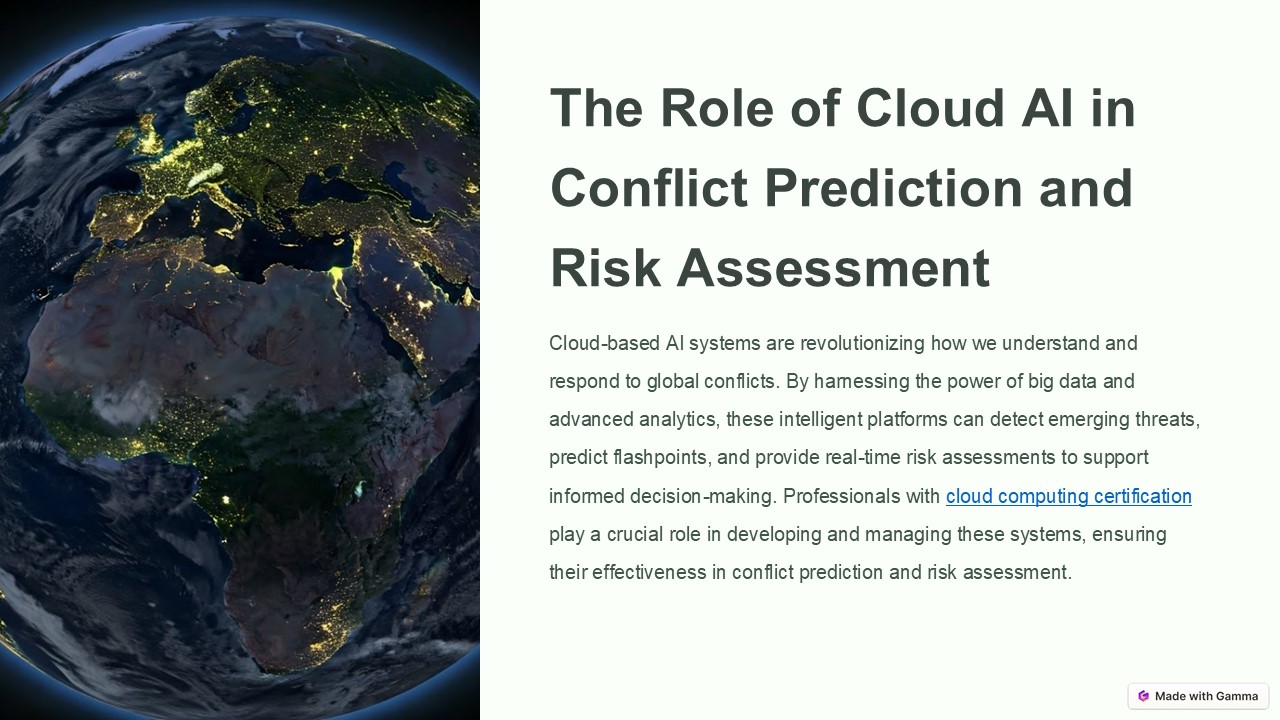
Title: The Role of Cloud AI in Conflict Prediction and Risk Assessment
1
The Role of Cloud AI in Conflict Prediction and
Risk Assessment
Cloud-based AI systems are revolutionizing how we
understand and respond to global conflicts. By
harnessing the power of big data and advanced
analytics, these intelligent platforms can detect
emerging threats, predict flashpoints, and
provide real-time risk assessments to support
informed decision-making. Professionals with
cloud computing certification play a crucial role
in developing and managing these systems,
ensuring their effectiveness in conflict
prediction and risk assessment.
2
Cloud Computing Unlocking the Potential of
Data-Driven Insights
Scalable Processing
Centralized Data
Collaborative Analysis
Cloud platforms offer virtually limitless
computing power to process and analyze vast
amounts of data from diverse sources.
Cloud-based data lakes consolidate information
from satellites, social media, news reports, and
other channels for comprehensive insights.
Interdisciplinary teams can access and work on
the same data sets, enabling real-time
collaboration and decision-making.
3
Artificial Intelligence Revolutionizing Conflict
Analysis
Pattern Recognition
Predictive Modeling
Natural Language Processing
1
2
3
AI models can identify complex patterns in large
datasets, detecting early warning signs of
potential conflicts.
Advanced algorithms can forecast the likelihood
and potential impact of geopolitical events and
security threats.
AI can analyze unstructured data, such as social
media posts and news reports, to gauge public
sentiment and emerging issues.
4
Predictive Analytics Anticipating Emerging
Threats
Data Aggregation
Scenario Planning
Collect and consolidate data from diverse
sources, including social media, news reports,
and government databases.
Simulate and evaluate various conflict scenarios
to assess risks and inform strategic
decision-making.
1
2
3
Machine Learning
Train predictive models to identify patterns and
correlations that can signal the emergence of
potential conflicts.
5
Geopolitical Risk Assessment Identifying
Flashpoints
Regional Tensions
Power Dynamics
Analyze historical conflicts, cultural
differences, and resource disputes to pinpoint
regions with a high potential for instability.
Monitor shifts in global power balances,
alliances, and the actions of influential actors
to anticipate the outbreak of new conflicts.
Emerging Threats
Utilize real-time data streams and advanced
analytics to detect early warning signs of
potential crises, such as civil unrest or
terrorist activities.
6
Multi-Source Data Integration Enhancing
Situational Awareness
Satellite Imagery
Social Media
News Reports
Monitor troop movements, infrastructure changes,
and environmental factors that could signal the
onset of conflict.
Analyze online chatter, sentiment, and activity
to detect early signs of social unrest or
impending violence.
Leverage natural language processing to rapidly
identify and synthesize relevant information from
global media sources.
7
Rapid Response and Scenario Modeling Empowering
Decision-Making
Data Fusion
Integrate and contextualize data from various
sources to provide a comprehensive,
up-to-the-minute understanding of the situation.
Scenario Simulation
Use AI-powered models to simulate potential
conflict scenarios and their consequences,
enabling informed decision-making.
Rapid Deployment
Quickly mobilize resources and coordinate
response efforts based on real-time assessments
and predictive insights.
8
Ethical Considerations and Responsible AI
Deployment
Transparency and Accountability
Data Privacy and Security
Algorithmic Bias
Implement robust data protection measures to
safeguard sensitive information and prevent
misuse or unauthorized access.
Proactively identify and mitigate potential
biases in AI models to prevent unfair or
discriminatory outcomes.
Ensure AI systems are transparent in their
decision-making processes and accountable to
ethical oversight and human judgment.
Recommended

