

How Data Science Powers Smartphone Security: Detecting Anomalies and Preventing Threats PowerPoint PPT Presentation
Title: How Data Science Powers Smartphone Security: Detecting Anomalies and Preventing Threats
1
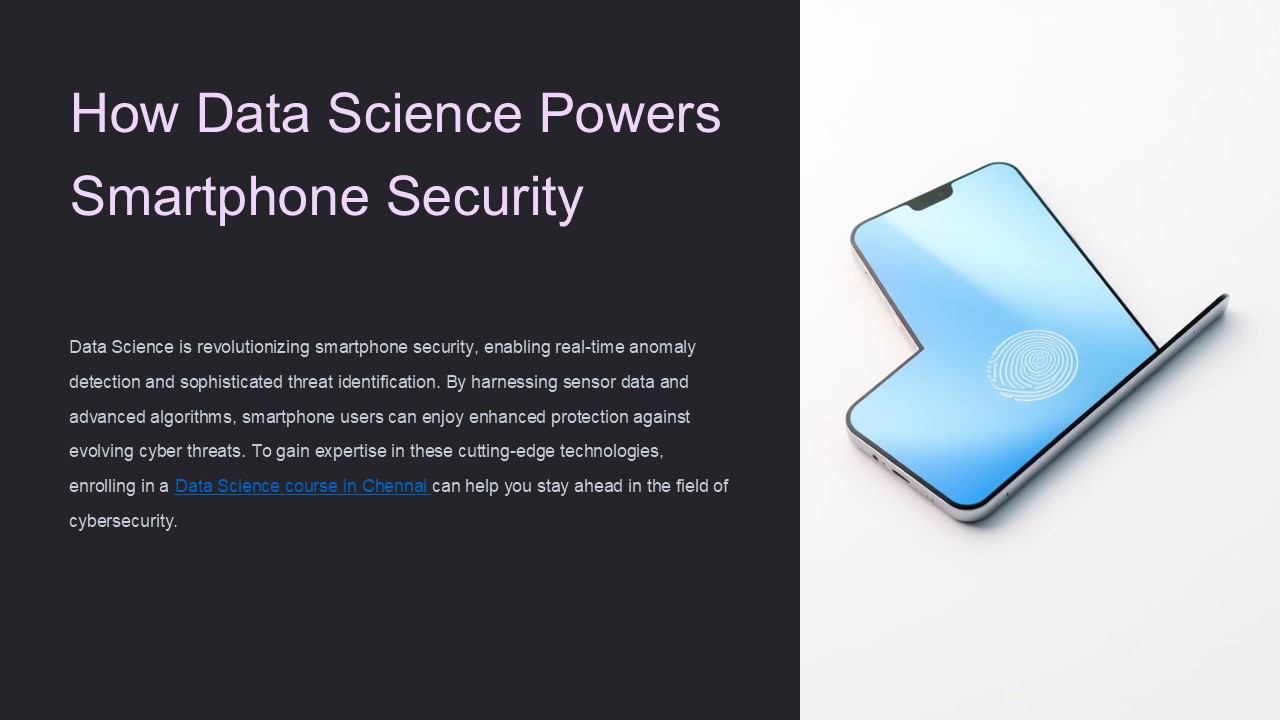
How Data Science Powers Smartphone Security
Data Science is revolutionizing smartphone
security, enabling real-time anomaly detection
and sophisticated threat identification. By
harnessing sensor data and advanced algorithms,
smartphone users can enjoy enhanced protection
against evolving cyber threats. To gain expertise
in these cutting-edge technologies, enrolling in
a Data Science course in Chennai can help you
stay ahead in the field of cybersecurity.
2
Understanding the Landscape Smartphone Security
Challenges
Evolving Threats
Device Complexity
User Behavior
1
2
3
Cybercriminals continuously develop new
techniques to exploit smartphone vulnerabilities
and access sensitive user data.
Smartphones pack a wealth of sensors and
functionalities, making comprehensive security
monitoring a complex challenge.
Understanding individual user patterns is crucial
for distinguishing legitimate activities from
potential security breaches.
3
The Role of Data Science Anomaly Detection and
Threat Identification
Anomaly Detection
1
Leveraging machine learning, data science models
can identify deviations from normal user
behavior, flagging potential security threats.
Threat Identification
2
Advanced analytics and deep learning techniques
enable the recognition of known and emerging
cyber attack patterns.
Real-Time Response
3
Rapid threat detection and mitigation are
crucial, allowing for immediate security actions
to protect user data.
4
Data Collection and Preprocessing Capturing
Relevant Smartphone Signals
Sensor Data
Network Traffic
Preprocessing
Smartphone sensors such as accelerometers,
gyroscopes, and touch screens generate a wealth
of behavioral data.
Analyzing network communication patterns can
reveal potential suspicious activities or
unauthorized access attempts.
Cleansing, normalizing, and enriching the
collected data prepares it for effective machine
learning models.
5
Machine Learning Models for Anomaly Detection
Supervised Learning
Unsupervised Learning
Trained on labeled data, models can recognize
known attack patterns and classify user behavior.
Clustering and outlier detection techniques
identify unusual activities that may indicate
security breaches.
Deep Learning
Ensemble Methods
Advanced neural networks excel at extracting
complex features and recognizing sophisticated
threats.
Combining multiple models can enhance the
accuracy and robustness of anomaly detection
systems.
6
Threat Recognition and Risk Assessment
Authentication Anomalies
Network Threats
Detecting abnormal login patterns or unauthorized
access attempts.
Identifying malicious network traffic, such as
data exfiltration or command-and-control
communication.
Malware Detection
Vulnerability Assessment
Recognizing the presence of malicious software
that could compromise device security and user
privacy.
Evaluating the risk of known software
vulnerabilities that could be exploited by
attackers.
7
Real-Time Monitoring and Adaptive Security
Continuous Monitoring
Persistent analysis of smartphone data streams to
detect anomalies and security incidents.
Adaptive Response
Automated security measures that can swiftly
adapt to evolving threats and user behaviors.
User Interaction
Seamless integration with users, providing alerts
and recommendations to enhance security awareness.
8
Conclusion The Future of Data-Driven Smartphone
Security
As data science and machine learning continue to
advance, the future of smartphone security holds
immense promise. By harnessing the power of
real-time analytics and adaptive security
systems, smartphone users can enjoy enhanced
protection against evolving cyber threats.
Recommended

