

John Deere A2 M-GATOR™ Utility Vehicle Operator’s Manual Instant Download (PIN030001-) (Publication No.OMM165325) PowerPoint PPT Presentation
Title: John Deere A2 M-GATOR™ Utility Vehicle Operator’s Manual Instant Download (PIN030001-) (Publication No.OMM165325)
1
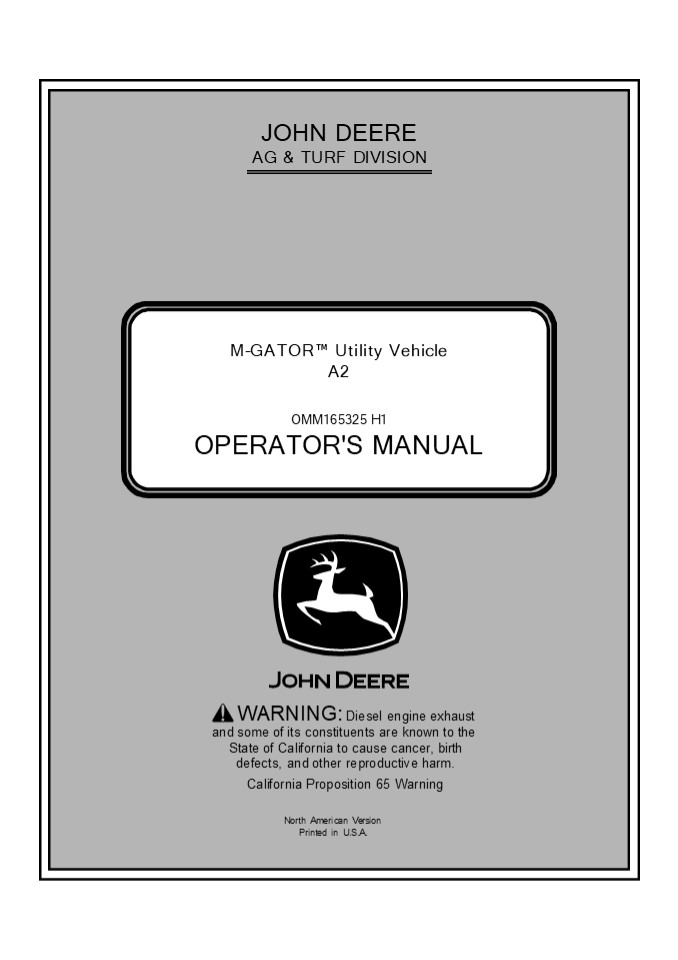
JOHN DEERE AG TURF DIVISION
M-GATOR Utility Vehicle A2 OMM165325
H1 OPERATOR'S MANUAL
WARNING Diesel engine exhaust and some of its
constituents are known to the State of California
to cause cancer, birth defects, and other
reproductive harm. California Proposition 65
Warning
North American Version Printed in U.S.A.
2
Introduction
Thank You for Purchasing a John Deere Product We
appreciate having you as a customer and wish you
many years of safe and satisfied use of your
machine.
CAUTION Avoid injury! This symbol and text
highlight potential hazards or death to the
operator or bystanders that may occur if the
hazards or procedures are ignored.
IMPORTANT Avoid damage! This text is used to
tell the operator of actions or conditions that
might result in damage to the machine.
Using Your Operator's Manual This manual is an
important part of your machine and should remain
with the machine when you sell it. Reading your
operators manual will help you and others avoid
personal injury or damage to the
machine. Information given in this manual will
provide the operator with the safest and most
effective use of the machine. Knowing how to
operate this machine safely and correctly will
allow you to train others who may operate this
machine. If you have an attachment, use the
safety and operating information in the
attachment operators manual along with the
machine operators manual to operate the
attachment safely and correctly. This manual and
safety signs on your machine may also be
available in other languages (see your authorized
dealer to order). Sections in your operators
manual are placed in a specific order to help you
understand all the safety messages and learn the
controls so you can operate this machine safely.
You can also use this manual to answer any
specific operating or servicing questions. A
convenient index located at the end of this book
will help you to find needed information
quickly. The machine shown in this manual may
differ slightly from your machine, but will be
similar enough to help you understand our
instructions. RIGHT-HAND and LEFT-HAND sides are
determined by facing in the direction the machine
will travel when going forward. When you see a
broken line (------), the item referred to is
hidden from view. Before delivering this machine,
your dealer performed a predelivery inspection to
ensure best performance.
Attachments for Your Machine Theres a John Deere
attachment or kit to make your new machine
perform more tasks or be more versatile, whether
your machine is a lawn tractor or compact utility
tractor or a utility vehicle. You can check out
the entire line of attachments for your machine
at JohnDeere.com or ask your John Deere dealer.
From aerators to electric lift kits to tillers,
theres a John Deere attachment or kit to fill
every need.
Special Messages Your manual contains special
messages to bring attention to potential safety
concerns, machine damage as well as helpful
operating and servicing information. Please read
all the information carefully to avoid injury and
machine damage.
Introduction
3
Product Identification
Record Identification Numbers M-GATOR A2 PIN
(030001- ) If you need to contact an Authorized
Service Center for information on servicing,
always provide the product model and
identification numbers. You will need to locate
the identification numbers for the product.
Record the information in the spaces provided
below.
A
MX46320
B
MX44981
DATE OF PURCHASE DEALER NAME DEALER
PHONE PRODUCT IDENTIFICATION NUMBER (A) ENGINE
SERIAL NUMBER (B)
Product Identification
4
https//www.ebooklibonline.com Hello dear
friend! Thank you very much for reading. Enter
the link into your browser. The full manual is
available for immediate download. https//www.ebo
oklibonline.com
5
Table of Contents
Safety Labels..................................
..................................................
..................................................
....................................1 Safety
..................................................
..................................................
..................................................
............................... 6 Machine
Cleanout..........................................
..................................................
..................................................
................... 13 Operating Controls
..................................................
..................................................
..................................................
......... 15 Operating ..........................
..................................................
..................................................
...............................................
16 Replacement Parts ............................
..................................................
..................................................
............................... 31 Service
Intervals.........................................
..................................................
..................................................
...................... 32 Service
Lubrication.......................................
..................................................
..................................................
.................... 33 Service Engine
..................................................
..................................................
..................................................
............... 35 Service Transmission..........
..................................................
..................................................
..............................................
48 Service Steering Brakes...................
..................................................
..................................................
.............................53 Service
Electrical........................................
..................................................
..................................................
......................55 Service
Miscellaneous.....................................
..................................................
..................................................
................. 59 Troubleshooting
..................................................
..................................................
..................................................
.............. 64 Storage ........................
..................................................
..................................................
..................................................
... 68 Specifications ...........................
..................................................
..................................................
........................................
70 Warranty .....................................
..................................................
..................................................
......................................
73 Index..........................................
..................................................
..................................................
.......................................76
Original Instruction All information,
illustrations and specifications in this manual
are based on the latest information at the time
of publication. The right is reserved to make
changes at any time without notice. COPYRIGHT
2011 Deere Co. John Deere Ag Turf Division
All rights reserved Previous Editions COPYRIGHT
OMM165325 H1 - English
Table of Contents
6
Safety Labels
Safety Label Location
E
D
F
C
B
A
G
H
J
L K
I
MX46314 Picture Note Use label number listed in
table below to locate complete text of safety
label message following this illustration. A -
Occupant Protective Structure (OPS) Label -
M156705 B - CAUTION - M160916 C - WARNING -
M165174 D - CAUTION - M161015 E - WARNING -
M165639
F - CAUTION - M159501 G - WARNING - M158180 H -
CAUTION - M165798 I - WARNING - M161567 J -
DANGER/CAUTION - M128669 K - WARNING - M159662 L
- WARNING - M117554
7
Safety Labels
Understanding The Machine Safety Labels The
machine safety labels shown in this section are
placed in important areas on your
CAUTION M160916
machine to draw attention to potential safety
hazards. On your machine safety labels, the words
DANGER, WARNING, and CAUTION are used with this
safety-alert symbol. DANGER identifies the most
serious hazards. The operators manual also
explains any potential safety hazards whenever
necessary in special safety messages that are
identified with the word, CAUTION, and the
safety- alert symbol. There can be additional
safety information contained on parts and
components sourced from suppliers that is not
reproduced in this operators manual.
M160916
- HELP PREVENT INJURY WHEN DUMPING LOADS
- Lock park brake before dumping
- Operate dump on level ground only
- Keep hands away from cargo box
Occupant Protective Structure Safety and
Certification Label
Warning M165174
M165174 Picture Note This label is required and
installed on machines sold in California. This
label may also be installed on machines sold in
other locations. Operation of This Equipment May
Create Sparks that Can Start Fires Around Dry
Vegetation. A Spark Arrestor May be Required. The
Operator Should Contact Local Fire Agencies For
Laws or Regulations Relating to Fire Prevention
Requirements.
M156705
- OCCUPANT PROTECTIVE STRUCTURE
- To maintain occupant protection and OPS
certification - Replace damaged OPS and worn seat belts. Do not
repair or revise. - Any alteration of OPS must be approved by
manufacturer.
CERTIFICATION Performance certified to SAE J2194
John Deere Gator HPX John Deere Gator XUV Deere
Company Moline, Illinois, U.S.A.
8
Safety Labels
CAUTION M161015
CAUTION M159501
- M159501
- To avoid injury, never carry riders.
- Use for cargo only, do not obstruct drivers
view. - Secure all loads.
- Max Capacity 100 lb (45 kg).
- BEFORE LEAVING VEHICLE
- Stop engine
- Set park brake
- Remove key
WARNING M158180
WARNING M165639
M165639
- AVOID SERIOUS INJURY OR DEATH
- Driver must be at least 16 years old with a valid
driver license. - Never have more than the driver and one passenger
in the vehicle. - Both the driver and passenger must use seatbelts
at all times. - Both the driver and passenger must use helmets
when driving aggressively, on rough or uneven
terrain, or at higher speeds. - Passenger must be able to grasp handholds with
seatbelt on and both feet on floor.
M158180B
- ROLLOVER OR FALLING OFF CAN CAUSE INJURY OR DEATH
- Watch video and read operators manual before
use. - Use seat belts.
- Avoid excessive speed and sharp turns.
- Be careful and slow down when loaded, on
difficult terrain, operating at night or in
reverse. - Use brakes going down a slope. Vehicle can gain
speed (freewheel) downhill. - No more than one driver and one passenger.
- Keep arms and legs in during use.
- Never operate vehicle under the influence of
alcohol or drugs. - For off-road use only. Not intended for use on
public roads or highways.
9
Safety Labels
CAUTION M165798
RIDERS CAN FALL OFF AND BE KILLED
M161567
- No riders in cargo box.
- IMPROPER LOADING CAN CAUSE ROLLOVER
M165798
- Avoid equipment fires.
- Accumulation of grass, leaves and other debris on
or near hot or moving parts can cause a fire. - Inspect machine before, during, and after use.
- Shut off engine and allow machine to cool before
cleaning.
M161567
- Secure and spread loads evenly.
- Do not exceed 1000 lb (454 kg) in cargo box or
3100 lb (1406 kg) gross vehicle weight. - Maintain proper tire pressure for load and
conditions. - Follow recommendations in operators manual.
- Inspect and clean the entire machine and pay
special attention to these locations - Muffler and exhaust pipes
- Exhaust manifold and heat shields
- Skid plate (if equipped)
- Radiator (if equipped)
DANGER M128699
WARNING M161567 AVOID INJURY FROM EXPLOSION
M128699
- Picture Note Located on battery
- Shield eyes, explosive gases can cause blindness
or injury. - No sparks, flames, smoking.
- Sulfuric acid can cause blindness or severe
burns. - Flush eyes immediately with water. Get medical
help fast. - Keep out of reach of children.
- Do not tip.
- Keep vent caps tight and level.
- M161567
- Do not place fuel container inside cargo box when
filling.
10
Safety Labels
WARNING M159662
The presence of an emissions label signifies that
the engine has been certified with the United
States Environmental Protection Agency (EPA)
and/or California Air Resources Board (CARB). The
emissions warranty applies only to those engines
marketed by John Deere that have been certified
by the EPA and/or CARB and used in the United
States and Canada in off-road mobile equipment.
Emission Compliance Period If your engine has the
emission compliance category listed on the
emission control system certification or air
index label, this indicates the number of
operating hours for which the engine has been
certified to meet EPA and/or CARB emission
requirements. The following table provides the
engine compliance period in hours associated with
the category found on the certification label.
Agency Category Hours
EPA C 250
EPA B 500
EPA A 1000
CARB Moderate 125
CARB Intermediate 250
CARB Extended 500
- M159662
- ROLLOVER OR FALLING OFF CAN CAUSE INJURY OR DEATH
- Keep arms and legs in during use.
- Avoid excessive speeds and sharp turns.
- USE SEAT BELT
WARNING M117554
M117554
Hot surface Emission Control System
Certification Label
11
Safety
- Supervisor Safety Responsibilities
- Make sure all operators of this machine are
thoroughly trained and are familiar with the
operators manual and understand the machine
warning labels. - Be sure to establish any special safety
procedures for existing work conditions and train
operators in those procedures. - Supervisors, operators and mechanics should be
familiar with and practice the safety standards
that apply to this machine.
- or crossing roadways. Use care when approaching
blind corners, shrubs, trees, or other objects
that may obscure vision. - The operator should always make sure that the
passenger is aware of correct safety procedures
while riding in the utility vehicle. - Use the correct flags, lights, signs and
reflectors on the vehicle to warn other drivers
when operating near roadways. Make sure these
features are clean and visible for 500 feet (152
m). - The passenger should always use the hand holds.
- To avoid serious injury, always ensure that
occupants have safely secured their seat belts
prior to starting this vehicle. - Horseplay or recreational riding can lead to
accidents, severe bodily injury or death. Do not
attempt stunts, jumps, or quick acceleration to
raise front wheels off the ground. These actions
can result in accidents or vehicle overturns. - Sit on the center of the seat and keep both feet
within the foot platform perimeter. Clean foot
platform if dirty, and remove any debris from
around foot controls. - Check for debris in engine compartment,
especially around brake linkage on each side of
the transaxle. - Always use both hands for steering.
- Know location of controls and how and what they
operate. - Never operate utility vehicle while standing.
- Never operate utility vehicle with the cargo box
raised. - Check brake action before beginning vehicle
operation. Adjust or service the brakes as
necessary. - To provide adequate braking ability and traction,
do not tow any attachment or loaded trailer
unless the cargo box is fully loaded. - Before shifting into reverse, always check for
obstacles or people behind the machine. - Always back slowly.
- Inspect vehicle before operating. Be sure
hardware is tight. Repair or replace damaged,
badly worn, or missing parts. Be sure guards and
shields are in good condition and fastened in
place. Make any necessary adjustments before
operating. - Do not leave vehicle unattended when it is
running. - Operate during daylight or with good artificial
light and if you drive at night, use the lights.
- Operator Training Required
- Read the operators manual and other training
material. If the operator or mechanic cannot read
English, it is the owners responsibility to
explain this material to them. This publication
is available in other languages. - Become familiar with the safe operation of the
equipment, operator controls, and safety signs. - All operators and mechanics should be trained.
The owner of the machine is responsible for
training the users. - Never let children or untrained people operate or
service the equipment. Local regulations may
restrict the age of the operator. - The owner/user can prevent and is responsible for
accidents or injuries occurring to themselves,
other people, or property. - Operate the machine in an open, unobstructed area
under the direction of an experienced operator.
- Operating Safely
- Read, understand and follow all instructions in
the operators manual, on the machine and on the
safety video before starting. - Do not misuse the utility vehicle. It is a
utility vehicle, not a recreation vehicle. - The utility vehicles tires are designed for
off-road use only. Paved surfaces may seriously
affect handling and control of the vehicle. If
you must operate on a paved surface, travel
slowly and do not make sudden turns or stops. - Do not operate this vehicle on a frozen body of
water. The vehicle could break through the ice,
causing injury or even death. - Go slowly and be extra careful when riding on
snow- covered or ice-covered terrain. - Slow down and be careful of traffic when
operating near
12
Safety
- Protect Children and Prevent Accidents
- This utility vehicle should not be operated by
anyone under the age of 16 years. - Young drivers may not be physically able to
control the machine or may not be mature enough
to make safe driving decisions. - Do not allow children to ride as a
- Do not wear radio or music headphones. Safe
service and operation require your full attention.
Using a Spark Arrestor The engine in this machine
is not equipped with a spark arrestor muffler.
The California Public Resources Code, section
4442.5 provides as follows No person shall sell,
offer for sale, lease, or rent to any person any
internal combustion engine subject to Section
4442 or 4443, and not subject to Section 13005 of
the Health and Safety Code, unless the person
provides a written notice to the purchaser or
bailee, at the time of sale or at the time of
entering into the lease or rental contract,
stating that it is a violation of Section 4442 or
4443 to use or operate the engine on any
forest-covered, brush- covered, or grass-covered
land unless the engine is equipped with a spark
arrestor, as defined in Section 4442, maintained
in effective working order or the engine is
constructed, equipped, and maintained for the
prevention of fire pursuant to Section 4443. Cal.
Pub. Res. Code 4442.5. Other states or
jurisdictions may have similar laws. A spark
arrestor for your machine may be available from
your authorized dealer. An installed spark
arrestor must be maintained in good working order
by the operator.
- passenger in this vehicle. Children may not be
able to sit safely in the passenger seat and use
handholds properly. - Passengers should always use the handholds while
the vehicle is moving. - The seat belt installed on utility vehicles with
an Occupant Protective Structure (OPS) is not
designed to restrain a child. - Never carry passengers, especially children, in
the cargo box area. Do not tow children in a cart
or trailer. - Never assume that children will remain where you
last saw them. Stay alert to the presence of
children. - Before backing or turning, look behind and around
the utility vehicle for children. - Be alert at all times, drive forward and in
reverse carefully. People, especially children,
can move quickly into an area of operation. - Use extra care when coming to blind corners,
shrubs, trees, or other objects that may block
vision. - Misuse and recreational riding can lead to
accidents, severe bodily injury or death.
- Parking Safely
- Stop vehicle on a level surface, not on a slope.
- Lock park brake.
- Stop engine.
- Turn ignition switch to the OFF position.
- Install steering wheel lock cable if leaving
vehicle unattended. - Before you leave the operators seat, wait for
engine and all moving parts to stop. - Disconnect the negative battery cables before
servicing the machine.
- Avoid Excessive Speeds
- Always travel at a speed that is safe and proper
for the terrain, visibility and operating
conditions, and your experience operating the
machine.
- Use caution when operating the machine in
reverse. Use a slow speed and do not make sharp
turns. Always look behind before backing. - Never travel at excessive speeds on slopes,
either going up or down. Use a slow speed and do
not make sharp turns. Become experienced driving
the machine on small slopes before driving on
larger hills.
13
Safety
Avoid Tipping Accidents resulting in serious
injury or death can occur from tipping the
utility vehicle. Observe the following practices
to help prevent accidents
- Layers of heavy clothing can interfere with
proper positioning of the seat belt and can
reduce the effectiveness of the seat belt.
- Keep Occupant Protective System (OPS) Installed
Properly - Never operate the machine without the OPS
installed. - Make certain all parts of the OPS are installed
correctly if the OPS structure is loosened or
removed for any reason. All OPS hardware should
be tightened to the proper torque per
manufacturers recommendations. - Any alteration of the OPS must be approved by the
manufacturer. The protection provided by the OPS
will be impaired if the OPS is subjected to
structural damage, is involved in an overturn
incident, or is in any way altered by welding,
bending, drilling, or cutting. - Never attempt to repair a damaged or altered OPS.
It must be replaced to maintain the
manufacturers certification of the structure.
- Do not misuse the utility vehicle. The utility
vehicle is not designed for recreational riding. - Drive very slowly when turning. Sharp turns could
cause the utility vehicle to tip over. - Reduce speed and exercise extreme caution on
slopes or on rough ground. - Do not overload vehicle and avoid shifting loads.
Reduce load when operating over rough or hilly
terrain. - Do not stop or start suddenly when going uphill
or downhill. Be especially cautious when changing
direction on slopes. - Stay alert for holes, rocks, and other hidden
hazards in the terrain. - Keep away from drop-offs, ditches, embankments,
as well as ponds and other bodies of water. The
machine could suddenly roll over if a wheel goes
over the edge of a cliff or ditch or if the edge
caves in. - Keep front wheels straight at crest of hill or
going over bumps. - When descending a hill, remove foot from
accelerator and apply brakes to reduce speed and
maintain control. - Do not make changes or modifications to the
utility vehicle.
- Keep Riders Off Vehicle
- Seating is provided for operator and one adult
passenger. - Never allow riders in the cargo box
- or other areas where seats are not provided.
- Riders on vehicle are subject to injury such as
being struck by foreign objects or being thrown
off of the vehicle and severely injured or
killed. - Riders affect the operators ability to control
the vehicle as well as its center of gravity.
Also, riders could obstruct the operators view
resulting in the vehicle being operated in an
unsafe manner.
- Use Seat Belt Properly
- Use a seat belt when operating with the folding
Occupant Protective Structure (OPS) in the
upright position to minimize chance of injury
- from an accident, such as an overturn.
- Do not use a seat belt when operating with the
folding OPS in the folded position. Return the
folding OPS to the upright position as soon as
possible. - Never modify, disassemble or attempt to repair
the seat belt. - Replace entire seat belt if mounting hardware,
buckle, belt, or retractor show signs of damage. - Inspect seat belt and mounting hardware at least
once a year. Look for signs of loose hardware or
belt damage, such as cuts, fraying, extreme or
unusual wear, discoloration, or abrasion. Replace
only with John Deere- approved replacement parts.
- Before Driving
- Clean foot platform if dirty, and remove any
debris from around foot controls. Sit on the
center of seat and keep both feet inside foot
platform perimeter. - Inspect utility vehicle for signs of wear or
damage. - All safety equipment must be in good condition
and fastened in place
- Lights.
- Shields.
- Safety start devices.
4. Before moving, check around utility vehicle,
be sure no
14
Safety
- one is near it.
- Inspect mechanical condition of your vehicle
before each use to minimize chance of injury or
being stranded. Remember, you can ride farther in
an hour than you can walk in a day. - Be sure to check condition of tires and wheels,
wheel hardware torque, and maintain proper tire
pressure. - Securely anchor all loads.
- Follow the manufacturers recommendations for
weight limits for towed equipment and towing on
slopes. - If you cannot back up a slope with a towed load,
the slope is too steep to operate on with the
towed load. Reduce the towed load or do not
operate. - Do not turn sharply. Use additional caution when
turning or operating under adverse surface
conditions. Use care when reversing. - Do not shift to neutral and coast downhill.
Transport Loads Safely
- Driving On Rough Terrain
- Use existing trails. Avoid terrain such as
dangerous slopes and impassable swamps. Watch
carefully for bumps, holes, ruts, loose terrain,
- Using Front Carrier and Litter Carriers
- Only transport injured patients on litters or
stretchers on front carrier and cargo box. - Using the front carrier can limit or restrict
visibility. Reduce speed. - Do not overload the vehicle. Observe maximum
vehicle and attachment load capacities.
- or other obstacles.
- Look ahead at terrain. Know what is coming and be
prepared to react. Be alert for hazards. - Keep front wheels straight at crest of hill or
going over bumps. - Reduce speed according to trail, terrain, and
visibility conditions. - The passenger should always use the hand holds.
- Using Cargo Box
- Be sure load is evenly distributed in cargo box.
- Do not load above load guard.
- Securely anchor all loads in cargo box.
- Reduce cargo box load when operating on rough or
hilly terrain.
- Climbing Or Descending A Hill
- Always use the brakes when going down slopes, the
utility vehicle can speed up (freewheel) going
down a
- Towing Loads Safely With Utility Vehicle
- To provide adequate braking ability and traction,
weight of towed load (trailer plus cargo) must
never exceed the vehicle payload (operator plus
passenger plus cargo box load). - Do not tow a load that exceeds the maximum
allowable towing load for this vehicle, as
specified in this operators manual. - Stopping distance increases with speed and weight
of towed load. Travel slowly and allow extra time
and distance to stop. - Tow load at a speed slow enough to maintain
control. - Excessive towed load can cause loss of traction
and loss of control on slopes. Reduce towed
weight when operating on slopes. - Never allow children or others in or on towed
equipment. - Use only approved hitches. Tow only with a
machine that has a hitch designed for towing. Do
not attach towed equipment except at the approved
hitch point.
- slope. Engine or clutch braking effect is
minimal. - Balance loads evenly and secure them. Braking
could shift the load and affect vehicle
stability. - Sit on center of seat and keep both feet within
foot platform. - Never drive past the limit of visibility. Slow
down near crest of hill until getting a clear
view of the other side. Never go over the top of
any hill at a high speed. An obstacle, sharp
drop, another vehicle or person, could be on the
other side of the hill. - Keep front wheels straight at crest of hill or
going over bumps. - Do not stop or start suddenly when going uphill
or downhill. Be especially cautious when changing
direction on slopes. - If vehicle stops or loses power going up a hill,
lock park brake to hold vehicle on slope.
Maintain direction of travel
15
Safety
- Wear Appropriate Clothing
- Wear close fitting clothing and safety equipment
appropriate for the job.
- and release brake slowly. Back straight down hill
slowly while maintaining control. Do not turn
vehicle sideways. Vehicle is more stable in a
straight forward or rearward position. - When descending a hill, remove foot from
accelerator and apply brakes to reduce speed and
maintain control.
- Certain operating conditions may dictate that the
operator and any passenger wear appropriate
safety equipment while operating the vehicle. Be
prepared for any existing and potential
conditions before operating machine. - Local safety or insurance regulations may require
additional safety equipment such as eye
protection or a hard hat. - Always wear substantial footwear and long
trousers. Do not operate the equipment when
barefoot or wearing open sandals.
- Driving Across Slopes
- Reduce speed and use caution on slopes and in
sharp turns. - Stay alert for holes, rocks and other
- hidden hazards in the terrain.
- When riding on soft terrain, turn front wheels
slightly uphill to keep utility vehicle on a
straight line across the hill. - If utility vehicle begins to tip, turn front
wheel downhill to gain control before proceeding.
- Practice Safe Maintenance
- Only qualified, trained adults should service
this machine. - Understand service procedure
- Riding Through Water
- Avoid water whenever possible. If drive belt
becomes wet, slippage will occur and vehicle will
lose power. - Never cross any body of water where depth may be
unknown to the operator. As an operational
guideline, deep water is considered anything in
excess of 152 mm (6 in.) in depth. Tires may
float, making it difficult to maintain control. - Choose a course within the waterway where both
banks have a gradual incline. Cross at a point
known to be safe. - Proceed at a slow steady speed to avoid submerged
obstacles and slippery rocks. - Avoid water crossings where the operation of a
utility vehicle may cause damage to waterway beds
or erode waterway shoreline. - Never operate this vehicle in fast-moving water.
- before doing work. Keep area clean and dry.
- Never lubricate, service, or adjust machine while
it is moving. Keep safety devices in place and in
working condition. - Keep hands, feet, clothing, jewelry, and long
hair away from any moving parts, to prevent them
from getting caught. - Disconnect battery(ies) or remove spark plug wire
(for gasoline engines) before making any repairs. - Keep all nuts and bolts tightened.
- Securely support any machine elements that must
be raised for service work. Lock service latches
before working on machine with raised
attachments. - Never run engine unless park brake is locked.
- Keep all parts in good condition and properly
installed. Fix damage immediately. Replace worn
or broken parts. Replace all worn or damaged
safety and instruction decals. - To prevent fires, remove any buildup of grease,
oil, or debris from the machine, especially the
engine. - Do not modify machine or safety devices.
Unauthorized modifications may impair its
function and safety. - Do not wear radio or music headphones while
servicing the machine. Safe service requires your
full attention. - Disconnect battery ground cable(s) (-) on the
machine or remove attachment from machine before
welding on the machine.
- Checking Wheel Hardware
- A serious accident could occur causing serious
injury if wheel hardware is not tight. - Check wheel hardware tightness often during the
first 100 hours of operation. - Wheel hardware must be tightened to specified
torque using the proper procedure anytime it is
loosened.
16
Suggest If the above button click is invalid.
Please download this document first, and then
click the above link to download the complete
manual. Thank you so much for reading
17
Safety
- Prevent Fires
- Machine fires and structure fires can occur if a
machine is stored before allowing it to cool, if
debris is not removed from critical areas of the
machine, or if machine is stored near combustible
materials. - Remove grass and debris from engine compartment
and muffler area, before and after operating
machine. - Always shut off fuel when storing or transporting
machine, if the machine has a fuel shutoff. - Do not store machine near an open flame or source
of ignition, such as a water heater or furnace. - Check fuel lines, tank, cap, and fittings
frequently for cracks or leaks. Replace if
necessary.
Handling Fuel Safely
- To avoid personal injury or property damage, use
extreme care in handling fuel. Fuel is extremely
flammable and fuel vapors are explosive - Extinguish all cigarettes, cigars, pipes, and
other sources of ignition. - Use only an approved fuel container. Use only
non-metal, portable fuel containers approved by
- the Underwriters Laboratory (U.L.) or the
American Society for Testing Materials (ASTM).
If using a funnel, make sure it is plastic and
has no screen or filter. - Never remove the fuel tank cap or add fuel with
the engine running. Allow engine to cool before
refueling. - Never add fuel to or drain fuel from the machine
indoors. Move machine outdoors and provide
adequate ventilation. - Clean up spilled fuel immediately. If fuel is
spilled on clothing, change clothing immediately.
If fuel is spilled near machine, do not attempt
to start the engine but move the machine away
from the area of spillage. Avoid creating any
source of ignition until fuel vapors have
dissipated. - Never store the machine or fuel container where
there is an open flame, spark, or pilot light
such as on a water heater or other appliance. - Prevent fire and explosion caused by static
electric discharge. Static electric discharge can
ignite fuel vapors in an ungrounded fuel
container. - Never fill containers inside a vehicle or on a
truck or trailer bed with a plastic liner. Always
place containers on the ground away from your
vehicle before fueling. - Remove fuel-powered equipment from the truck or
trailer and refuel it on the ground. If this is
not possible, then refuel such equipment with a
portable container, rather than from a fuel
dispenser nozzle. - Keep the nozzle in contact with the rim of the
fuel tank or container opening at all times until
the fueling is complete. Do not use a nozzle
lock-open device. - Never overfill fuel tank. Replace fuel tank cap
and tighten securely. - Replace all fuel container caps securely after
use. - For gasoline engines, do not use gas with
methanol. Methanol is harmful to your health and
to the environment.
Do Not Modify Machine Do not make any
unauthorized modifications to the machine in any
way. Modifications can result in making the
machine unstable, increasing the possibility of
rollover causing severe bodily injury or death.
Tire Safety Explosive separation of a tire and
rim parts can cause serious injury or death
- Do not attempt to mount a tire without the proper
equipment and experience to perform the job. - Always maintain the correct tire pressure. Do not
inflate the tires above the recommended pressure.
Never weld or heat a wheel and tire assembly. The
heat can cause an increase in air pressure
resulting in a tire explosion. Welding can
structurally weaken or deform the wheel. - When inflating tires, use a clip-on chuck and
extension hose long enough to allow you to stand
to one side and NOT in front of or over the tire
assembly. - Check tires for low pressure, cuts, bubbles,
damaged rims or missing lug bolts and nuts. - Make sure all tires are inflated to the
recommended pressure, especially when operating
on slopes. Low pressure can cause machine to
become unstable on slopes.
Handling Waste Product and Chemicals Waste
products, such as, used oil, fuel, coolant, brake
fluid, Safety - 11
18
https//www.ebooklibonline.com Hello dear
friend! Thank you very much for reading. Enter
the link into your browser. The full manual is
available for immediate download. https//www.ebo
oklibonline.com
Recommended

