

Aquafeed Market Dynamics: How Technology is Revolutionizing Aquaculture PowerPoint PPT Presentation
Title: Aquafeed Market Dynamics: How Technology is Revolutionizing Aquaculture
1
Aquafeed Market Dynamics How Technology is
Revolutionizing Aquaculture
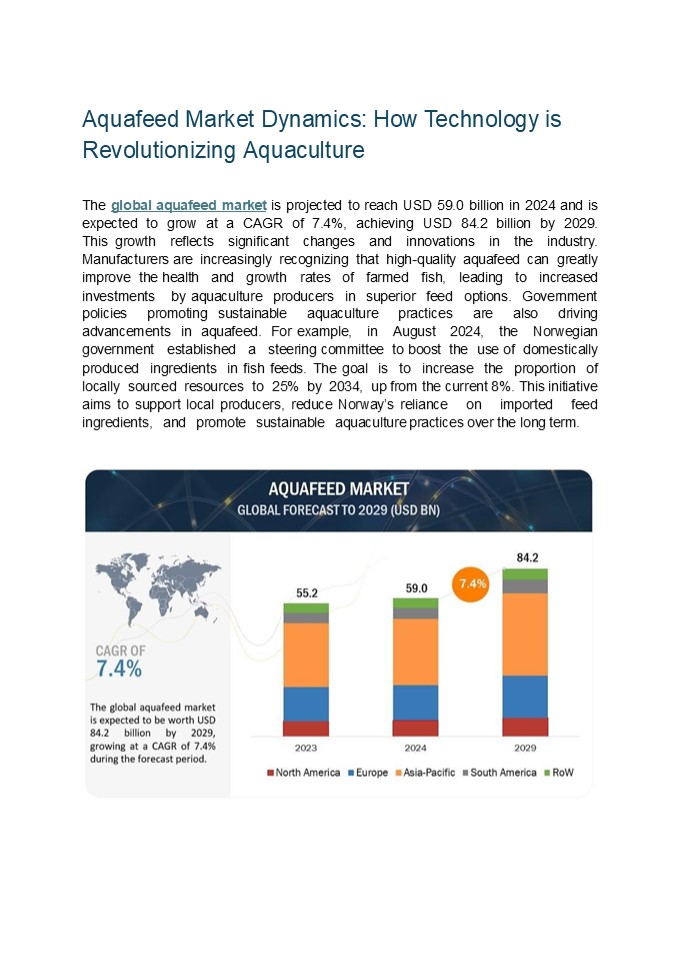
The global aquafeed market is projected to reach
USD 59.0 billion in 2024 and is expected to
grow at a CAGR of 7.4, achieving USD
84.2 billion by 2029. This growth reflects
significant changes and innovations in the
industry. Manufacturers are increasingly
recognizing that high-quality aquafeed can
greatly improve the health and growth
rates of farmed fish, leading to
increased investments by aquaculture
producers in superior feed options.
Government policies promoting sustainable
aquaculture practices are also driving
advancements in aquafeed. For example, in
August 2024, the Norwegian government
established a steering committee to boost
the use of domestically produced ingredients
in fish feeds. The goal is to increase the
proportion of locally sourced resources to
25 by 2034, up from the current 8. This
initiative aims to support local producers,
reduce Norways reliance on imported feed
ingredients, and promote sustainable
aquaculture practices over the long term.
2
- Moreover, certifications like Global GAP and
the Aquaculture Stewardship Council highlight
the importance of delivering sustainable and
high-quality feed. Companies pursuing these
certifications not only invest in feed
products that enhance fish growth and health
but also commit to meeting stringent
environmental and social standards. - Download PDF Brochure
- https//www.marketsandmarkets.com/pdfdownloadNew.a
sp?id1151 - What is Aquafeed?
- Aquafeed refers to feed specifically
formulated for aquatic animals, including
fish, crustaceans, and mollusks. It is a
critical component of aquaculture, the
farming of aquatic organisms. Aquafeed is
designed to meet the nutritional
requirements of these animals, promoting growth,
health, and optimal performance. - Aquafeed can include a variety of ingredients,
such as - Fishmeal and Fish Oil Commonly used for their
high protein and omega-3 fatty acid content. - Plant-Based Ingredients Such as soybean
meal, corn, and wheat, which provide
essential nutrients and can reduce dependence on
fishmeal. - Additives Vitamins, minerals, amino
acids, and other supplements to enhance
the nutritional profile. - Byproducts Ingredients from the processing of
other foods, like wheat bran or rice husks, which
can be used to reduce costs. - The formulation of aquafeed is tailored to the
specific needs of different species and their
growth stages, ensuring efficient feed
conversion and sustainable aquaculture
practices. - Aquafeed Market Trends
- Here are some current trends in the Aquafeed
market - Sustainability Focus There's a growing emphasis
on sustainable aquafeed ingredients. Companies
are increasingly adopting eco-friendly
practices and seeking alternative, sustainable
sources of protein, like algae and insect meal. - Technological Advancements Advances in feed
formulation and processing technology are
enhancing feed efficiency and nutritional
value. Innovations such as precision
nutrition and automated feeding systems
are gaining traction. - Shift Towards Functional Feeds Aquafeed
producers are incorporating functional
ingredients that offer health benefits beyond
basic nutrition, such as probiotics, prebiotics,
and omega-3 fatty acids.
3
- Increasing Demand for Seafood Rising global
seafood consumption is driving the demand
for high-quality aquafeed. As aquaculture
expands, the need for efficient and
cost-effective feed solutions grows. - Regulatory Developments There are stricter
regulations regarding feed safety and quality.
Compliance with these regulations is becoming
crucial for market players to ensure product
safety and build consumer trust. - Focus on Traceability and Transparency
Consumers and regulators are demanding more
transparency in the sourcing and production
of aquafeed. Companies are investing in
traceability systems to meet these demands. - Aquafeed Market Opportunities
- According to the Food and Agriculture
Organization, global fish production reached
179 million metric tons in 2022, with 89
intended for human consumption. The rising
consumption of fish has increased the demand for
high-quality feed, benefiting the specialized
aquafeed market by enhancing fish yields and
quality. As fish farming and consumption grow, so
does the need for effective and nutritious feed,
leading to improved production outcomes.
Additionally, the proportion of farmed fish
in global production has surged from 25.7
in 2000 to over 46 in 2022, underscoring
the significance of aquafeed in the
industry. Government support is also
evident for example, China, the leading
producer of aquaculture products, has
implemented policies to foster innovation and
sustainability in aquafeed. The expanding
seafood trade drives demand for aquafeed
and encourages advancements in feed
formulation to meet strict export standards
and consumer preferences. As the seafood
market continues to grow, the aquafeed sector
will focus on addressing the specific
nutritional needs of various fish species,
contributing to the availability of
high-quality and sustainable seafood worldwide. - Make an Inquiry
- https//www.marketsandmarkets.com/Enquiry_Before_B
uyingNew.asp?id1151 - The fish category within the aquafeed
species segment retains a prominent position
throughout the forecast period. - In the aquafeed species segment, the fish
category is expected to remain dominant
throughout the forecast period. This
dominance is attributed to the ongoing
innovation and development of specialized
feeds tailored for key fish species. For
example, in February 2024, Aquasoja (Brazil)
launched POND PLUS, a newly formulated feed
designed to meet the nutritional needs of
two crucial species in global aquaculture
Nile tilapia and European carp. This
extruded floating feed contains over 25
high-quality poultry ingredients and
about 15 marine ingredients, including
fishmeal from trimmings, shrimp hydrolysates,
and fish oil. Its balanced composition of
carbohydrates, vitamins, and minerals, along
with health- promoting additives such as
marine hydrolysates, algae-derived substances,
and yeast extracts, supports optimal growth,
health, and survival throughout the fish's
4
development. As such, targeted feed solutions
underscore the fish category's critical role in
the aquafeed market, addressing complex
nutritional needs and solidifying its leadership
in aquaculture. Asia Pacific dominates the
aquafeed market share. According to the FAO,
in 2022, Asia produced 119.7 million tons
of aquaculture, representing 91.4 of the
global production. China led with 40,
followed by Indonesia with 10 and India
with 7. This significant output underscores
Asia's dominance in global aquaculture. This
intensive production is directly related to the
high demand for seafood, which has resulted
from a large, growing population and rising
per-capita incomes. According to the National
Bureau of Statistics of China in 2023, the
country is the largest producer and
consumer of seafood globally it consumes
approximately 63.4 million metric tons annually.
Producers are compelled to expand and enhance
their offerings to meet the nutritional
needs of aquaculture farms. Government
policies in the region further back this
growth. The 14th Five- Year Plan of China
focuses on both sustainable aquaculture and
technological innovation, thereby improving
production efficiency. Similarly, the Indian
National
Fisheries Policy is targeted at expansion in
investments, thus stimulating growth in the
market. Top Aquafeed Companies
aquaculture and infrastructure
- ADM (US)
- Cargill, Incorporated (US)
- dsm-firmenich (Switzerland)
- Nutreco (Netherlands)
- Alltech (US)
- Ridley Corporation Limited (Australia)
- Purina Animal Nutrition LLC (US)
- Adisseo (France)
- Aller Aqua Group (Denmark)
- Avanti feeds Limited (India)
- The Waterbase Limited (India)
- JAPFA LTD (Singapore)
- Charoen Pokphand Foods PCL (Thailand)
- BioMar Group (Denmark)
- Norel Animal Nutrition (Spain)
5
- Request Sample Pages
- https//www.marketsandmarkets.com/requestsampleNew
.asp?id1151 - Aquafeed Market Segmentation
- This research report categorizes the
aquafeed market based on ingredient, form,
lifecycle, species, and region. - By Ingredients
- Soybean
- Fish Meal
- Corn
- Fish Oil
- Additives
- Amino Acids
- Vitamins Minerals
- Prebiotics Probiotics
- Enzymes
- Antibiotics
- Antioxidants
- Other Additives
- Other Ingredients
- By Form
6
- Growth Promoters
- Immunity Support
- Texture Palatability
- Other Functionalities
- By Region
- North America
- Europe
- Asia Pacific
- South America
- Rest of the World (RoW)
- Aquafeed Industry News
- In June 2024, Nutreco launched its
innovative "Garden of the Future,"
marking a significant advancement in
phytotechnology. This groundbreaking initiative
focuses on developing cutting-edge
phytotechnology solutions designed to enhance
the performance, health, and welfare of aquatic
species, as well as farm and companion
animals. The "Garden of the Future"
represents a forward-thinking approach,
leveraging advanced plant-based technologies to
improve animal nutrition and overall well-being. - In January 2024, the joint venture between
ADM and Vitafort opened a new
state-of-the-art feed mill in Hungary that
is poised to achieve full production
capacity. This reflects ADM's steadfast
commitment to ushering in a new era of
modernization in the region's production
infrastructure. - In July 2023, Charoen Pokphand Foods
PCL partnered with the Thai Sustainable
Fisheries Roundtable (TSFR) to promote the
conservation and protection of the ecosystem and
resources in the Gulf of Thailand through the
Fishery Action Plan (FAP), a crucial
component of the Fishery Improvement Project
(FIP). This determination is strengthening the
companys commitment to a responsible aquafeed
raw material supply chain. - Schedule a call with our analysts to discuss your
business needs https//www.marketsandmarkets.com/
speaktoanalystNew.asp?id1151
Recommended

