

The Heart of India in a Cup: Exploring Indian Tea Culture PowerPoint PPT Presentation
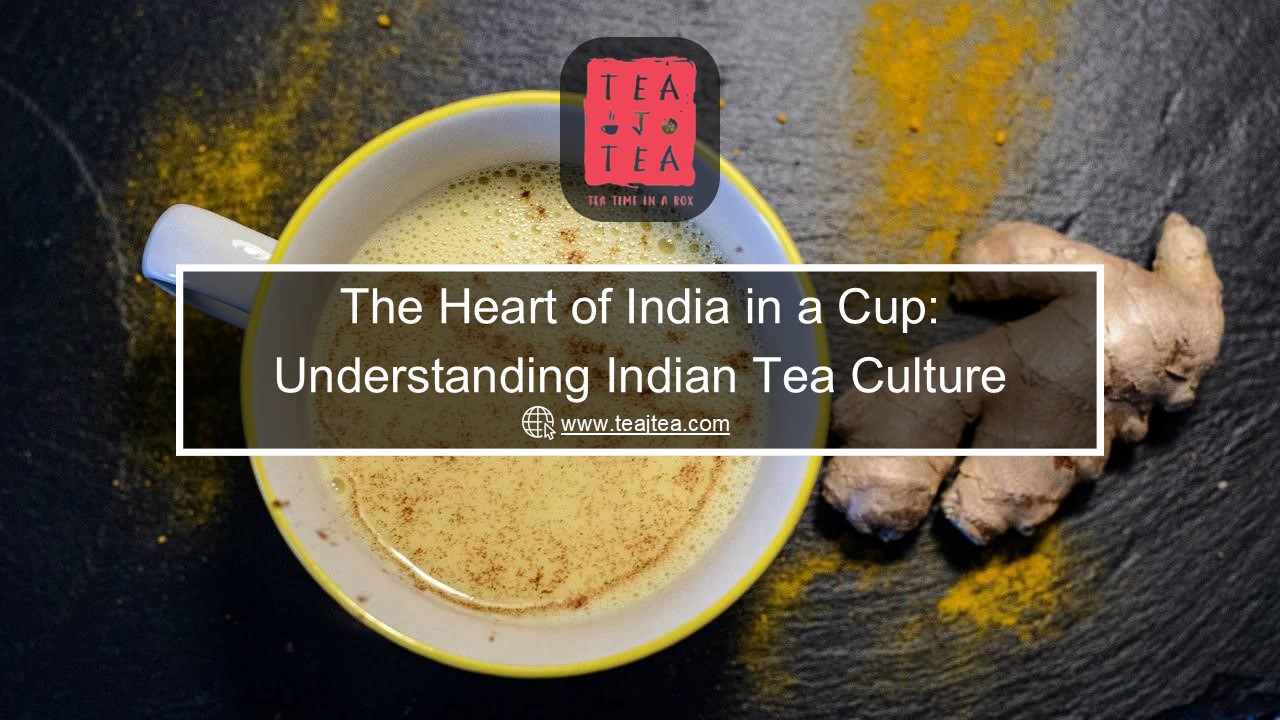
Title: The Heart of India in a Cup: Exploring Indian Tea Culture
1
The Heart of India in a Cup Understanding Indian
Tea Culture
www.teajtea.com
2
The Heart of India in a Cup Understanding Indian
Tea Culture
Hey there, how about a cup of masala chai? The
creamy sensation is uplifted with authentic
Indian spices. While masala chai might be the
first thing that comes to mind when we think of
Indian tea, there is much more to explore in
Indian tea culture. Today's exploration is all
about Indian tea and its rich culture. Stay tuned
for a truly exotic journey.
India is the world's second-largest tea producer,
known for its world-famous Assam and Darjeeling
teas. It is also the worlds largest consumer of
tea, accounting for about 30 of the global tea
output. Lets delve into the fascinating tea
culture of India in this article.
3
Origins
The consumption of tea in India dates back to 750
BC when tea was primarily used as a cooking
ingredient. Typically, Indians prepared tea
leaves with garlic and oil. However, the history
of Indian tea truly begins with Chai tea.
The origin of Chai tea in India has a unique
story. According to legend, an ancient Indian
king struggled to stay alert for long periods and
sought a solution. He tried a drink made by
boiling tea leaves with water and some spices. It
proved effective, helping him remain alert and be
an effective ruler. That's how Chai tea was born.
Sweet, milky Chai, made by adding high-quality
milk to Chai tea, has become one of the favorite
drinks among Indian people. Consequently, Indian
tea culture has a strong relationship with Chai
tea.
4
Tea Production in India
Today, India is the second-largest tea producer
in the world, following China. The commercial
production of tea in India began with the arrival
of the British East India Company. Around one
million Indians work in the tea industry.
The primary tea-growing regions in India include
Darjeeling and Assam in the northeast and Nilgiri
in the south.
5
Indian Tea Culture
Indian tea culture reveals that almost 70 of the
total tea produced in India is consumed by its
own people. The tea varieties produced in India
vary significantly due to differences in climate
and geography. As mentioned, the three main
tea-growing regions in India are Assam,
Darjeeling, and Nilgiri. Assam and Darjeeling are
situated in northeastern India, while Nilgiri is
located in the southernmost part of the country.
Each tea-producing region offers unique yet ideal
climatic conditions for tea cultivation.
The Legacy of Assam
Among the three tea-growing regions, Assam is the
largest in India and the world. It produces
between 50 to 75 of Indias total tea output.
The tea plant used to grow Assam tea is Camellia
sinensis assamica. The Assam region, with its
mountainous backdrop, traps hot, humid air in the
valley and retains river water to produce flood
plains that nourish the tea gardens.
Assams tropical weather directly contributes to
the production of thick, lush tea plants with
large, abundant leaves. The hot and humid
conditions, along with abundant rainfall, result
in a characteristically strong, full-bodied, and
malty tea. The plucking and production season for
Assam tea spans from March to November, with two
harvests per season the first flush and the
second flush. The first flush, harvested in early
spring (March), produces a more delicate tea,
while the second flush, harvested in mid-summer,
yields a tippy tea.
Assam primarily produces black tea, which offers
a distinctly nice taste with or without milk and
sugar. Assam tea holds a significant place in
Indian tea culture and is renowned worldwide as a
breakfast tea.
6
The Flavors of Darjeeling
Following the success with Assam tea, the British
sought to find highly prized tea plants to
compete with China. They eventually succeeded in
smuggling seeds and growing a Chinese tea
variety, Camellia sinensis sinensis, in the
high-altitude, cool, rainy, and rugged mountains
of Darjeeling. Darjeeling tea is often referred
to as the Champagne of teas. Some Darjeeling
tea gardens cultivated the native Indian tea bush
variety (assamica), while others grew the China
variety. Many Darjeeling tea bushes are likely
China-India hybrids.
Darjeeling tea leaves are small and delicate
compared to Assam tea. Due to the severe winter
weather in the Darjeeling region, tea bushes
remain dormant for many months of the year.
Depending on the location of the tea garden, the
harvest season can run from February to November,
with several seasonal flushes
- First Flush (February and March) The earliest
spring growth of the tea plant, consisting of two
leaves and a bud. The tea brew is light, floral,
fresh, and astringent in flavor.
- Second Flush (May) Larger, more mature leaves
with silver tips or leaf buds. The tea brew has a
muscatel, full-bodied, and fruity flavor.
- Monsoon Flush (June to October) Large leaves.
The tea brew is strong and bold in flavor.
- Autumnal Flush (October and November) The tea
brew is copper in color with a full and smooth
flavor.
7
The Fragrances of Nilgiri
The same Chinese tea bush seeds were planted in
the Nilgiri mountains, another fertile
tea-growing region in India. The size of this
region and the number of estates are comparable
to those in Darjeeling. Nilgiri tea accounts for
about 25 of India's total tea production, with
50 of it exported to the United Kingdom and
Europe.
The growing and plucking schedules for Nilgiri
tea are defined by its monsoon seasons. The
tropical climate of the region allows for
year-round plucking and production. However, the
best Nilgiri teas are harvested between November
and March. Compared to Darjeeling tea, Nilgiri
tea bushes are a high-yielding variety.
Nilgiri tea is fragrant, bright, and full-bodied.
It combines the fruity characteristics of
Darjeeling with the strong, bold traits of Assam.
Due to its robust and consistent flavor, Nilgiri
tea is often used as a base for masala chai.
Additionally, Nilgiri tea contains very little
tannin, allowing it to brew for a long time
without becoming overly astringent.
8
The Spiciness of Chai
Chai tea, a blend of tea mixed with spices, holds
a significant place in Indian tea culture. There
are many chai recipes around the world. To make a
chai tea blend, ingredients such as black tea,
cinnamon, cardamom, cloves, ginger, and black
pepper are commonly used. The origin of chai
dates back more than 5000 years, with the
original masala chai not containing Camellia
sinensis. The addition of tea, sugar, and milk
occurred thousands of years later.
Within India, there are numerous customs for
preparing chai tea, varying by region, town, and
individual preferences. Chai tea makers who
operate shops near the streets are known as Chai
- wallahs. Despite the diversity in preparation
methods, the basic process involves boiling tea
leaves with spices and then boiling again after
adding milk and sugar. Among Western consumers,
the chai latte is more popular than traditional
chai tea.
9
Most Popular Varieties of Tea Culture in India
Chai tea can be considered the national drink of
India. Indian tea culture shows that a high
percentage of tea produced in the country is
consumed domestically. There are many popular tea
varieties in Indian tea culture.
Masala Chai
Noon Chai
Butter Tea
Green Tea
Black Tea
White Tea
Herbal Tea
Iced Tea
Irani Chai
Amrut Tulya
Tandoori Chai
10
Contact Us
www.teajtea.com
support_at_teajtea.com
(253) 293-5323
Renton, WA, USA
Recommended

