

Analytical Laboratory Instruments Market: Prominent Equipment PowerPoint PPT Presentation
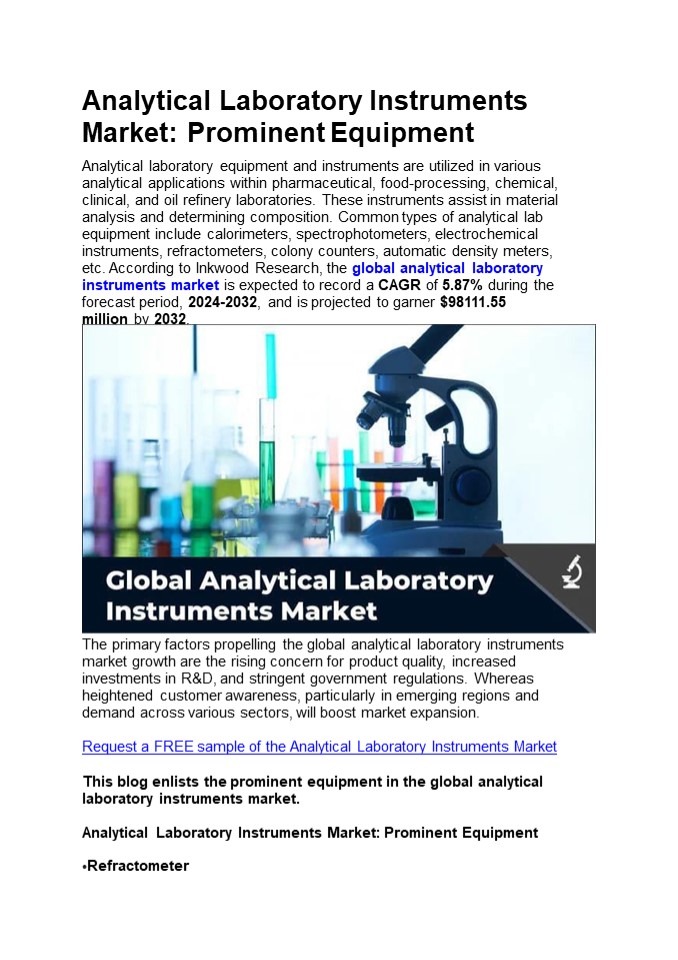
Title: Analytical Laboratory Instruments Market: Prominent Equipment
1
Analytical Laboratory Instruments Market
Prominent Equipment Analytical laboratory
equipment and instruments are utilized in various
analytical applications within pharmaceutical,
food-processing, chemical, clinical, and oil
refinery laboratories. These instruments assist
in material analysis and determining composition.
Common types of analytical lab equipment include
calorimeters, spectrophotometers, electrochemical
instruments, refractometers, colony counters,
automatic density meters, etc. According to
Inkwood Research, the global analytical
laboratory instruments market is expected to
record a CAGR of 5.87 during the forecast
period, 2024-2032, and is projected to garner
98111.55 million by 2032.
- The primary factors propelling the global
analytical laboratory instruments market growth
are the rising concern for product quality,
increased investments in RD, and stringent
government regulations. Whereas heightened
customer awareness, particularly in emerging
regions and demand across various sectors, will
boost market expansion. - Request a FREE sample of the Analytical
Laboratory Instruments Market - This blog enlists the prominent equipment in the
global analytical laboratory instruments market. - Analytical Laboratory Instruments Market
Prominent Equipment - Refractometer
2
- A refractometer is used to determine the
refractive index of liquids, gases, and
translucent solids. This measurement is essential
for analyzing the specific gravity of urine,
fluid concentration, salinity, and blood
proteins. Additionally, it helps determine how
much the speed of light is reduced in various
solutions, gases, or solids. - Common applications include measuring the sugar
content in fruit and fruit juices, milk, wine,
soft drinks, and yeast cultures. There are
various types of refractometers, including
traditional handheld refractometers, laboratory
refractometers, digital handheld refractometers,
and inline process refractometers. - Gas Detector
- A gas detector is commonly found in oil rigs, gas
refineries, gas plants, and other locations where
gas is stored or produced. Its primary role is to
detect gas leaks in industrial settings and
trigger an alarm to prevent accidents. - Essentially, it is a security device equipped
with a control system that automatically sounds
an alarm when gas leaks are detected. - Gas detectors alert operators in the vicinity of
a gas leak, providing an opportunity to avert
hazards. This is crucial in such environments
because many gases can be harmful to both humans
and animals. The device can detect flammable and
toxic gases, combustibles, and oxygen depletion.
Gas detectors are also used in firefighting. - Calorimeter
- A calorimeter is an analytical laboratory
instrument used in the process of calorimetry.
This process involves measuring the heat
generated during physical or chemical reactions.
Calorimeters vary in type based on the nature of
the activities being conducted. Some of the most
commonly used calorimeters include Titration
calorimeters, Differential scanning calorimeters,
Accelerated rate calorimeters, and Isothermal
calorimeters. - TOC Analyzer
3
- Additionally, they aid in water management for
public sources, manufacturing processes,
wastewater treatment, and the pharmaceutical
industry. - Viscometer
- A viscometer is an instrument used to measure the
viscosity of fluids. It determines the viscosity
of liquids under a single flow condition. In
contrast, a rheometer is used to measure
viscosity under varying flow conditions. - Viscometers are employed in various applications,
including assessing - polymer solutions, measuring wort in beer,
testing inks, analyzing low-viscosity oils, and
other uses in the biotechnology and
pharmaceutical industries. - Get CUSTOMIZED market insights delivered right to
your inbox! - Future Developments in the Global Analytical
Laboratory Instruments Market - Artificial intelligence (AI) is seeing growing
utilization within clinical laboratories,
encompassing standalone expert systems aiding
clinical decision-making and - knowledge-based systems integrated into
laboratory equipment. Besides, AI - systems applicable to conventional computers,
advancements are underway in crafting software
architectures mirroring human intelligence.
Research efforts in this domain contribute to
enhanced comprehension of human (natural)
intelligence. Termed naturally intelligent,
this distinct approach delineates itself from
other artificial intelligence methodologies. - Nanotechnology has significantly influenced
chromatography, enhancing separation techniques,
efficiency, and sensitivity. The utilization of
commonly used nanomaterials such as carbon
nanotubes, silica, and magnetic nanoparticles
improves interactions with analytes and expands
surface area. - Stay up-to-date with whats trending in the
Global Analytical Laboratory Instruments Market
4
- FAQs
- What are the key factors driving the growth of
the global analytical laboratory instruments
market? - A The growth of the global analytical laboratory
instruments market is - primarily driven by increasing research and
development activities in pharmaceuticals,
biotechnology, environmental monitoring, and food
testing industries. Additionally, the demand for
advanced analytical techniques to ensure product
quality, safety, and compliance with regulatory
standards contributes to market growth. - How do advancements in analytical laboratory
instruments impact research and development in
various industries? - A Advancements in analytical laboratory
instruments have a profound impact on research
and development across multiple industries. These - instruments enable researchers to conduct complex
analyses with higher accuracy, sensitivity, and
speed, thereby accelerating the - discovery and development of new drugs,
materials, and technologies.
Recommended

