

Japan 90 Colors of life7 PowerPoint PPT Presentation
Title: Japan 90 Colors of life7
1
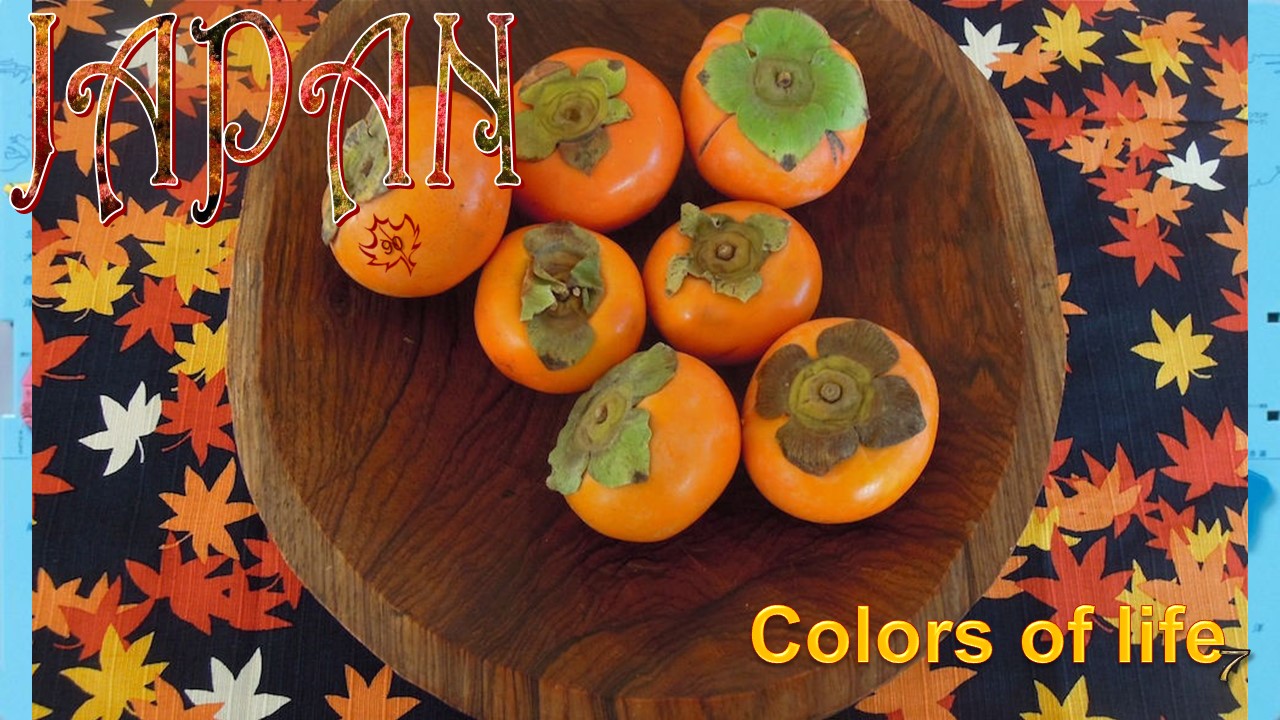
JAPAN
Colors of life
7
2
(No Transcript)
3
The persimmon is the edible fruit of a number of
species of trees in the genus Diospyros. The most
widely cultivated of these is the Oriental or
Japanese persimmon, Diospyros kaki. Diospyros is
in the family Ebenaceae, and a number of
non-persimmon species of the genus are grown for
ebony timber
4
The word Diospyros comes from the ancient Greek
words "dios" and "pyron". A popular etymology
construed this as "divine fruit", or as meaning
"wheat of Zeus" or "God's pear" and "Jove's fire"
5
The tree Diospyros kaki is the most widely
cultivated species of persimmon. Asian or
Japanese persimmon (Diospyros kaki) is native to
Japan, China, Korea, Burma and Nepal
6
Persimmon (kaki in Japanese) has been revered in
Japan for centuries, unlike in the west where
it has never advanced beyond the status of a
minor fruit
7
(No Transcript)
8
(No Transcript)
9
(No Transcript)
10
Persimmons are eaten fresh, dried, raw, or cooked
11
Zosterops japonicus eating Diospyros kaki in
Kaisho Forest, Seto
12
When the fruit is mature, its pulp darkens and
becomes softer. The best way to eat the fruit is
by cutting it at each end and digging into it
with a spoon, leaving the peel uneaten
13
(No Transcript)
14
Hachiya
When it comes to persimmons, called kaki in
Japanese, there are two main types. One type is
the hachiya persimmon the astringent type that
can only be eaten when very soft or all youll
get is a mouthful of bitterness. The other is
called fuyu gaki a shorter, squatter persimmon
which can be eaten at any period of ripeness.
15
Fuyu gaki
Hachiya
16
Mount Fuji, Japanese Fuji-san,
highest mountain in Japan, rises to 12,388 feet
(3,776 metres)
17
(No Transcript)
18
(No Transcript)
19
Persimmon and Japanese radish in sweet and sour
sauce
20
Japanese Persimmon (Kaki) Tart
21
Caramelized Fuyu Persimmon
22
Ishikawa Toyonobu Picking persimmons ca 1748
1764 Library of Congress
23
(No Transcript)
24
It is told that the only things to survive the
atomic bomb in 1945 were a few persimmon trees,
which are also known as trees of peace
25
Though persimmon trees belong to the same genus
as ebony trees, persimmon tree wood has a limited
use in the manufacture of objects requiring hard
wood. It is hard, but cracks easily and is
somewhat difficult to process. Persimmon wood is
used for paneling in traditional Korean and
Japanese furniture. Persimmon wood is not
commonly found in furniture, but is used for
making billiards and percussion instruments
26
Shirakawa-go
27
Sittiparus varius eating kaki in Kaisho Forest,
Seto Kakis on manhole cover in
Kudoyama, Wakayama pref
28
Bonsai
29
Washi tape
Many believe that the Lotus Eaters mentioned by
Homer in the Odyssey, were actually eating
persimmon fruit and not lotus flowers
Bonsai
30
Bonsai
31
Kokei Kobayashi (18831957) Shusai, 1934,
Yamatane Museum of Art
Hama Kosho (1895-1990)
32
Kokei Kobayashi (18831957)
Sakai Hoitsu (17611828) Metropolitan Museum of
Art
33
Sakai Hoitsu (17611828) Two-fold paper screen
painted in ink and colour on a gold ground
34
Tanaka Ryohei (Japan, 1933)
35
Shotei Watanabe (1851-1918) Bird on a Persimmon
Tree
Tanaka Ryohei (Japan, 1933)
36
Imamura Shiko (Japanese, 1880 - 1916)
Kazuyuki Ohtsu Persimmon in Autumn, 2007
Kazuyuki Ohtsu Persimmon in Autumn, 2007
37
Ohara Koson (1877-1945) A nuthatcher upon a
persimmon tree
Ohara Koson - Monkey in a Tree
Ohara Koson - Crow eating a Persimmon
38
The most precious version of persimmon fruit
comes from Japan. Brown on the inside, they are
known locally as chocolate kaki (Tsurunoko) or
cinnamon kaki because of its spicy taste. ? The
fruit was introduced to America and Europe in the
19th Century
Ohara Koson (1877-1945)
39
Persimmon-by Haku Maki
Fukagawa Blue Cobalt
Persimmons and Mountain, by Ryohei Tanaka
Lacquered Wood Kogo or Box
40
Tamura Kouichi
Japanese seal chop box persimmon rat
41
Kiyoshi Saito (1907-1997) Village Scenes
42
Gesso Yoshimoto Bird on Persimmon wood print 1920
Shimura Tatsumi
43
The Chinese use persimmon fruit as a metaphor for
human life tasteless and bitter when too young,
soft and sweet once mature
44
(No Transcript)
45
Kaki are in season in late autumn and winter when
they are often seen hanging on otherwise barren
trees. Originally coming from China, kaki have
been cultivated in Japan since the 7th century
46
Snow and a Persimmon tree Koichi Watanabe
47
Winter snow laden tree with red berries
Shirakawago
48
A gassho-zukuri house with snowy persimmon tree
49
( Jyun Ogawa/Minden Pictures)
50
Text pictures Internet Copyright All the
images belong to their authors Presentation
Sanda Foisoreanu
2017
Sound Toshinori Yonekura - Emergency
51
Colors of life
Recommended

