

Japan 36 Colors of life3 PowerPoint PPT Presentation
Title: Japan 36 Colors of life3
1
JAPAN
Colors of life
3
2
(No Transcript)
3
March 3 is Hinamatsuri (Doll Festival), the day
to hope for the uneventful growth and good
fortune of girls. People decorate their houses
with Hina ("Hina" means "small") dolls and peach
flowers. It is believed that Hina dolls take
over misfortunes and troubles falling on girls
4
The day is the second of the gosekku (the five
annual ceremonies that were traditionally held at
the Japanese imperial court) and is also known as
Momo no Sekku, since it is the season of peach
("momo") flowers
5
A group of dolls dressed in traditional court
dress of the Heian period called Hinaningyo are
displayed in the home of the family that has a
young daughter. The dolls represent members of
the ancient imperial court, and displayed on
tiers of shelves
6
(No Transcript)
7
Platforms covered with a red carpet are used to
display a set of ornamental dolls representing
the Emperor, Empress, attendants, and musicians
in traditional court dress of the Heian period
8
(No Transcript)
9
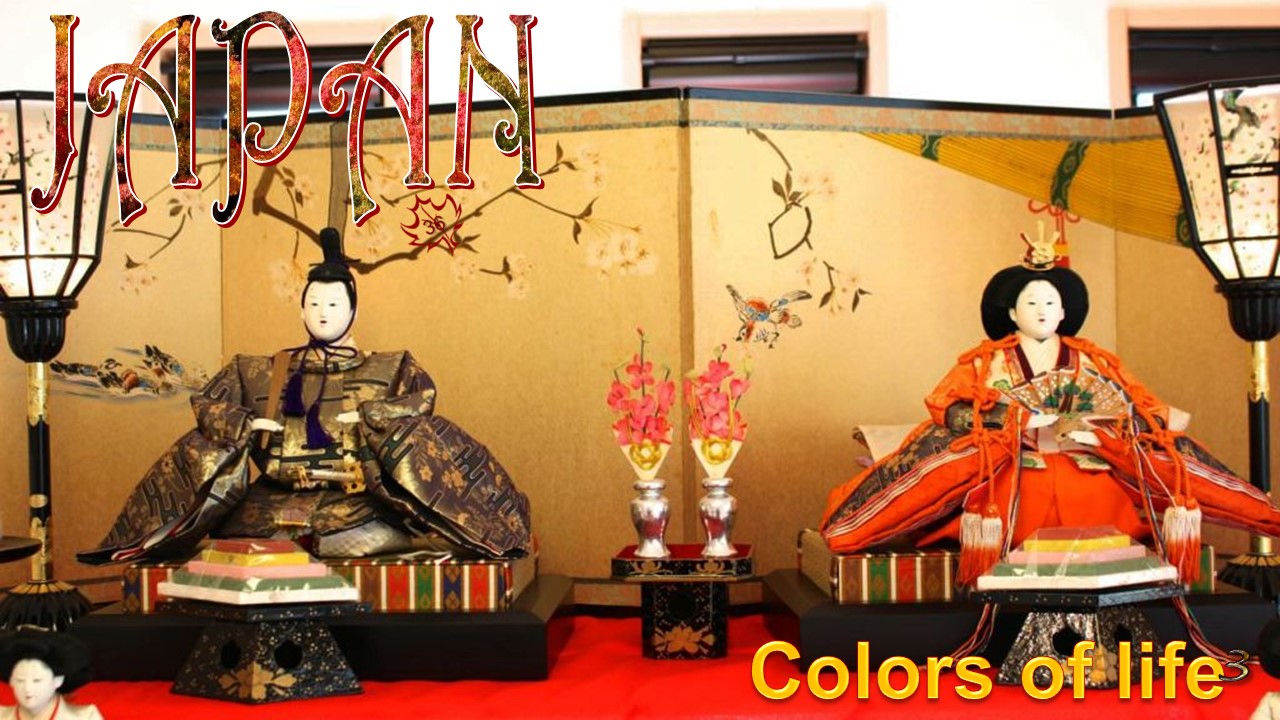
An Emperor doll with an Empress doll, in front
of a painted screen
10
The Emperor, Dairitono
The Empress, Dairihime
11
(No Transcript)
12
An Emperor doll with an Empress doll, in front
of a gold screen
13
(No Transcript)
14
(No Transcript)
15
The Emperor and the Empress (called Dairi-Bina)
are displayed on the top shelf
16
The dolls represent members of the ancient
imperial court, and displayed on tiers of
shelves Dairihime The Empress
17
The Emperor and the Empress are displayed on the
top shelf, three court ladies (Sannin-Kanjo)
each holding Sake equipment, five musicians
(Gonin Bayashi), two ministers (Udaijin and
Sadaijin), and three servants are typically
arrayed below them
18
Three court ladies (Sannin-Kanjo)
19
Three court ladies (Sannin-Kanjo) The mission
of 3 doll is poured sake for the king and queen
20
(No Transcript)
21
(No Transcript)
22
Five musicians (Gonin Bayashi)
23
Edo Drummer
24
Musicians (Gonin Bayashi)
25
Hinamatsuri dates from medieval times but the
custom of displaying dolls in todays fashion
started around 18th century
26
Families starts to display the dolls in February,
and store them away immediately after the
festival, as it is believed that leaving the
dolls displayed late after the festival would
result in late marriage for the daughter
27
Two ministers (Udaijin and Sadaijin), one old
and one young
28
(No Transcript)
29
(No Transcript)
30
(No Transcript)
31
(No Transcript)
32
Small representative furniture and food are also
displayed on the lower shelves
33
Tsurushibina (Hanging Hina Dolls) is a
traditional Japanese craftwork, which is hung
both sides of a hina-doll-altar for the first
hinamatsuri of the first daughter to wish her
good health and good relationships for the
future. It was also a substitute for
hina-doll-altars for ordinary folks in old age
34
Tsurushibina (Hanging Hina Dolls)
35
The dolls are often passed from generations to
generations, mother to daughter
36
Dolls have been a part of Japanese culture for
many years, and the phenomenon of collecting them
is still practiced. Many collections are
preserved in museums, including the Peabody Essex
Museum, Kyoto National Museum, and the Yodoko
Guest House
37
(No Transcript)
38
Every year, the Hina Ningyo (Hina doll set) are
taken out of their boxes and are placed on
stepped platforms laid with red cloth a ritual
that little girls enjoy and older women recall
with fond nostalgia
39
(No Transcript)
40
Though they were made for little girls, the
Japanese dolls are not the typical toys that
children play with. In fact, they are actually
quite expensive as they are handmade, with their
faces hand-painted and silk kimono hand-sewn by
master craftsmen
41
There are many other additional figures on
display over the whole five tiers, but it is also
common to find simplified displays which include
only the top tier
42
(No Transcript)
43
Traditional paper tachibina, emblem of hina
matsuri
Hina doll mouse, wearing a kimono
44
Now exist simplified Hina Dolls A pair of clay
Hina figurines as well as a pair of round Hina
wooden Kokeshi. It is also common to find the
imperial pair in anthropomorphic form, such
zodiac animal or in this case, a pair of Hina
Maneki Neko. Additionally, they may also be in
the form of paper dolls, origami, chirimen
craftworks, or framed drawing, and so forth.
45
In Hinamatsuri holidays, Japanese children also
enjoy a variety of dishes typical of this
festival. In particular, indispensable
Hishi-mochi cakes are made in the form of diamond
with bright colors, symbolizing the vitality of
spring
46
Hishimochi and Hina-Arare
Hishimochi
47
Hina Arare is colorful and cute small rice
cracker. Colors of these rice crackers have
meanings in it. White represents the earth of the
winter, pink and red represent the life, and
green represents green shoots in the spring. Hina
Arare is the snack which shows our expectation
that spring will come soon after the long cold
winter.
48
People also say that you will live healthy for
this coming year as you eat each color of Hina
Arare
49
Shirozake/ Amaze is a type of sake made from
fermented rice. It is an indispensable drink for
the Hina Matsuri celebrations Japanese believe
Shirozake will free them of illness to sustain
youthfulness
Amazake is a low or non-alcoholic drink made from
fermented rice koji. It is served warm and
available as a liquid or powder mix, in a can or
bottle. Shirozake, a sweet, pulpy liquor, made
with shochu, mochi, mirin, and koji, is sold next
to seasonal pink beer cans.
50
Typically, food such as below are served at
Hinamatsuri festival Hishimochi, diamond
shape rice cake Hina-Arare, bite size
crackers Shirozake, sake made from fermented
rice Hamaguri, clam with shells served with
salt-base soup Chirashi-Sushi, scattered Sushi
Hina Matsuri Flower Sushi
51
Chirashizushi - Scattered SushiIt is a dish
of vinegared sushi rice topped with colorful
seafood and vegetable ingredients, served in a
large bowl or on a plate. Beautifully arranged
artistic dish is often prepared for celebrating
special occasions or festivals, such as the Doll
Festival, the Girls Festival on March 3
52
- The dish is usually served cold, and the topped
ingredients are typically cooked seafood and
vegetables, rather than raw Sashimi. - Standard toppings include
- Simmered Shiitake Mushrooms
- Vinegared Renkon, Lotus Roots
- Shredded Nori, Seaweed
- Kinshi Tamago, Shredded Egg Crepes
- Nianago, Broiled Conger Eel
- Cooked Shrimps
- Ikura, Salmon Roe
53
Ingredients they put in Chirashizushi have
meanings as well, Lotus roots is for seeing
through things will happen in the future, shrimps
for living for a long life till your back will be
bent like shrimps are and so on...
54
Hamaguri Ushio-jiru
They also eat osuimono (clear soup) made of
clams. Because clams are double-shelled with the
shells forming a pair parents hope their
daughters will find a lifelong partner
Clams are eaten because they consist of two
perfect halves which only fit each other and
symbolize the ideal couple, just like the Emperor
and the Empress dolls
55
Hinacake
56
(No Transcript)
57
Over hundreds of years of history, the festival
for girls at March 3 has become a unique culture
in the life of Japanese people
58
Hina Ningyo (Girls Day Dolls) Sushi
Mizuno Toshikata, ca.1900
59
(No Transcript)
60
Nagashi Bina (kind of Hina matsuri doll)
61
There are also some other customs people do
depending on the religion. One of them is
Nagashi Bina which people throw dolls made from
paper into the river in order to get bad lucks
away
62
Sandawara (small round boat made of straw)
63
The ceremony of "Nagashibina (dolls floated
downriver) is traditional ceremony to pray for
good health
64
Putting dolls of pair (wife and husband) with
rice cake and branch of peach on "Sandawara
(small round boat made of straw) and release it
on the flow of Sendaigawa (river).
65
Nagashi-bina is an event that involves dispelling
impurities and misfortunes by floating dolls away
on water
66
Sandawara (small round boat made of straw)
Nagashi Bina
67
Maiko
68
In earlier days Nagashi-bina took place all over
Japan, but the practice has died out in most
areas. Only in Tottori City and Mochigase-cho in
Tottori Prefecture does nagashi-bina survive today
69
As Nagashi-bina has become quite a rare event, in
recent years it has come to attract visitors by
the busload
70
As Nagashi-bina has become quite a rare event, in
recent years it has come to attract visitors by
the busload
71
It is designated as intangible folk cultural
asset by the prefecture
72
Nagashi Bina
73
Another custom is to display Hina dolls on a
tiered stand which is high like a pyramid
74
Text pictures Internet All copyrights belong
to their respective owners Presentation
Sanda Foisoreanu
2016
Sound Toshinori Yonekura - Baby baby
baby
75
4
1
3
2
Colors of life
Colors of life
Colors of life
Colors of life
7
6
5
Colors of life
Colors of life
10
Colors of life
9
8
Colors of life
Colors of life
Colors of life
Colors of life
Recommended

