

Methods of Land Clearing – Best Ways to Clear Your Property PowerPoint PPT Presentation
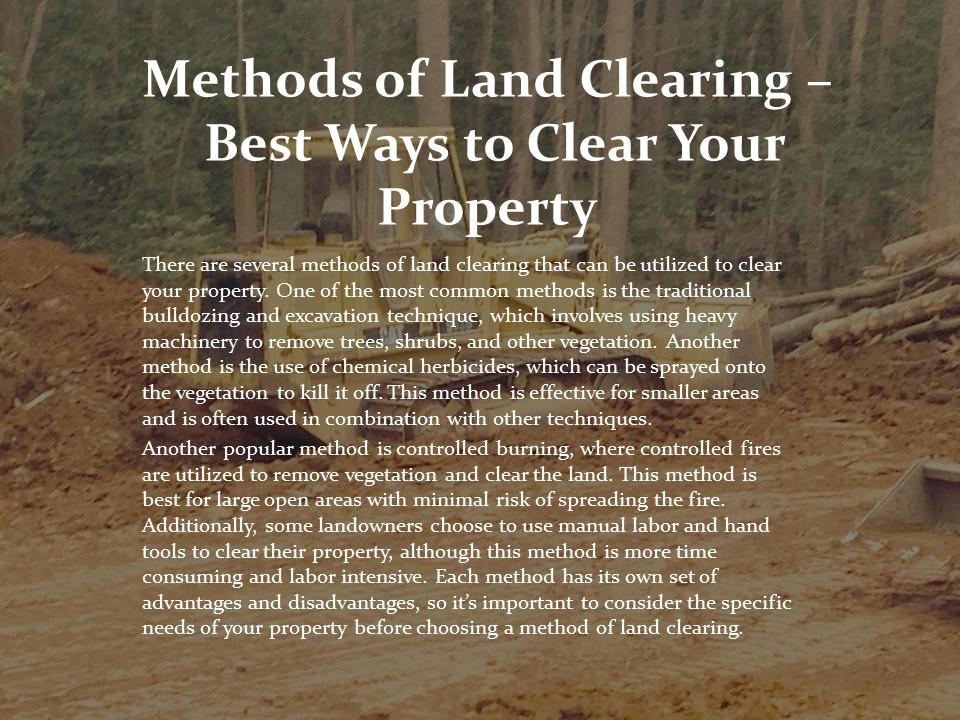
Title: Methods of Land Clearing – Best Ways to Clear Your Property
1
Methods of Land Clearing Best Ways to Clear
Your Property
- There are several methods of land clearing that
can be utilized to clear your property. One of
the most common methods is the traditional
bulldozing and excavation technique, which
involves using heavy machinery to remove trees,
shrubs, and other vegetation. Another method is
the use of chemical herbicides, which can be
sprayed onto the vegetation to kill it off. This
method is effective for smaller areas and is
often used in combination with other techniques. - Another popular method is controlled burning,
where controlled fires are utilized to remove
vegetation and clear the land. This method is
best for large open areas with minimal risk of
spreading the fire. Additionally, some landowners
choose to use manual labor and hand tools to
clear their property, although this method is
more time consuming and labor intensive. Each
method has its own set of advantages and
disadvantages, so its important to consider the
specific needs of your property before choosing a
method of land clearing.
2
Methods of Land Clearing
- 1. Grubbing and Dozing
- Grubbing and dozing are integral components of
land clearing processes, particularly in areas
with dense vegetation or forests. Grubbing
involves the removal of roots, stumps, and other
underground obstacles to prepare the ground for
construction or agricultural activities. Heavy
machinery, such as bulldozers and excavators, is
commonly employed in this process. These machines
are equipped with blades and rippers to uproot
vegetation and clear the land effectively. - The dozing aspect involves pushing aside or
leveling large quantities of vegetation, rocks,
and debris using the bulldozers blade. Grubbing
and dozing are efficient methods for large-scale
land clearance, offering a quick and systematic
approach to preparing the land for various
purposes.
3
2. Burning
- Burning, also known as controlled or prescribed
burning, is a land clearing method that utilizes
controlled fire to remove vegetation. This
technique is often employed in areas with
excessive dry grass, shrubs, or other combustible
materials. Controlled burns help reduce the risk
of uncontrolled wildfires by eliminating
potential fuel sources. Additionally, burning can
stimulate the germination of certain plant
species, promoting ecological diversity. - However, it requires careful planning and
execution to prevent the fire from spreading
uncontrollably. Proper consideration of weather
conditions, wind direction, and environmental
impact is essential when implementing controlled
burning as a land clearing method.
4
3. Hand Clearing
- Hand clearing involves manual removal of
vegetation using hand tools, such as machetes,
chainsaws, and axes. This method is suitable for
smaller-scale projects or areas where heavy
machinery is impractical or environmentally
sensitive. - Hand clearing allows for precise control over
which plants are removed and is often used in
conjunction with other methods for more selective
land clearing. While it is a labor-intensive
process, hand clearing is chosen in situations
where preserving specific vegetation or
minimizing soil disruption is crucial.
5
4. Mulching
- Mulching is a method that involves mechanically
shredding and grinding vegetation into mulch,
which is then spread over the ground. Mulching
has several benefits, including weed suppression,
moisture retention, and erosion control. It also
helps in recycling organic matter back into the
soil, enriching its fertility. - Mulching machines can be mounted on tractors or
specialized equipment and are efficient in
clearing smaller vegetation without causing
significant soil disturbance. This method is
often preferred in landscaping projects and for
creating firebreaks in areas where maintaining
ground cover is essential.
6
What is Land Clearing ?
- Land clearing is the process of removing trees,
shrubs, rocks, and other natural obstacles from a
piece of land in order to prepare it for
construction, agriculture, or other purposes.
This can involve cutting down trees, pulling up
roots, and clearing away brush and debris. Land
clearing may also involve grading and leveling
the land to create a suitable surface for
building or planting. - While land clearing serves important purposes,
such as creating space for development and
agriculture, it can also have negative
environmental impacts if not done carefully and
sustainably. It is important to consider the
ecological and environmental implications of land
clearing and to adhere to regulations and best
practices in order to minimize any potential harm
to the natural ecosystem.
7
Why is Land Clearing Necessary?
- Land clearing is necessary for various reasons.
One of the main reasons is to make way for
development and construction projects. Clearing
land allows for the creation of residential and
commercial areas, as well as infrastructure such
as roads and utilities. Additionally, land
clearing may be necessary for agricultural
purposes, as it provides space for planting crops
and raising livestock. - Furthermore, clearing land can help reduce the
risk of wildfires by creating firebreaks and
removing potential fuel sources. While land
clearing is necessary for human advancement and
resource utilization, it is important to do so
responsibly and sustainably to minimize negative
impacts on the environment and wildlife. Proper
planning and mitigation measures can help balance
the need for land clearing with environmental
conservation.
8
Final Thoughts
- In conclusion, the methods of land clearing vary
widely, offering a range of options to suit
different project sizes, environmental concerns,
and specific objectives. Grubbing and dozing
prove effective for large-scale operations,
swiftly removing obstacles and leveling terrain
with the aid of heavy machinery. Controlled
burning, when carefully planned, not only clears
vegetation but also plays a role in wildfire
prevention and ecological management. - Hand clearing stands out for its precision,
making it an ideal choice for smaller projects or
areas where a more selective approach is
necessary. Lastly, mulching provides an
environmentally friendly option, turning cleared
vegetation into beneficial mulch for soil health
and erosion control.
Recommended

