

Process Control Monitoring (PCM) and Wafer Acceptance Test (WAT) in the Semiconductor Manufacturing Industry PowerPoint PPT Presentation
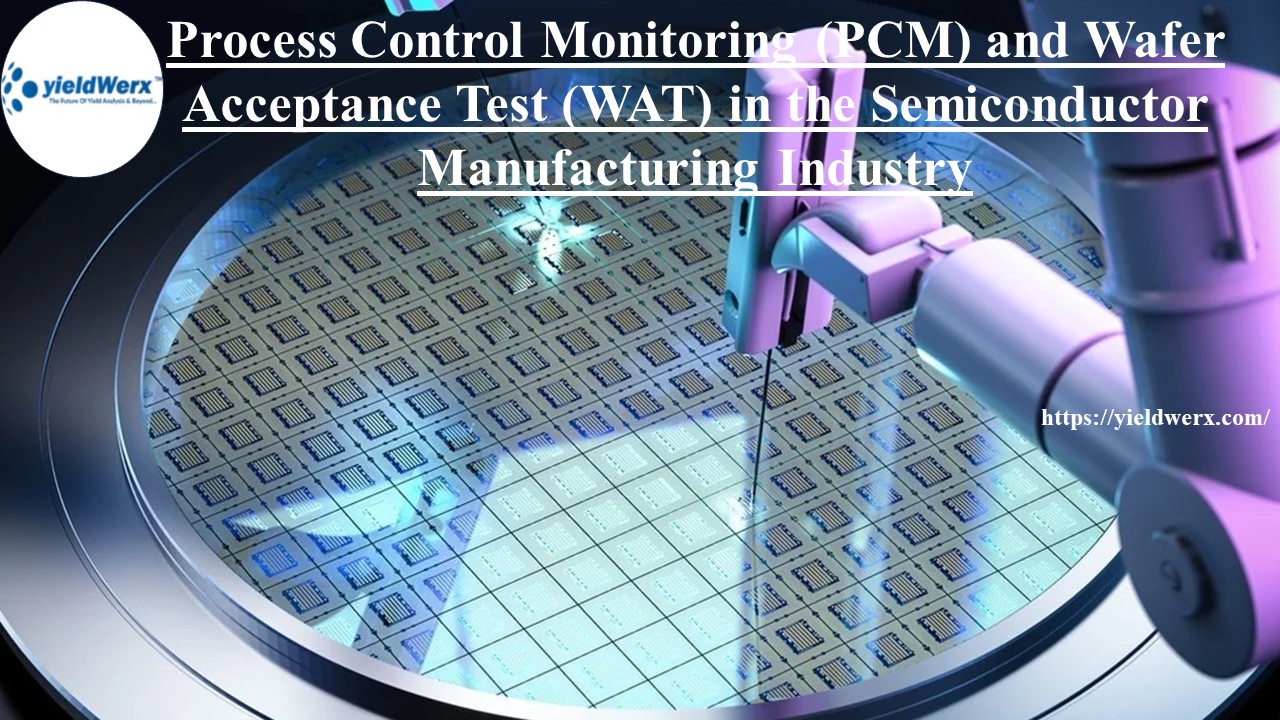
Title: Process Control Monitoring (PCM) and Wafer Acceptance Test (WAT) in the Semiconductor Manufacturing Industry
1
Process Control Monitoring (PCM) and Wafer
Acceptance Test (WAT) in the Semiconductor
Manufacturing Industry https//yieldwerx.com
/
2
Semiconductor manufacturing is an intricate
process involving numerous stages, from wafer
preparation to the final packaging of the
integrated circuit. Two critical components of
this process are Process Control Monitoring (PCM)
and Wafer Acceptance Testing (WAT). PCM and WAT
data are crucial in verifying the quality of the
wafer at the end of fabrication, identifying
potential defects, and ensuring the consistent
production of high-quality semiconductor
devices. Understanding PCM PCM Monitoring
(Process Control Monitoring) refers to the
control systems implemented in semiconductor
manufacturing to monitor the process parameters
during wafer fabrication. The aim is to maintain
the consistency of the production process, thus
ensuring the desired quality and performance of
the semiconductor devices. PCM involves
collecting data from the various stages of
manufacturing, from deposition and etching to
photolithography and ion implantation. This data
is then used to assess the integrity of the
process, identify potential issues, and make
necessary adjustments to maintain statistical
process control semiconductor. Different test
structures are fabricated on the wafer for PCM
data. These test structures are designed to mimic
the devices that will be manufactured on the
wafer. By monitoring these structures,
manufacturers can assess the effects of process
variations on the final device performance. Unders
tanding WAT Wafer Acceptance Testing (WAT), also
known as Process Check Monitor (PCM monitor)
testing, involves testing a small sample of die
from each wafer after fabrication. The purpose of
WAT is to measure the electrical properties of
the devices on the wafer to determine if the
fabrication process has produced devices with the
desired characteristics. In WAT semiconductor,
test patterns are used to exercise the device and
evaluate its performance. This testing involves
applying a sequence of input signals to the
device and monitoring its response. The resulting
data is then compared with expected results to
determine whether the device meets the required
specifications. WAT can also be used to identify
process drifts that may occur over time. By
monitoring trends in the WAT data, manufacturers
can detect changes in the fabrication process
that might impact device performance. Such
information is essential for maintaining process
control monitoring semiconductor and ensuring the
consistent quality of the devices.
3
PCM/WAT Data Analysis Challenges and
Importance PCM and WAT data analysis is an
essential but challenging aspect of semiconductor
manufacturing. These datasets are vast and
complex, representing various dimensions of the
manufacturing process. In addition, they're often
incomplete or inconsistent due to measurement
errors or equipment malfunctions. Despite these
challenges, analyzing PCM/WAT data is vital for
several reasons. Firstly, it allows manufacturers
to detect defects or variations in the
manufacturing process that could lead to device
failure. For example, by monitoring the data,
manufacturers can identify issues such as
contamination, equipment malfunctions, or process
drifts that might affect yield. Secondly, PCM/WAT
data analysis can also help improve operational
efficiency. By identifying the causes of defects
or pcm process variations, manufacturers can
implement corrective actions to prevent
recurrence. This proactive approach can help
reduce waste, improve yield, and lower
manufacturing costs. Moreover, the STDF data
analysis can also provide insights into the
performance of individual devices or wafers. This
information can be used to classify the devices
according to their performance, which can be
beneficial in applications where high reliability
is essential. The Role of Advanced PCM/WAT Data
Analysis Tools Advanced PCM/WAT data analysis
tools can play a significant role in improving
the effectiveness of the analysis process. These
tools can help standardize and map data across
different stages of the manufacturing process,
enabling more accurate and insightful analysis.
They can also facilitate data visualization,
making it easier to identify trends or anomalies.
Moreover, these tools can also integrate data
from different sources, such as the wafer sort
test data and final test yield data. This
integration can provide a holistic view of the
manufacturing process, enabling manufacturers to
identify correlations between different process
parameters and their impact on yield. Another key
advantage of advanced PCM/WAT data analysis tool
is the ability to automate data analysis. With
the vast amount of data generated in
semiconductor manufacturing, manual analysis is
often impractical. Automation can significantly
speed up the analysis process and minimize human
error, enabling more accurate and timely
decision-making.
4
- Conclusion
- PCM and WAT data are crucial components in
semiconductor manufacturing, playing a critical
role in process control, quality assurance, and
operational efficiency. By effectively analyzing
this data, manufacturers can detect and address
potential issues, improve yield, and ensure the
consistent production of high-quality devices.
The use of advanced PCM/WAT data analysis tools
can significantly enhance the effectiveness of
this analysis, providing valuable insights that
can drive process improvement and cost reduction
in semiconductor manufacturing. - References
- Bader, D., and Nguyen, T. (2010). Statistical
Process Control A Tool for High-Quality
Systematic Yield Improvement. Semiconductor
Manufacturing Handbook, Second Edition (pp.
13.1-13.21). McGraw Hill. - May, G.S., and Spanos, C.J. (2006). Fundamentals
of Semiconductor Manufacturing and Process
Control. John Wiley Sons. - Zorzi, N., De Marchi, M., Lanza, G., Ghibaudo,
G., and Ricco, B. (2015). PCM based workflow for
wafer acceptance test analysis. Microelectronic
Engineering, 147, 133-136. - Levy, R. (2000). Process control and yield
modeling in semiconductor manufacturing. World
Scientific. - Yeh, P. (2015). Semiconductor Manufacturing
Technology. Pearson. - SEMI. (2021). Guide to SEMI Standard for SEMI
Equipment Communication Standards (SECS/GEM). - Kim, Y., and Kim, C. (2016). A study on the
measurement system for wafer acceptance test
data. Journal of Semiconductor Technology and
Science, 16(2), 227-233.
Recommended

