

Diaphragm Gas Meter: How It Works and Why It Matters PowerPoint PPT Presentation
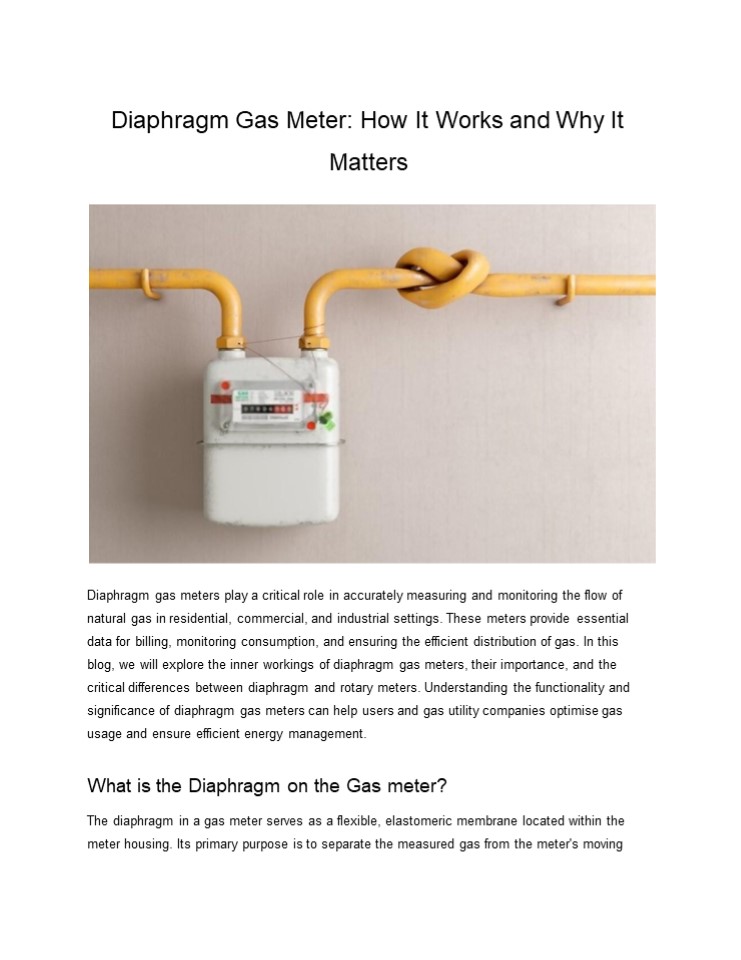
Title: Diaphragm Gas Meter: How It Works and Why It Matters
1
Diaphragm Gas Meter How It Works and Why It
Matters
Diaphragm gas meters play a critical role in
accurately measuring and monitoring the flow of
natural gas in residential, commercial, and
industrial settings. These meters provide
essential data for billing, monitoring
consumption, and ensuring the efficient
distribution of gas. In this blog, we will
explore the inner workings of diaphragm gas
meters, their importance, and the critical
differences between diaphragm and rotary meters.
Understanding the functionality and significance
of diaphragm gas meters can help users and gas
utility companies optimise gas usage and ensure
efficient energy management. What is the
Diaphragm on the Gas meter? The diaphragm in a
gas meter serves as a flexible, elastomeric
membrane located within the meter housing. Its
primary purpose is to separate the measured gas
from the meter's moving
2
parts. This isolation ensures that the gas flow
does not interfere with the internal mechanisms
of the meter, allowing for accurate measurement.
The diaphragm flexes in response to the pressure
difference caused by the gas flow, enabling
precise gas consumption monitoring. How Does a
Diaphragm Gas Flow Meter Work? A diaphragm gas
meter operates based on the principle of positive
displacement. The gas flows through the meter
and enters a chamber where the diaphragm is
positioned. As the gas pressure increases, it
causes the diaphragm to expand, filling the
chamber. Subsequently, the diaphragm contracts,
displacing the gas volume from the chamber. This
cyclical expansion and contraction of the
diaphragm occur with each gas pulse, enabling
accurate gas flow rate measurement. The movement
of the diaphragm is typically converted into
rotational motion, which is then used to drive
the register that records the gas
consumption. What is the Capacity of a Diaphragm
Gas Meter? Diaphragm gas meters are available in
various sizes to accommodate different flow rates
and gas consumption levels. The capacity of a
diaphragm gas meter is typically measured in
cubic meters per hour (m³/h) or cubic feet per
hour (ft³/h). These meters come in various
capacities, from small meters suitable for
individual households to larger meters capable of
handling high gas demands in industrial or
commercial applications. Gas utility companies
carefully select the appropriate meter capacity
based on expected gas usage, pressure, and the
number of connected appliances or units. What
is the Difference Between Diaphragm and Rotary
Meters? Diaphragm and rotary meters are two
commonly used types of gas flow meters, each with
its own set of characteristics. Here are the key
differences between the two Technology
Diaphragm meters use positive displacement
technology, while rotary meters operate on the
principle of rotary motion. Diaphragm meters
measure gas flow by counting the number of gas
pulses, whereas rotary meters utilise a rotating
impeller or rotor to measure the volume of gas
passing through.
3
Accuracy Diaphragm gas meters are known for
their high precision, making them ideal for
precise measurement of gas consumption in
residential and commercial settings. They can
accurately measure even low flow rates. Rotary
meters, on the other hand, are generally used
for larger gas loads and offer slightly lower
accuracy. However, technological advancements
have made rotary meters more accurate in recent
years. Maintenance Diaphragm meters are
relatively easy to maintain and service. They
have fewer moving parts and are less prone to
wear and tear. Due to their more complex design,
rotary meters may require more frequent
maintenance. The rotating impeller or rotor in
rotary meters is susceptible to damage,
requiring periodic inspection and
calibration. Application Diaphragm meters are
commonly employed in residential, commercial,
and small-scale industrial applications. Their
accurate measurement capabilities make them
suitable for billing and monitoring gas
consumption in households, businesses, and small
industrial facilities. On the other hand, rotary
meters are typically used for more significant
industrial and commercial gas consumers where
higher gas flow rates are expected. Conclusion Di
aphragm gas meters are crucial components of the
gas supply chain, providing accurate gas
consumption measurements. Their positive
displacement technology, high accuracy, and
suitability for various applications make them
indispensable in ensuring reliable gas
distribution. These meters enable fair billing
and help identify potential gas leaks, and manage
energy usage effectively. Understanding the
functioning and significance of diaphragm gas
meters can empower users and gas utility
companies to optimise gas consumption, reduce
waste, and contribute to efficient energy
management. When considering installing or
replacing diaphragm gas meters, it is important
to consult reputable diaphragm gas meter
manufacturers for specific information and
recommendations tailored to your gas metering
needs. They can guide you in selecting the
appropriate meter capacity, ensuring compliance
with regulations, and addressing any unique
requirements related to your gas supply. With
reliable and accurate gas measurements provided
by diaphragm gas meters, we can continue to
enjoy the benefits of natural gas while promoting
sustainability and energy efficiency in our
communities.
4
(No Transcript)
Recommended

