

Halal Cosmetics Market: Growing Demand among Non-Muslim Consumers PowerPoint PPT Presentation
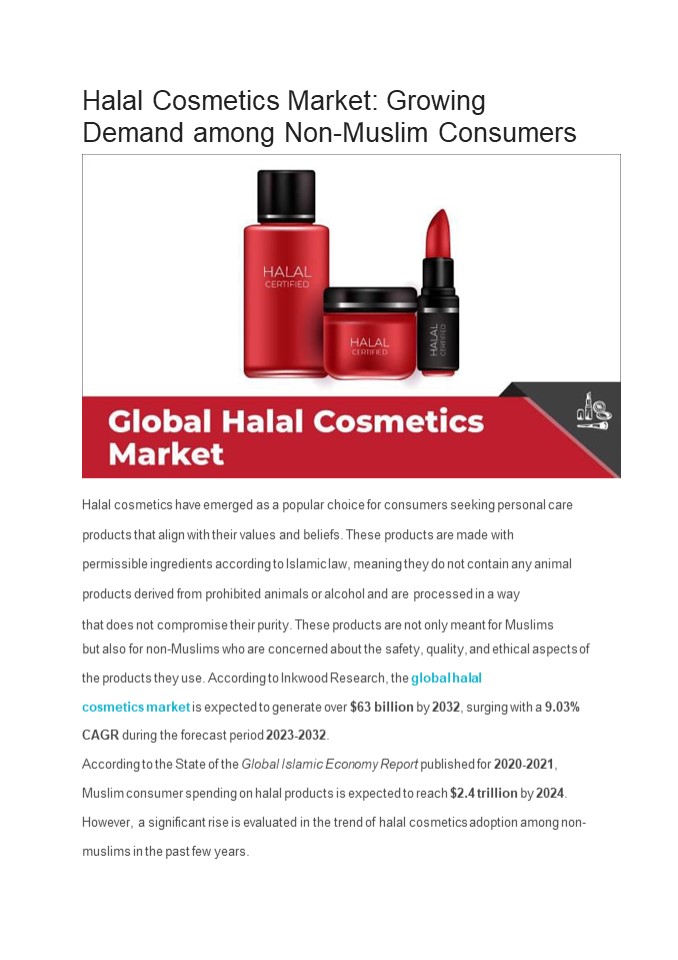
Title: Halal Cosmetics Market: Growing Demand among Non-Muslim Consumers
1
Halal Cosmetics Market Growing Demand among
Non-Muslim Consumers
Halal cosmetics have emerged as a popular choice
for consumers seeking personal care products that
align with their values and beliefs. These
products are made with permissible ingredients
according to Islamic law, meaning they do not
contain any animal products derived from
prohibited animals or alcohol and are processed
in a way that does not compromise their purity.
These products are not only meant for Muslims but
also for non-Muslims who are concerned about the
safety, quality, and ethical aspects of the
products they use. According to Inkwood Research,
the global halal cosmetics market is expected to
generate over 63 billion by 2032, surging with a
9.03 CAGR during the forecast period
2023-2032. According to the State of the Global
Islamic Economy Report published for 2020-2021,
Muslim consumer spending on halal products is
expected to reach 2.4 trillion by 2024. However,
a significant rise is evaluated in the trend of
halal cosmetics adoption among non-muslims in the
past few years.
2
- Why is Halal Cosmetics a Thriving Choice Among
Non- Muslims? - Healthier Alternative for Chemical-Based Products
- Halal cosmetics are generally considered to be
safer and healthier as they are free from - substances such as alcohol, animal-derived
ingredients, and other chemicals that may cause
skin irritation or allergies. Halal cosmetics are
also cruelty-free as they are not - tested on animals, a major concern for many
consumers against animal testing. - In 2018, LOréal, a prominent global cosmetics
company, launched a halal-certified skincare line
in Malaysia. Additionally, Schwan-Stabilo
Cosmetics, a German company, is ready to offer
halal-certified products to key customers such as
Procter Gamble and LOréal. Additionally, in a
press release recorded by LiveMint, Joerg Karas,
the general manager of Schwan-Stabilo Cosmetics,
predicted that Halal certification is a
requirement that might be put in place by other
countries in the future and that they are
well-equipped for this niche market. (Source) - Friendly to the Environment
- Halal cosmetics are considered environmentally
friendly as they do not contain harmful - chemicals or pollutants that may harm the
environment. This is particularly important for
environmentally conscious consumers who want to
reduce their carbon footprint. - For example, Amara Halal Cosmetics is a United
States-based company that provides a wide range
of halal-certified cosmetics. Amara faces
competition from other companies in the same
industry, such as ILIA Beauty, Renee Cosmetics,
ESQA, - and LIVETINTED. According to the companys
sources, Amara Halal Cosmetics is ranked 49th
among 140 active competitors. (Source) - Premium Quality Product
- Halal cosmetics are often marketed as premium
products. Many non-Muslims are
3
- premium price. This factor presents a significant
opportunity for companies to tap into this
lucrative market, and many established personal
care brands have launched halal - product lines to cater to the growing demand for
these products. - In 2020, Unilever Ventures led a Series A funding
round in Esqa, raising 6 million for the
Indonesian vegan brand. Founded in 2016 by
entrepreneurs Cindy - Angelina and Kezia Trihatmanto, Esqa was the
first local vegan brand to launch in Indonesia.
The investment also marks Unilever Ventures
first foray into the Southeast - Asian market. The brand offers 120 SKUs,
certified as halal and vegan, making it lucrative
for non-muslim and muslim consumers alike. - Worldwide presence via E-Commerce
- E-commerce platforms have played a significant
role in the growth of the halal cosmetics - market, making it easier for consumers to access
these products from different parts of - the world. Many halal cosmetics brands have
leveraged e-commerce platforms to reach consumers
in different countries, increasing their reach
and expanding their customer base. - For Instance, Saaf Beauty, a United Kingdom-based
halal-certified brand, sells its products on
Amazon, making it easier for consumers to
purchase its products from different parts of the
world. Launched in February 2008, Saaf Beauty has
received accreditations from the Soil
Association, Halal and cruelty-free certified by
Naturewatch. One of the most popular halal
cosmetic brands in the United Kingdom, Saaf
Beauty is popular among non-muslim consumers for
being a suitable vegan option. - The Future of Halal Cosmetics Shifting
Perspective of Buyers - The global halal cosmetics market growth is
accelerating as a significant share of the
non-Muslim population is also shifting towards
halal beauty products, as they symbolize
cleanliness and hygiene. This shift has resulted
in a revolutionary demand for consumer
4
products such as skincare and cosmetics. For
instance, as more women in rural and urban
Bangladesh enter the workforce or pursue higher
education for economic and social empowerment,
traditional beauty personal care standards are
being challenged. Furthermore, the ability to
implement the KYC concept effectively has
positioned numerous local companies as
frontrunners in the industry, empowering them to
compete effectively with multinational
corporations. This is a widely recognized factor
that has contributed to their success and
emergence as industry leaders. By offering
innovative and high-quality halal-certified
products, companies can capture a significant
market share and cater to the evolving needs of
consumers seeking personal care products
that align with their values and beliefs. In
conclusion, the growing demand for halal
cosmetics among non-Muslims presents a
significant opportunity for companies willing
to invest in this space. With the increasing
awareness of harmful ingredients in personal care
products, the rising purchasing power of Muslim
and non-muslim consumers, and the perception that
halal products are safer, healthier, and more
ethical, the global halal cosmetics market is
expected to continue growing during the
forecast period. By Sukanya Mukherjee FAQs What
are some of the popular trends in the global
halal cosmetics market? The popularity of male
skincare and grooming products and brands
targeting middle eastern or Southeast Asian
muslims as primary customers are some of the
popular trends in the global halal cosmetics
market. What factors drive the global halal
cosmetics market growth?
5
Growing awareness regarding halal cosmetics among
youth, a tectonic shift toward natural ethical
beauty products, and the surging muslim
population globally drive the global halal
cosmetics market growth.
Recommended

