

Global Water Quality Monitoring Market Report | 2023-2030 PowerPoint PPT Presentation
Title: Global Water Quality Monitoring Market Report | 2023-2030
1
Rising Health Concerns to Drive Global Water
Quality Monitoring Market Triton Market Research
presents the Global Water Quality Monitoring
Market report sectioned by Component (pH
Sensors, DO Sensors, Temperature Sensors,
Turbidity Sensors, Other Components), by
Application (Utilities, Industrial, Commercial,
Residential, Other Applications), and by Regional
Outlook (Middle East and Africa, Latin America,
Europe, Asia-Pacific, North America).
The report further discusses the Market Summary,
Industry Outlook (Technology Snapshot, Parent
Market Analysis, Porters Five Forces Analysis,
Market Maturity Analysis, Key Buying Impact
Analysis, Regulatory Framework, Key Market
Strategies, Drivers, Challenges, Opportunities,
Analyst Perspective), Competitive Landscape,
Research Methodology Scope, Global Market Size,
Forecasts Analysis (2023-2030). Tritons
research report suggests that the global water
quality monitoring market would advance with a
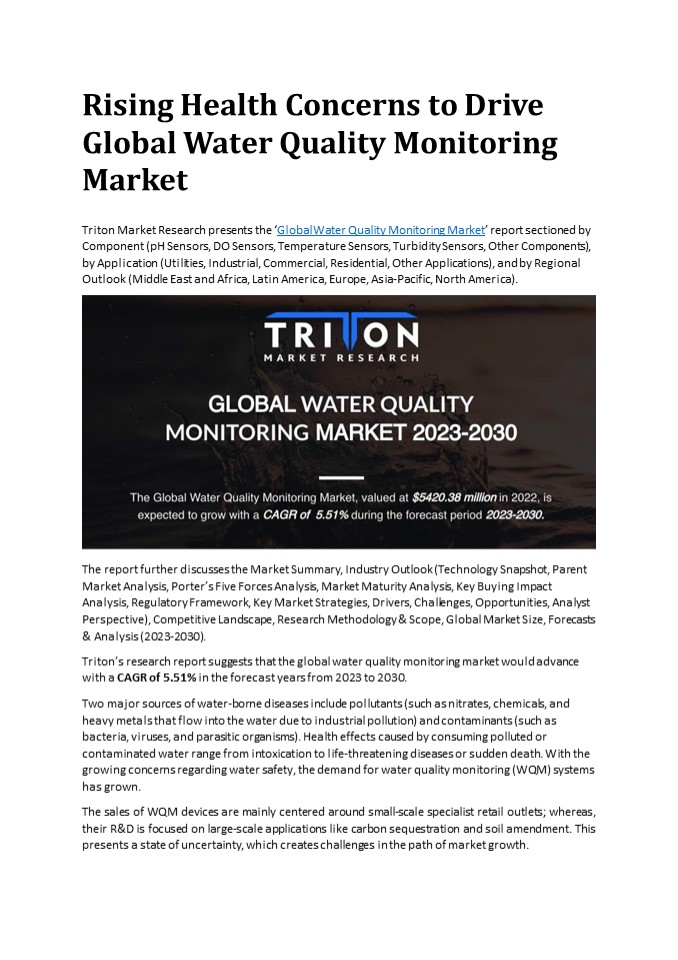
CAGR of 5.51 in the forecast years from 2023 to
2030. Two major sources of water-borne diseases
include pollutants (such as nitrates, chemicals,
and heavy metals that flow into the water due to
industrial pollution) and contaminants (such as
bacteria, viruses, and parasitic organisms).
Health effects caused by consuming polluted or
contaminated water range from intoxication to
life-threatening diseases or sudden death. With
the growing concerns regarding water safety, the
demand for water quality monitoring (WQM) systems
has grown. The sales of WQM devices are mainly
centered around small-scale specialist retail
outlets whereas, their RD is focused on
large-scale applications like carbon
sequestration and soil amendment. This presents a
state of uncertainty, which creates challenges in
the path of market growth.
2
North America is the leading regional market
globally, which accounted for the highest revenue
share in 2022. The contamination of water
resources with pathogens (such as fecal coliform
bacteria) is a grave concern in many areas across
the region. The source of this pathogenic
contamination is mainly untreated or poorly
treated sewage. Thus, the high adoption of water
quality monitoring systems is witnessed across
North America. Leading names engaged in the water
quality monitoring market include Xylem Inc,
Pentair Plc, Shimadzu Corporation, Agilent
Technologies Inc, Thermo Fisher Scientific Inc,
Emerson Electric Co, Evoqua Water Technologies
Corp, Horiba Instruments Inc, Teledyne
Technologies Inc, and Danaher Corporation. The
large capital investment required for RD,
manufacturing, and distribution acts as a
hindrance for aspiring market players. The
construction of a complete manufacturing unit
accounts for the largest share in terms of
capital investment. Moreover, the low number of
buyers owing to the lack of awareness across
several geographical locations hampers the growth
prospects for companies. The price wars and ease
of substitution are also anticipated to influence
the market dynamics in the forthcoming years.
Recommended

