

Water Quality Monitoring Market: IoT & Tech Prospects PowerPoint PPT Presentation
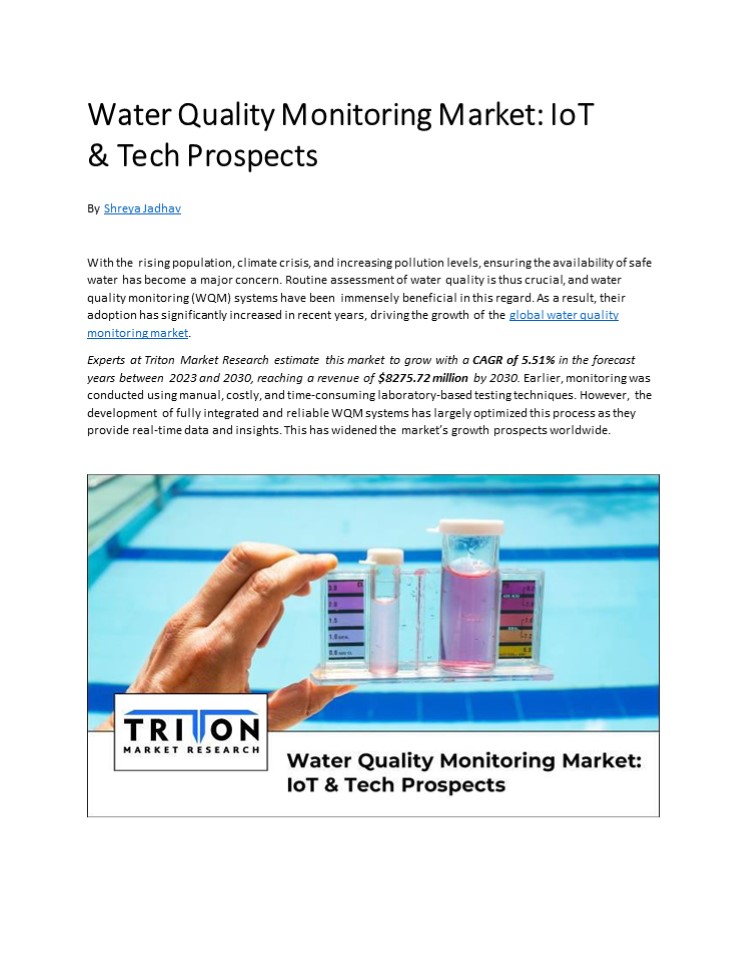
Title: Water Quality Monitoring Market: IoT & Tech Prospects
1
Water Quality Monitoring Market IoT Tech
Prospects
- By Shreya Jadhav
- With the rising population, climate crisis, and
increasing pollution levels, ensuring the
availability of safe water has become a major
concern. Routine assessment of water quality is
thus crucial, and water quality monitoring (WQM)
systems have been immensely beneficial in this
regard. As a result, their adoption has
significantly increased in recent years, driving
the growth of the global water quality monitoring
market. - Experts at Triton Market Research estimate this
market to grow with a CAGR of 5.51 in the
forecast years between 2023 and 2030, reaching a
revenue of 8275.72 million by 2030. Earlier,
monitoring was conducted using manual, costly,
and time-consuming laboratory-based testing
techniques. However, the development of fully
integrated and reliable WQM systems has largely
optimized this process as they provide real-time
data and insights. This has widened the markets
growth prospects worldwide.
2
How are Developed and Developing Markets
Leveraging WQM Systems? Several governments in
Europe have implemented stringent regulations to
safeguard water bodies in the region. The
increased emphasis on promoting sustainable water
usage, preventing reducing pollution, and
protecting improving the aquatic ecosystem has
largely enhanced the adoption of water quality
monitoring devices and systems across the
European market. Major players from the chemical,
textile, beauty cosmetics, and automotive
industries are shifting their manufacturing and
industrial facilities from developed nations to
developing ones. With this, the carbon emission
levels and industrial waste generation have also
risen. Moreover, the regulations pertaining to
wastewater disposal in these countries are not as
stringent as those in developed economies. The
serious health issues caused by consuming
contaminated water have necessitated the adoption
of WQM systems. Thus, the studied market shows
immense scope for expansion in the Asian,
African, and Latin American regions. In fact, the
Latin America water quality monitoring market is
anticipated to progress with the fastest CAGR of
7.42 during the forecasted period. pH Sensors
Their Utility, Demand, and Prospects One of the
causes of waterborne diseases is the consumption
of water that is highly acidic or alkaline in
nature, as it can disrupt the bodys balance.
Thus, measuring its pH levels is important. While
this was traditionally done using pH indicators,
sensor technology advancements have enabled more
accurate assessment with the development of pH
sensors. pH sensors dominates the component
segment. It held the highest revenue share of
1705.72 million in 2022, and is likely to grow
with the fastest CAGR of 5.83 during
2023-2030. Using its patented technology, Emerson
Electric Co has developed the Rosemount 550
single-use pH sensor it has a two-year shelf
life, and is incorporated with immediate sensor
verification and calibration features, which
eliminates the need for initial stabilization.
Besides, Xylem Inc and Thermo Fisher Scientific
Inc are also renowned for their cutting-edge pH
sensors and analyzers. Product launches by market
players, government regulations on
water-intensive industries, and the damaging
effects of acidic or basic water on pipelines
other equipment have surged the demand for these
sensors. The above-mentioned factors, along with
the high applicability of the sensors across
various industries, contribute to the growth of
the global pH sensors analyzers market. IoT
Integration Facilitating the Shift towards
Smart Water Quality Monitoring Even though the
currently used wireless sensor network-based
water monitoring systems have undergone
technological advancements over the years, they
come with their share of problems. However, the
integration of the Internet of Things (IoT) in
them has facilitated smart water quality
monitoring, by ensuring greater efficiency,
security, and cost-effectiveness, along with
providing real- time data. IoT allows smart
devices to conveniently store and exchange data,
and thus, this technology has found its
applications in environmental monitoring. One of
its benefits is that IoT-enabled WQM systems help
treat wastewater before it is released into
freshwater bodies.
3
Every year, millions of gallons of water are
wasted due to leaks, meter errors, and other
operational inefficiencies. IoT-based water flow
sensors are useful for spotting leakages and
other malfunctions immediately by analyzing the
flow through pipes. This helps curb the problem
before it results in high bills for commercial
and residential end-users. Realizing this growth
opportunity, Scotland-based M2M Cloud is working
towards enhancing its existing Neptune water
monitoring devices capabilities by incorporating
IoT, as part of a 156,247 project, in
association with CENSIS. This is indicative of
the fact that tech integration and innovation are
key for players to sustain and thrive in the
water quality monitoring market. FAQs Q 1)
What factor restricts the global markets
growth? The high cost of WQM systems majorly
hinders their adoption, thus restricting the
market growth. Q 2) Which are the various
applications studied in the market
report? Industrial, Commercial, Utilities,
Residential, and Other Applications are studied
in the market report. Q 3) Which region leads the
global WQM market? With the highest revenue of
2220.46 million in 2022, North America leads the
global market.
Recommended

