

How to practice the 5 Yamas of Yoga? PowerPoint PPT Presentation
Title: How to practice the 5 Yamas of Yoga?
1
What Are Yamas (Restraints) And How To Practice
The 5 Yamas?
There are eight parts of Raja Yoga, as mentioned
by Maharishi Patanjali. (1) Yama, (2) Niyama,
(3) Asana, (4) Pranayama, (5) Pratyahara, (6)
Dharana, (7) Dhyana, (8) Samadhi. Among these
eight, Yama has been given the first place.
Yama-niyama is two important parts of yogic
practice that provide a sufficient moral basis
for yogic practice. In both types of moral
discipline, there is a clear indication that the
open field of the person involves engaging in
some personal obligations. Yama Self-Restraint
List Yama means to keep the mind fixed in Dharma.
The form of Yama contains some moral principles
of life. In the chapter-2 (SADHANA PADA) verse 30
of Yoga Sutra, it is told in relation to Yama -
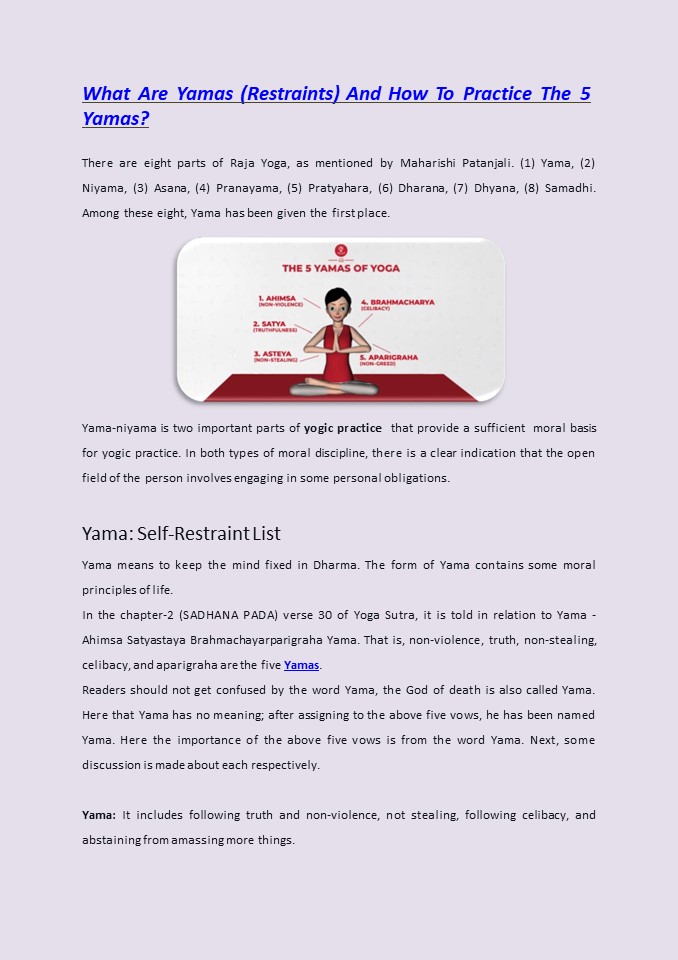
Ahimsa Satyastaya Brahmachayarparigraha Yama.
That is, non-violence, truth, non-stealing,
celibacy, and aparigraha are the five
Yamas. Readers should not get confused by the
word Yama, the God of death is also called Yama.
Here that Yama has no meaning after assigning to
the above five vows, he has been named Yama.
Here the importance of the above five vows is
from the word Yama. Next, some discussion is
made about each respectively. Yama It includes
following truth and non-violence, not stealing,
following celibacy, and abstaining from amassing
more things.
2
Yama is restraints-oriented. These five are -
Satya, Ahimsa, Asteya, Brahmacharya, and
Aparigraha. Ahimsa (Non-Violence) For a yogi,
doing Ahimsa is completely forsaken. Non-violence
against any living being, my mind, word, and
deed is non-violence. In this way, renouncing all
kinds of hatred towards all beings is considered
non-violence. Non-violence, in a narrow sense, is
not only not related to the killing of anyone,
but it has been kept in its wide use. It is also
given in the form of love to all beings in an
emotional condition. Patanjali believes that a
yogi who is non-violent naturally renounces the
enmity of all beings. Satya
Truthfulness Satya is to say as the mind has
understood, the eyes have seen, and the ears
have heard. But the truth must be not only
external but also internal. Knowing and believing
a thing as it is is called truth. For example,
knowing and fe eling a snake be a snake would be
true, and seeing a snake as a rope and otherwise
to see a rope as a snake would be untrue. It is
said in the scriptures that truth can be troubled
but not defeated. All the world's religious
texts unite the fact and make it the best. It is
believed that where truth resides, there are no
other vices. Every judicial system in the world
has been created to protect the fact. When sattva
is manifested through mind, word, and deed, it is
called truth or truth. In Sanatan culture, truth
is said to be the most special thing of God, and
it is said that God loves the truthful
one. There is a saying that truth and water
cannot be suppressed the more it is buried, the
stronger its power becomes. They make their
direction and come in front. Asteya Not
Steal The third Yama after truth and non-violence
is asteya, not to steal. The word Asteya has the
opposite meaning of the Sanskrit word 'Steyn'.
The word 'style' means 'to steal'. Asteya does
not mean stealing or deceiving the wealth or
property of
3
others for one's benefit. Asteya is an important
Yama in the Yoga-sutras of Patanjali. On the
contrary, "Asteya" means not committing any
theft. The observance of Asteya is not limited
to not stealing in physical form. Rather, it also
has to be followed at the level of speech and
thoughts. Brahmacharya The Brahman To control
the sense organs along with all other
sensesespecially not to obtain sexual pleasure
from the mind, speech, and bodyis
brahmacharya. Brahmacharya is the protection of
all the powers of the body with
restraint. Aparigraha Not To
Attach Renunciation of spontaneously acquired
means of happiness is Aparigraha. In Asteya,
theft is renounced, but charity is accepted.
Accumulation of wealth, property, and enjoyment
materials for selfishness is aparigraha, and not
doing so is aparigraha. By following Aparigraha,
there is a massive increase in non-violence so
that every human being can live happily by
fulfilling his basic needs. Aparigraha is also
followed for the accomplishment of non-violence.
Possession is always done by inflicting pain on
others.
Conclusion Yama is the first step of Ashtanga
yoga which means 'control' or 'restraint'.
Control should be over all the three minds,
speech and bodies. Yama is the moral promise that
to attain inner strength, it is necessary to
make the outer life sattvik and divine. Source
Link https//www.onfeetnation.com/profiles/blogs/
5-yamas
Recommended

