

Characteristics will differ charge on how the mineral is processed PowerPoint PPT Presentation
Title: Characteristics will differ charge on how the mineral is processed
1
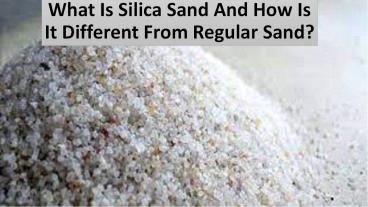
What Is Silica Sand And How Is It Different From
Regular Sand?
2
- Silica Sand is additionally referred to as Quartz
Sand because it is the obtained result of Quartz.
With the friction of wind, water, and Quartz,
stone break down into small granular molecules.
Thus, silicon oxide Sand is formed. They're
delicate non-crystalline molecules of SiO2. The
mineral composition of silicon oxide (SiO2) may
be a mixture of chemical elements and oxygen.
They will be obtainable on Earth Crust or mined
to extract pure silica sand exporters. - The extracted ore undergoes a process to remove
impurities to get the purest type of silica sand.
It's then dried up and sized to an exact particle
size in keeping with its application. It is
highly used in several construction purposes and
is one of the finest quality sands available in
the market.
3
- Silica sand, additionally called quartz sand,
white sand, or industrial sand, comprises two
main elements silica and oxygen. Specifically,
silica sand is made up of oxide (SiO2). The
foremost common variety of SiO2 is Quartz a with
chemicals inert and comparatively onerous
mineral. SiO2 grades at a seven out of ten on the
Mohs hardness scale, creating it ideal for
filtration media and abrasive blasting sands.
Though Quartz is commonly white or colorless, it
is available in an enormous type of shades. - The color of every sand deposit depends, for the
most part, on the range of minerals and rock
detritus that form up the resource. The fabric
should contain a minimum of 95 SiO2 and fewer
than 0.6 iron oxide to be considered oxide sand.
If the sand doesn't meet this criterion, it will
qualify as what's usually referred to as
''regular'' sand.
4
How is Silica Sand Different From Regular Sand?
- Silica sand consists of a minimum of 95 of SiO2,
whereas different styles of sand have about 80
of SiO2 or below. Silicon dioxide sand isn't like
other sand, concrete, and gravel types because it
is one of the purest types of sand. The
pure silica sand exporters offer that doesn't
have any color. If it does, then that's solely
because of the impurities in it. Usually found in
white, yellow, or beige colors. Thanks to its
high strength and hardness, it's wide employed in
numerous industries. Hence, it is named
Industrial Sand. - Regular sand, also referred to as Feldspathic
sand, brown sand, or construction sand, can
perpetually contain some oxide, however solely in
amounts below 95. For example, typical brown
sand used for concrete applications will have up
to 80 SiO2, with varying amounts of iron,
carbonate, potassium, and trace
elements/minerals. - These ''impurities'' build regular sand more with
chemicals reactive and infrequently darker in
color compared to silica sand. - The color for non-silica sands exporters (regular
sands) is often numerous shades of white, pink,
green, and black yet betting on the sand
deposit's earth science makeup and geographic
location.
5
Uses of Silica Sand
- There are various uses for oxide sand within the
industrial and business sectors, from golf
courses to glassmaking. Oxide sand may be a
commercial and shopper product that's wide
obtainable throughout North America.
However, silica sand exporters are employed on
physical, chemical, and mechanical
characteristics adore grain size, shape, color,
structure, distribution, refractoriness,
strength, and stability. These characteristics
will differ reckoning on how the mineral is
processed once it's mined. - 1. Construction It's extensively used in
construction. It's highly used in the assembly of
mortars and concrete because it acts as a primary
part for several building materials, i.e., the
total grain oxide sand is employed in roofing
shingle, cement, mortars, asphalt mixtures, and
alternative flooring compounds. Thanks to its
properties, it helps improves durability. Ground
silica, an anti-corrosive material, acts because
of the practical extender. - 2. Glass Production To manufacture any glass,
silica sand is used as raw material. The robust
chemical purity of silica sand exporters makes it
the most precise fit for manufacturing any glass
style, whether or not it might be mirror glass,
fiberglass. Take a look at tubes, ornamental
glassware, window glasses, monitor screens, bulbs
are more.
6
- 3. Oil and Gas Recovery the most valuable
property of silicon oxide sand within the oil
business is its hardness. Here it's referred to
as Frac Sand. Because its chemical purity can
attack the corrosive environment, its granules
deposit makes the foremost formation cuttings.
Once wired down in deep wells, it helps improve
the oil rate. - 4. Water Filtration and its Production We tend
to have heard that sand is employed in the water
filtration process. However, victimization
silicon oxide Sand as a filtration bed works
additional effectively in filtering the
contaminants in wastewater process associate
drinkable degreed filtration. Once exposed to
pollutants, solvents, and acids, this sand won't
react with any of those. Instead, it neutralizes
the acidic components and balances the pH levels
in water filters. - 5. Industrial Abrasives It is unremarkably used
in industries as an abrading for Sand Blasting.
Because of its angular varieties, it makes the
rough surfaces swish with Industrial Abrasive
Blasting. However, Industries ought to take
precautions to forestall the health problems
caused by the damaging sand dust. It can be
prevented by victimization resins or coating sand
with solvents to control the sand dirt.
7
Conclusion
- Silica is a type of mineral, and sand is a type
of sediment. If sand-sized sediment grains are
principally silicon oxide mineral or high in
silica mineral, it is classified as silica sand.
If feldspar (another mineral) is added to
sand-sized particles, it's called sand. However,
it is not silica sand (it is, obviously, feldspar
sand). Thus, silica sand exporters offer silica
sand which is far more durable than several
different rock minerals. - Silica sand is one of the foremost thick minerals
to survive the various weathering conditions. It
additionally has the potential to possess sand
made of non-rock forming mineral materials. Made
from ground-up cattle, different types of sands
are unremarkably manufactured from ground-up
shells of bivalves and other ocean creatures,
giving rise to organ or brown beach sands.
8
(No Transcript)
Recommended

