

The Indian Food Culture and the Noodle: the Historic Relationship PowerPoint PPT Presentation
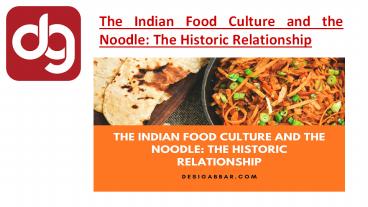
Title: The Indian Food Culture and the Noodle: the Historic Relationship
1
The Indian Food Culture and the Noodle The
Historic Relationship
2
When we hear about the noodle, a delicious and
spicy cuisine, which has been accepted across the
globe, we directly associate it with the Chinese
and Japanese culture. Even food historians do the
same. Yes, we don't deny the fact that the
Chinese and Japanese cultures have brought up the
noodle to the popular culture, we need to remind
us that wherever the noodle has travelled, it has
made a unique, integrated and its way to mix with
different cultures and has become an integral
part of the food cultures of those countries.
This blog discusses in length about the history
of the noodle in India, including when it arrived
in India, how the noodle has become an
inseparable part of the Indian food culture and
its place in contemporary Indian society. The
post will analyse India's historical relationship
with noodles, India specific noodles such as sev,
sevai, faluda and the occupation of new noodle
brands such as Chings noodles. Also, the blog
discusses historical texts and sources which
throw the light on the noodle and its
relationship with India. Stay tuned!
3
The noodle's introduction to India There is an
ongoing debate with no obvious conclusions about
whether noodles were introduced by the Indian or
Chinese society. Both the sides have their own
arguments and we can manage to conclude that both
the nations came up with their own versions of
noodles. However, both nations agree on one
point. When we talk about the potential
introduction and migration of noodles, both the
countries agree that the consumption of noodles
predates Marco Polo's travels along with the Silk
Road. Also, food historians believe that noodles
were an integral part of the Indian food culture
for a long time. Food historians and food
scholars believe that finger millet or ragi were
used in 2300 BC to make noodles, vermicelli and
other pasta type products. However, there is a
divided opinion for this fact among food
historians. However, we can safely conclude that
noodles have been a part of the Indian food
culture for more than 4000 years and even today,
public figures like Baba Ramdev proudly states
that noodles are very much Indian. However,
although its presence in India dates back to 4000
years, the acceptance of contemporary noodles
such as Ching's secret Hakka noodles require some
efforts to make it fit into the Indian society.
Next, we will discuss the characteristics and
aspects of noodles which made them fit into the
Indian community to understand and explore the
subject better.
4
Integration of noodles into the Indian food
culture A foreign dish that wants to integrate
with the local food culture must line up its
values and beliefs with that of the local food
culture's values, something that the local
community values more. The main reason here for
this commonality is to ensure that the local
community puts a foreign dish into their plates
as a part of adding experiences to their food
canon. Noodles have made the impression of social
bonding, gratitude, love and respect towards the
friends, families and particularly spouses.
Hinduism is also all about social harmony,
respect and acceptance for various beliefs and
loyalty to family. In addition to that, noodles
allow chefs to experiment with various fresh
ingredients and spices, something that the Indian
food culture greatly admires. You can have
tailor-made Indian noodles with the use of Indian
spices, herbs, vegetables and other staples that
can make the foreign dish more Indian. Also,
these additional ingredients bring so many health
benefits on the table too. These two unique
features have helped noodles to become an
inseparable part of the Indian food culture and
cemented its place in it.
5
Communal nature of the noodle The Indian
society is made of collective beliefs, practices
and interdependence over individual practices.
The ancient Indian scriptures clearly out this
feeling "Vasudheiv Kutumbkam" (the whole world is
a family and we all are related) and "Sanghe
Shakti Kalauyuge" (Together we can work and grow
for better meanings). The Indian joint family
culture has declined a bit but is still a strong
practice in India. Social cohesion, communal
harmony and respect for other religions and
cultures have been an integral part of the Indian
value system. On the other hand, noodles have
always been the symbol of love and respect
between the consumer and the one who serves it.
It has been a part of the Chinese communal
ceremonies and traditions. This symbolism
perfectly suits the Indian culture and traditions
and there is no doubt that the noodle has become
part of the Indian food culture and tradition.
India has always believed in forming new
relationships and experiences and collective
ideologies which perfectly coincides with the
general assumption of the values the noodle
form.
6
Contemporary role of noodles in India The modern
times came with many changes and modifications,
especially when it comes to Indian values and
traditions. The globalization and the influence
of western society. However, apart from the
traditional Indian noodles such as sev, sevai and
faluda have been the integrated part of Indian
ceremonies and celebrations. The contemporary
noodles such as Chings noodles are slowly making
its way into the changing Indian food dynamics.
It has found its resilience and adaptability in
India, especially among the new generation of
people. These packaged, positioned and marketed
noodles have been accepted by the new generation
despite the cultural shifting of values and
beliefs. The contemporary noodles will penetrate
the Indian food culture steadily and there is no
looking back now. Conclusion What makes the
Indian culture unique and distinctive is its
adaptability to accommodate anything, including
various dishes. Contemporary noodle items such as
Chings secret Hakka noodles and Maggi have been
accepted by the Indian culture, thanks to the
evolving nature of the Indian value system. The
history of the noodle and India goes a long back
and the relationship is not going to see a
decline for sure.
7
Contact Us
- Company Name Desi Gabbar
- Email support_at_desigabbar.com
- Phone (919) 762-6420
- Website - https//desigabbar.com/
8
Thank You
Recommended

