

High Quality Lab Filtration Product at Axiva Sichem Biotech PowerPoint PPT Presentation
Title: High Quality Lab Filtration Product at Axiva Sichem Biotech
1
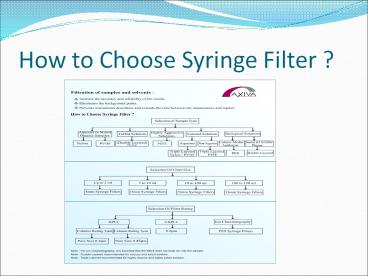
How to Choose Syringe Filter ?
2
SYRINGE FILTERS
A syringe filters generally consists of a plastic
housing with a membrane which serves as a filter.
The fluid to be purified may be cleaned by
drawing it up the syringe through the filter, or
by focusing the unfiltered fluid out through the
filter.
Membrane Filters
Membrane Filters or membrane is microporus films
with specific filtration rating. Membrane retains
particles and micro organisms that exceed their
filtration rating by acting as a physical barrier
and capturing such particles on the surface of
membrane.
3
Case study
- Chloroform (Halogenated Hydro carbon)
- DMSO (Dimethyl Sulfoxide)
- Lipid solution
- Hormones
- IVF / NMR
- Non aqueous colored solutions
- Highly viscous aqueous solution (Plasdone XL,
kolldon SR, Xanthan gum, Avicel PH 112)
4
How to choose Membrane Filter ?
5
What is blotting ?
- Blotting are techniques for transferring DNA, RNA
- and proteins onto a carrier so they can be
separated, - and often follows the use of a gel
electrophoresis. The - southern blot is used for transferring DNA, the
- Northern blot for RNA and the western blot for
- PROTEIN.
6
TYPES OF BLOTTING TECHNIQUES
7
Protein Blotting
- Protein blotting is an analytical Method that
involves the immobilization Of proteins on
membranes before detection Using monoclonal or
polyclonal antibodies. - There are different blotting protocols (dot blot,
2D blot) one of the most powerful is western
blotting.
8
Principle of Western Blotting
- Western blotting is an Immunoblotting
- technique which rely on the specificity of
binding - between a molecule of interest and a probe to
allow - detection of the molecule of interest in a
mixture of - many other similar molecules.
- In Western blotting, the molecule of interest is
a - protein and the probe is typically an antibody
raised - against that particular protein.
- The SDS PAGE technique is a prerequisite for
- Western blotting.
9
Flow Diagram of Western Blot
- Protein Blot on
SDS Polyacrylamide - Nitrocellulose
Gel Electrophoresis -
10
- Label With Specific
Detect Antibody - Antibody
-
Reveals Protein
-
of Interest
11
Western
Blot (Immunoblotting)
- A technique for detecting specific proteins
separated by electrophoresis by use of labeled
antibodies. So called Since it has some
similarity to a southern blot.
12
Definition
- The Western Blot is an analytical technique used
to detect specific proteins in a given sample
of tissue homogenate or extract.
13
Advantages of Western Blot
- Western blot analysis can analyze any protein
sample whether from cells or tissues, but also
can analyze recombinant proteins synthesized in
vitro. - Western blot is dependent on the quality of
antibody you use to probe for your protein of
interest, and how specific it is for this protein
14
Gel Electrophoresis
- Uses gel electrophoresis to separate native or
denatured proteins by the length of the
polypeptide (denaturing conditions) or by the 3-D
structure of the protein (native / non-denaturing
conditions). The proteins are then transferred to
a membrane (typically nitrocellulose or PVDF),
where they are probed (detected) using antibodies
specific to the target protein.
15
Monoclonal and Polyclonal Antibodies are used
- Here are now many reagent companies that
specialize in providing antibodies (both
monoclonal and polyclonal antibodies ) - Against tens of thousands of different proteins.
16
Most Uselful In
- This methods is used in the fields of
molecular biology, Biochemistry, immunogenetics
and other molecular biology disciplines.
17
The Procedure Includes
- Tissue Preparation
- Gel Electrophoresis
- Transfer
- Blocking
- Detection
- Analysis
18
Tissue Preparations
- Samples may be taken from whole tissue or from
cell culture. - In most cases, solid tissues are first broken
down mechanically using a blender. - It should be noted that bacteria, virus or
environmental samples can be the source of
protein and thus Western blotting is not
restricted to cellular studies only. - Assorted detergents, Salts, and buffers may be
employed to encourage lysis of cells and to
solubilize proteins. - Tissue preparation is often done at cold
temperature to avoid protein denaturing.
19
Gel Electrophoresis
- The proteins of the samples are separated using
gel - electrophoresis. Separation of proteins may be by
isoelectric - point molecular weight, electric charge, or a
combination of - these factors.
- The Principle involved is the difference in the
ELECTROPHORETIC - MOBILITIES of different proteins.
20
Gel Electrophoresis Machine
21
Transferring
- In Order to make the proteins accessible to
antibody - detection, they are moved from within the gel
onto a membrane made of nitrocellulose or
polyvinylidene difluoride (PVDF). The membrane is
placed on top of the gel, and a stack of filter
papers placed on top of that. The entire stack is
placed in a buffer solution which moves up the
paper by capillary action, bringing the proteins
with it. - Another method for transferring the proteins is
called electro blotting and uses an electric
current to pull proteins from the gel onto the
PVDF or nitrocellulose membrane.
22
Blocking
- The membrane has the ability to bind to proteins
in this case both the target and - antibodies are proteins and so there could be
some unwanted binding. - Blocking of non-specific binding is achieved by
placing the membrane in a dilute solution of
protein typically Bovine serum albumin (BSA)
with a minute percentage of detergent such as
tween 20. - The protein in the dilute solution attaches to
the membrane in all places where the target
proteins have not attached. Thus, when the
antibody is added, there is no room on the
membrane for it to attach other than on the
binding sites of the specific target protein.
23
Detection
- During the detection process, the membrane is
Probed for the protein of interest with a
modified antibody which is linked to a reporter
enzyme, which when exposed to an appropriate
substrate drives a colorimetric reaction and
produces a color.
24
WESTERN BLOT REACTIVITY IN ONE HIV- 1,
SEROCONVERTER
25
Analysis
- After the unbound probes are washed away, the
western blot is ready for detection of the
probes, that are labeled and bound to the protein
of interest. - Size approximations are taken by comparing the
stained bands to that of the marker loaded during
electrophoresis. - The process is repeated for a structural protein,
such as actin, or tubulin that should not change
between samples.
26
Advantages
- While ELISA being a non-specific test, Western
blotting is a more specific test for detection of
HIV. - It can detect one protein in a mixture of
proteins while giving information about the size
of the protein and so is more specific. - Western blot test is referred to as the Gold
standard - It also tells you how much protein has
accumulated in cells.
Recommended

