

Keep A Check On Those Frozen Pipes From Winter’s Demolition PowerPoint PPT Presentation
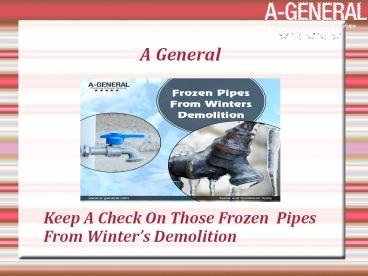
Title: Keep A Check On Those Frozen Pipes From Winter’s Demolition
1
A General
Keep A Check On Those Frozen Pipes From Winters
Demolition
2
February is very near and it is also that month
of the year, when freezing temperatures create
havoc in our daily lives. According to the latest
weather reports, 2015 is going to be the coldest
year in America, which is mainly due to
incoherent atmospheric behaviour. But in these
chilly conditions, the two most common risks that
you would face at your home, office and school
are the ice dams and frozen pipes. Ice dams are
formed when heavy snow buildup melts during the
day, then refreezes as temperatures drops down
overnight. This is a continuous process, which
occurs during the full length of winter season.
After several days of this cycle, the melted
water and ice combine together under the
shingles, entering the attic and eventually
damaging ceilings, walls, and contents.
3
One household accessory that directly faces the
problem of this killer winter are the plumbing
fixtures and frozen pipes. Frozen water pipes are
always a cause of concern and a sure shot
possibility during the cold winter months.
Although there are various tips and tricks that
you can do to prevent frozen pipes, there is
always a chance that pipes will freeze and
finally burst. But, if such is the situation, a
rapid action to thaw frozen pipes can help
minimize or prevent damage to pipes. There are
various indicators that suggest your pipeline is
affected due to the unconditional snow. A faucet
that produces no water, or very little water is
one of the signs of a frozen pipe. Sniff out the
location of the freeze by following the water
pipes from the faucet to the frozen area. Note
down that pipes are more likely to freeze when
they are near exterior walls, places with little
insulation and the point from where the water
comes into the house from outside. An exposed
pipe is easier to thaw than pipes located behind
walls.
4
(No Transcript)
5
Below are some tips and tricks on how to thaw
frozen pipes and help prevent burst pipes. How
To Thaw Frozen Pipes? To thaw a frozen pipeline,
begin by checking all the faucets in your home to
find out how many areas of pipe are affected.
Sometimes only one of the faucet will be
affected, but otherwise multiple fixtures do
freeze. Once you get to know the extent of
freeze, it will be easy for you to determine, how
and where to start thawing frozen pipes. When
you start the process, turn the affected faucets
on and allow water to drain as it thaws. The
running water helps to melt the frozen water in
the pipeline more rapidly. Point to note here is
that a trickle of running water is a good way to
prevent frozen pipes.
6
The next step would be to gradually warm up the
pipe to melt the ice with several safe heating
sources which are specially used to thaw frozen
pipelines. The best appliance would be an
electric heating pad as it can be wrapped around
the pipe to heat it evenly. Human accesories such
as a hair dryer or portable space heater are also
good heat sources to use. Thaw frozen pipes
moderately and evenly to prevent damage to the
pipe. Please keep in mind to never use a
blowtorch or open flame of any sort for this
plumbing process, as a torch or a flame can
develop a fire hazard and it can heat the water
present in the pipe very quickly, causing you
further damage. Finally, continue to heat and
closely check for any frozen pipes until water is
running through the faucet at the regular
pressure. Just a slight decrease in water
pressure is a tip off which says there is still
some ice in the pipes. When the water is once
again running in the regular flow, now its time
to consider what preventive measures you can take
to avoid frozen pipes in the near future.
7
- Tips to Overcome Frozen Pipe Hazard
- Be alert to shut off the main water line if the
pipe begins to leak as it thaws. Always carry a
container to catch the dripping water. - Never be distracted or walk away while you are
thawing a frozen pipe. The process should be
watched closely to avoid water damage in case of
a leak. - If you are not able to access the frozen pipe
because if it is in the wall, the process can be
carried out by turning up the heat in the house. - If you are not able to trace the location or you
are unable to carry out the operation of the
frozen pipes, do not hesitate to call a
professional plumbing service company, as they
are the experts to carry general plumbing
repairs. - Quick action against frozen pipes can save you of
the misery and expense of repairing a burst pipe.
8
- A General Plumbing Sewer
- 129, Adelphia Road,
- Farmingdale, NJ 07727
- http//www.a-general.com/
- Phone No. - 732-919-7000
9
(No Transcript)
Recommended

