

All About Wire Installation In Aircrafts - Miracle Electronics PowerPoint PPT Presentation
Title: All About Wire Installation In Aircrafts - Miracle Electronics
1
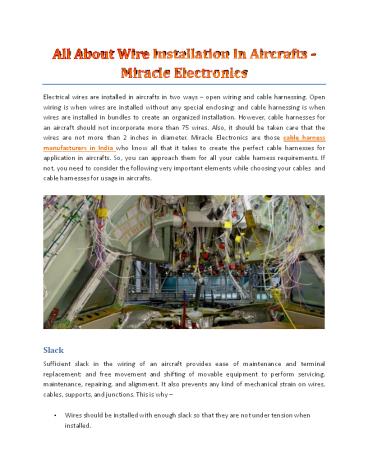
Electrical wires are installed in aircrafts in
two ways open wiring and cable harnessing. Open
wiring is when wires are installed without any
special enclosing and cable harnessing is when
wires are installed in bundles to create an
organized installation. However, cable harnesses
for an aircraft should not incorporate more than
75 wires. Also, it should be taken care that the
wires are not more than 2 inches in diameter.
Miracle Electronics are those cable harness
manufacturers in India who know all that it takes
to create the perfect cable harnesses for
application in aircrafts. So, you can approach
them for all your cable harness requirements. If
not, you need to consider the following very
important elements while choosing your cables
and cable harnesses for usage in aircrafts.
- Slack
- Sufficient slack in the wiring of an aircraft
provides ease of maintenance and terminal
replacement and free movement and shifting of
movable equipment to perform servicing,
maintenance, repairing, and alignment. It also
prevents any kind of mechanical strain on wires,
cables, supports, and junctions. This is why - Wires should be installed with enough slack so
that they are not under tension when installed.
2
- Wires connected to movable equipment should have
enough length so as to allow travel without
tension on the bundle. - Wires at terminals or connectors should have
enough slack to allow two re-terminations
without the need for replacing the wires. - Bend Radius
- The minimum radius of bends in the wire bundles
must not be less than 10 times the outside
diameter of the largest wire. However, where the
wire is well-supported, the radius may be 3
times the diameter of the wire. There are certain
situations when it is not practical to install
the wires within these radius requirements. In
such cases, the bend should be enclosed in
insulating tubing. Another important point to
remember is that RF cables should be bent at a
radius not less than 6 times the outside diameter
of the wire. - Splicing
- Splicing can be done as long as it doesnt affect
the reliability and electromechanical
characteristics of the wiring. But, even if this
condition is take care of splicing can only be
done if there is engineering approval for the
same. However, there are certain limitations that
need to be kept in mind - Splicing should be kept to the minimum.
- There shouldnt be more than one splice in an
individual wire segment between two - connectors or disconnect points.
- Splice should not be used within 12 inches of a
termination device. - Splicing should be completely avoided where there
is extreme vibration. - Twisting
3
- Clamps
- Wires and harnesses within an aircraft are
supported by clamps, making them a very important
constituent in aircraft wire installation, which
is why we include this section in this blog. - Clamps should be constructed of materials that
are compatible with the environment in which
they will be installed. The considerations here
include temperature, mechanical loads, fluid
resistance, and exposure to UV rays. - Clamps should be spaced at intervals of not more
than 24 inches and sufficient slack should be
left between the last clamp and electrical
equipment to prevent strain at the terminal and
other adverse effects. - Clamps should be installed with their attachment
hardware positioned above them so that they are
prevented from rotating. They must be installed
with the back rested - against a structural member. Also, it must be
taken care that the wires do not come in contact
with other parts of the aircraft due to
inappropriate clamping, when subjected to
vibration. - Clamps should snugly fit around the wires so as
not to pinch them, while also taking care that
the wires do not move through the clamp even with
the slightest axial pull. However, clamps on RF
cables must be such that they dont permit free
movement of the cable through the clamp, but
allow the cable to slide through the clamp with
the application of a light axial pull. - Clamps shouldnt be used where they interfere
with movable controls, or where wire bundles
come in contact with movable equipment. Also,
they must not be used on vertical runs where
involuntary slack movement could result in
chafing or other damage. - These are only some of the very important
considerations of installing wires and harnesses
within an aircraft. There is much more to be
considered, which is why you need experts for the
job, who can take care of not only the
installation, but also the protection of wires
and harnesses against elements like high
temperatures, fluids, solvents, chafing, and
movement. - For more details, please visit Miracle
Electronics
Recommended

