

Melbourne 's History,Climate, Economy,religion, crime and goverence PowerPoint PPT Presentation
Title: Melbourne 's History,Climate, Economy,religion, crime and goverence
1
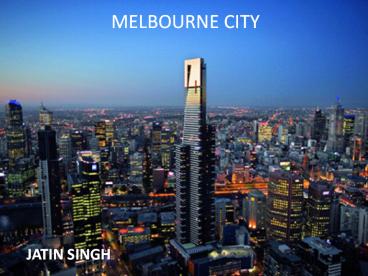
MELBOURNE CITY
- JATIN SINGH
2
Tables of Content
- About Melbourne
- History
- Culture
- Climate
- Economy
- Religion
- Governance
- Crime
- Source
3
About Melbourne
- The city is the second authority seat and second
authority residence of the Governor-General of
Australia and the Prime Minister of the country. - The city is the second authority seat and second
authority residence of the Governor-General of
Australia and the Prime Minister of the country. - Melbourne rates highly in education,
entertainment, health care, research and
development, tourism and sport making it the
world's most liveable city - It was named "Melbourne" by the Governor of New
South Wales, Sir Richard Bourke, in honour of the
British Prime Minister of the day, William Lamb,
2nd Viscount Melbourne.
4
History
- The area around Port Phillip and the Yarra
valley, on which the city of Melbourne now
stands, was the home of the Kulin people. - an alliance of several language groups of
Indigenous Australians, whose ancestors had lived
in the area for an estimated 31,000 to 40,000
years. - The area was an important meeting place for the
clans of the Kulin, as well as a vital source of
food and water. The Kulin lived by fishing,
hunting and gathering, and made a good living
from the rich food sources of Port Phillip and
the surrounding grasslands.
5
Culture
- Melbourne is an international cultural centre,
with cultural endeavours spanning major events
and festivals, drama, musicals, comedy, music,
art, architecture, literature, film and
television. - The city celebrates a wide variety of annual
cultural events and festivals of all types,
including Australia's largest free community
festival. - The culture of the city is an important drawcard
for tourists, of which just under two million
international overnight visitors and 57.7 million
domestic overnight visited during the year ending
March 2014.
6
Climate
- Melbourne has a temperate oceanic climate and is
well known for its changeable weather conditions. - This temperature differential is most pronounced
in the spring and summer months and can cause
very strong cold fronts to form. - These cold fronts can be responsible for all
sorts of severe weather from gales to severe
thunderstorms and hail, large temperature drops
and heavy rain. - Melbourne receives 48.6 clear days annually. Dew
point temperatures in the summer range from 9.5
C (49.1 F) to 11.7 C (53.1 F).
7
Economy
- Melbourne has a highly diversified economy with
particular strengths in finance, manufacturing,
research, IT, education, logistics,
transportation and tourism. - The city is home to Australia's largest and
busiest seaport which handles more than 75
billion in trade every year and 39 of the
nation's container trade. - Airport provides an entry point for national and
international visitors, and is Australia's second
busiest airport. - Melbourne is also an important financial centre.
Two of the big four banks, NAB and ANZ, are
headquartered in Melbourne.
8
Religion
- Melbourne has a wide range of religious faiths,
the most widely held of which is Christianity. - This is signified by the city's two large
cathedralsSt Patrick's (Roman Catholic), and St
Paul's (Anglican). Both were built in the
Victorian era and are of considerable heritage
significance as major landmarks of the city. - According to the 2011 Census, the largest
responses on religious belief in Melbourne were
Roman Catholic (27.2), no religion (23.5),
Anglican (10.8), Eastern Orthodox (5.5),
Buddhist (4.0), Muslim (3.5), Jewish (2.5) and
Hindu (2.0).
9
Governance
- The governance of Melbourne is split between the
government of Victoria and the 26 cities and five
shires which comprise the metropolitan area. - There is no ceremonial or political head of
Melbourne however, the Lord Mayor of the City of
Melbourne often fulfils such a role as a first
amongst equals, particularly when interstate or
overseas. - The local councils are responsible for providing
the functions set out in the Local Government Act
1989 such as urban planning and waste management.
10
Crime
- Although Melbourne's crime rate dropped 6.3 in
2014, it still has Victoria's worst crime rate
with over 26,000 offences per 100,000 people.
11
Source
- http//australiapopulation2017.com/population-melb
ourne-2017.html - https//en.wikipedia.org/wiki/MelbourneReligion
Recommended

