

NIH to Decide the Fate of Revolutionary Gene Editing Technology PowerPoint PPT Presentation
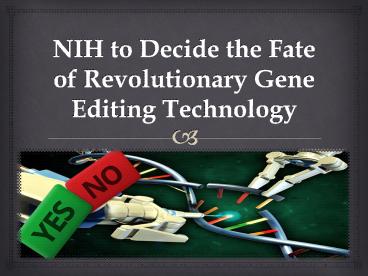
Title: NIH to Decide the Fate of Revolutionary Gene Editing Technology
1
NIH to Decide the Fate of Revolutionary Gene
Editing Technology
2
- National Institutes of Health (NIH)s Recombinant
DNA Advisory Committee (RAC) will review the
decision of using the CRISPR/Cas9 technology for
the first-in-human use for gene editing.
3
- The Federal Advisory Committee will review the
proposal for test of CRISPR /Cas9 technology on
humans on 21st and 22nd June, 2016.
4
- The committee is set up to calculate the
potential risk factor of this technology, as the
modified T cells can skip the regular checks and
bypass that prevent immune system from attacking
ones own tissue.
5
- CRISPR (Clustered regularly interspaced short
palindromic repeats) technology is a popular gene
editing tool. It is based on a bacterial
CRISPR-associated protein-9 nuclease (Cas9) from
Streptococcus pyogenes.
6
- It was first observed in bacterial community. The
video below explains the CRISPR /Cas9 technology
in detail (Video credit McGovern Institute for
Brain Research at MIT).
7
(No Transcript)
8
- Future plans of many researchers in renowned
Universities as well as high profile biotech
companies depend upon the approval of the review.
9
- One of such proposals will be of University of
Pennsylvania, where researchers will start their
studies of this genome editing technology on
humans specifically targeting two genes in the T
cells which they aim to edit by using CRISPR.
10
- The T cells will be modified and enabled by the
CRISPR technology to encounter the myeloma,
melanoma and sarcomas tumor cells. University of
Pennsylvania was also a contributor to a pioneer
reformed blood cancer treatment where the
patients blood cells were genetically altered
and refused in blood stream to identify and
eliminate the cancer cells.
11
(No Transcript)
12
- Usually pharmaceutical companies are reluctant to
use such novel technologies without trying and
testing but CRISPR/Cas9 is an exception to it. As
many upstart companies as well as high profile
biotech companies are interested in this
reliable, efficient and cheap technique.
13
- In short, CRISPR is a powerful gene editing
therapy used to cut and paste genes swiftly,
precisely and rapidly. Cambridge based
therapeutic company Editas Medicine are
planning to use this technology for a certain
rare eye disease and will start their trial
somewhere around in 2017.
14
- Several other companies also intend to capitalize
on this technique if the green signal is given.
Crispr Therapeutics, Caribou Biosciences (and
spinoff Intellia Therapeutics) are gearing up to
invest in this emerging technology.
15
- A lot is at stake for the researchers as well as
the investors on the decision of the panel. The
future of medicine and various treatments lies in
the upcoming review. But the technique does come
with its own pros and cons.
16
- For More Update, Visit Us
http//medgenera.com/
Recommended

