

SECURITY ANALYSIS A topdown approach PowerPoint PPT Presentation
1 / 5
Title: SECURITY ANALYSIS A topdown approach
1
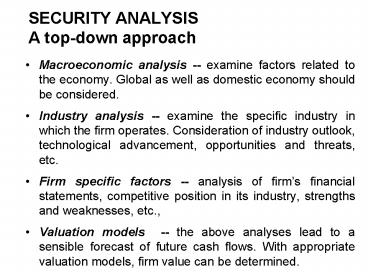
SECURITY ANALYSISA top-down approach
- Macroeconomic analysis -- examine factors related
to the economy. Global as well as domestic
economy should be considered. - Industry analysis -- examine the specific
industry in which the firm operates.
Consideration of industry outlook, technological
advancement, opportunities and threats, etc. - Firm specific factors -- analysis of firms
financial statements, competitive position in its
industry, strengths and weaknesses, etc., - Valuation models -- the above analyses lead to a
sensible forecast of future cash flows. With
appropriate valuation models, firm value can be
determined.
2
Macroeconomic Analysis
- The global economy -- Globalization of economy
links individual country economy to the rest of
the world. International trades become very
important to a countrys economic health. - Domestic economy -- country specific factors are
considered to evaluate the firms economic
environment. - GDP (gross domestic product)
- Employment
- Inflation
- Interest rates
- Budget deficit
- Sentiment
3
Macroeconomic Analysis
- The demand and supply shocks -- Shifts in
aggregate demand and supply due to macroeconomic
factors are examined. - reduction (increase) in tax rates
- increases (decreases) in money supply
- increases (decreases) in government spending
- increases (decreases) in foreign export demand
- Federal government policy -- Federal government
often intervenes by setting its fiscal and
monetary policies. - Fiscal policy government spending and tax
policy. This can affect aggregate demand either
directly or indirectly.
4
Macroeconomic Analysis
- Monetary policy manipulation of money supply
through changes in interest rates. This affects
the aggregate demand in the economy. - Supply-side policy The use of tax incentives to
increase aggregate supply. - Business cycle -- understanding patterns of
economic expansion and contraction help to
predict industry as well as firm performance.
5
Industry Analysis
- Industry life cycles -- investigation of
industry life cycle to determine the growth
prospects. - Start-up stage
- Consolidation stage
- Maturity stage
- Relative decline
- Industry structure and performance
- threat of entry
- rivalry between existing competitors
- competition from substitution products
- bargaining power of buyers
- bargaining power of suppliers
Recommended

