

The New Jersey Meadowlands Commission: Measuring and Tracking Performance PowerPoint PPT Presentation
1 / 36
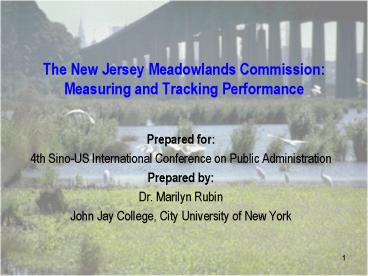
Title: The New Jersey Meadowlands Commission: Measuring and Tracking Performance
1
The New Jersey Meadowlands Commission Measuring
and Tracking Performance
- Prepared for
- 4th Sino-US International Conference on Public
Administration - Prepared by
- Dr. Marilyn Rubin
- John Jay College, City University of New York
2
The New Jersey Meadowlands Commission
- The New Jersey Meadowlands Commission is a
regional zoning, planning and regulatory agency
created by the New Jersey Legislature in 1968. - Its three mandates are to protect the
environment, ensure orderly economic development,
and provide for solid waste management in the New
Jersey Meadowlands District.
3
The New Jersey Meadowlands District
- The New Jersey Meadowlands District is located
in northeastern New Jersey just west of New York
City.
4
(No Transcript)
5
The New Jersey Meadowlands District
- The Meadowlands District stretches mainly along
the terminus of the Hackensack and Passaic Rivers
where they flow into Newark Bay which is part of
what is known as the Hudson Raritan Estuary
(HRE). - The HRE covers more than 16,000 square miles and
surrounds the Ports of New York and New Jersey in
a region populated by 20 million people close
to seven percent of the total U.S. population.
6
(No Transcript)
7
The New Jersey Meadowlands District
- The Meadowlands District, a part of the Hudson
Raritan Estuary, encompasses 30.4 square-miles or
nearly 20,000 acres in parts of 14 northern New
Jersey municipalities. - About 8,200 acres constitute what are referred to
as wetlands. The remaining 12,000 acres in the
District are highly developed with offices,
warehouses and entertainment venues built over
what were, at one time, also natural wetlands.
8
Wetlands
- Wetlands are a collective term referring to land
that is intermittently or periodically
waterlogged including marshes, tidal estuaries
and swamps. - Wetlands generally host a multitude of plant and
animal species. About 40 percent of the 800
species of birds in North America breed in or use
the wetlands in the Meadowlands during spring and
fall migrations. - Wetlands, which also filter pollutants from water
and help to mitigate flood damage, have been
disappearing from the Meadowlands area for
several centuries.
9
The Meadowlands Over Time the Changing
Environment
10
Before the Europeans
- Before the arrival of the Europeans, the area we
now call the New Jersey Meadowlands was home to
the Lenape people. - The area the Lenape inhabited was a marshy forest
of tamarack and Atlantic white cedar trees that
covered most of the lands along the river
running through the meadowlands. - The Lenape called the river the Atchensehaky
meaning the River of Many Bends. They treated
the River and the land around it with reverence.
10
11
The Meadowlands Develop
- Europeans first sailed up the river they renamed
the Hackensack in the early 1600s. - They built dozens of drawbridges spanning the
Hackensack River to facilitate movement of goods
and people by land as well as by water. - In the 19th century railroads began to crisscross
even the formerly impenetrable marsh now known as
the New Jersey Meadowlands. The area would
eventually become todays regional transportation
hub.
12
The Beginning of Environmental Problems
- As the regions population increased, the
Hackensack River was used more and more for waste
disposal, creating pollution in the water and in
the nearby areas. - Environmental problems increased during the
industrial revolution of the 19th and early 20th
centuries when companies routinely dumped their
raw sewage into the Hackensack River and the
lowlands on both sides of the River.
13
The Meadowlands Become a Dumping Area for the
Region
- In the 1940s and 1950s and into the 1960s, the
Meadowlands were the regions garbage dump with
more than 100 municipalities dumping and burning
garbage, polluting the air, ground and water in
the area. - Some of the trash was buried the rest was
deposited in what are called landfills or trash
mountains which are built into or on top of the
ground destroying the wetlands that they cover.
14
Trash Being Dropped at a Landfill
15
Trash Being Loaded and Compacted in a Landfill
16
Economic Development Comes to the Meadowlands
- In the 1960s, while trash burning and
land-filling continued to destroy acres of
wetlands in the Meadowlands, there was also rapid
economic development taking place in many
northern New Jersey municipalities along and
close to the Hackensack River - The new development quickly took over what had
been acres of natural wetlands.
17
Need for Control
- By the late 1960s, it had become increasingly
clear that continued dumping and uncontrolled
economic growth would, if left unchecked, wipe
out the rest of the wetlands and the remaining
open space in the Meadowlands area.
18
The State Steps In
- In recognition of the need to address economic
development and environmental issues in the
Meadowlands, the Legislature of the State of New
Jersey State passed the Hackensack Meadowlands
Reclamation Development Act in 1968. - The Act created the Hackensack Meadowlands
Development Commission (HMDC) to provide for more
orderly economic development and to regulate
solid waste disposal in what was designated as
the Meadowlands District.
19
Hackensack Meadowlands Reclamation and
Development Act
- When the Commission began operations in 1969,
landfills had buried 1,200 of the 20,000 acres in
the District with garbage. Offices, warehouses,
highways, railroads, and a sports complex covered
a large part of the remaining acreage.
20
The Meadowland Commission Mission Evolves
- Over the next two decades, as the HMDC carried
out its two primary mandates, its work took a
much greater environmental focus. - This realignment reflected the growing
realization of the linkage between protecting the
environment, especially the wetlands, and
sustainable economic development. - In 2001, the Commissions evolving mission was
reflected in its name change to the New Jersey
Meadowlands Commission (NJMC).
21
NJMC Master Plan
- In 2004, the NJMC issued its first Master Plan
which provided a blueprint for promoting economic
development while protecting the endangered
environment and, at the same time, managing solid
waste disposal.
22
The NJMC Comprehensive Action Plan
- In 2006, the NJMC developed a comprehensive
action plan (CAP) - (1) to provide a more strategic approach in its
management and planning operations and - (2) to establish a set of performance measures
that would help to track activities and to assess
how well the Commission was meeting the goals and
objectives set forth in the Master Plan.
23
The Comprehensive Action Plan Has Five
Components
- I Strategic Plan - sets measurable goals,
objectives, and strategies - II Performance Measures - establishes metrics
and the tracking of goals and strategies - III Human Resources Management - links employee
performance to NJMC goals and objectives - IV Performance Budgeting - links the NJMC
budget to Strategic Plan goals - V Financial Plan - helps ensure long-term
availability of resources in changing environment
24
Focus in My Presentation Is on the First Two
Components
- I The Strategic Plan
- II Performance Measures
25
Part I The Strategic Plan
- The Strategic Plan sets measurable goals,
objectives, and strategies for the Commission
evolving from its vision and mission.
26
The NJMC Vision and Mission
Vision As steward of the 30.4 square mile
Meadowlands District, the NJMCs vision is to
create a revitalized, green, and sustainable
urban community for people who live, work,
commute to, or visit the District.
Mission To protect and promote the Meadowlands
environment ensure orderly economic development
and growth in the District and provide for
shared regional services including, but not
limited to solid waste management.
27
Five themes Organize the Goals, Objectives and
Strategies in the Strategic Plan
28
Four Themes Set the Action Plan for the NJMC
29
The Fifth Theme Focuses on Improving the
Operational Efficiency of the Agency
30
Each Goal has Several Objectives and Strategies
Objectives
Strategies
Objective 2.1 Enhance and maintain
educational/outreach programs Objective 2.2
Enhance existing research and wetlands monitoring
initiatives
Strategy 2.11 Improve publicity for
eco-tourism Strategy 2.12 Increase eco-tourism
participation Strategy 2.13 Expand use of the
Meadowlands Environmental Center (MEC) by school
children Strategy 2.14 Enhance the publics use
of, and satisfaction with, the MEC Strategy 2.15
Enhance the MEC website for educators Strategy
2.16 Develop distance learning capabilities at
the MEC for grades K-12 Strategy 2.17 Increase
the number of volunteers participating in
environmental protection activities Strategy
2.21 Continue to encourage research
opportunities and collaboration with New Jerseys
institutions of higher education
31
Part II Performance Measures and the Strategic
Plan
- Metrics are linked to individual strategies for
each goal and its related objectives. - A tracking system is established to assess
progress in meeting the goals, objectives and
strategies set forth in the Strategic Plan.
32
Performance Metrics An Illustration
33
Tracking An Illustration
34
The Tracking System
- The Meadowlands Performance Measurement Tracking
System will provide the NJMC with a electronic
means to collect, track and report performance
data (See Handout). - The system will utilize web-based software that
allows for data entry and report generation and
automatically generates graphic images (e.g.,
line graphs, pie graphs, and bar graphs). - The system will produce quarterly as well as
multi-year reports and provides for adaptability
to meet the changing needs of the Commission.
35
Progress in Implementing the Strategic Plan
- The governing board of the NJMC has adopted the
Comprehensive Action Plan. - The NJMC has, however, not yet implemented the
data collection and tracking system described in
my presentation. - Only time will tell if and how strategic planning
is used to guide the operations and activities of
the Commission.
36
(No Transcript)
Recommended

