

Local actors in Mediterranean mass tourism development: the Majorcan case PowerPoint PPT Presentation
1 / 24
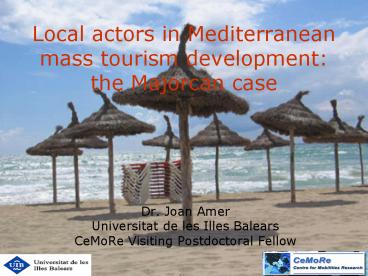
Title: Local actors in Mediterranean mass tourism development: the Majorcan case
1
Local actors in Mediterranean mass tourism
development the Majorcan case
- Dr. Joan Amer
- Universitat de les Illes Balears
- CeMoRe Visiting Postdoctoral Fellow
2
TABLE OF CONTENTS
- Foreword.
- Introduction.
- The Majorcan transition to a tourist economy.
- The beginnings of hoteliers.
- The entrepreneurial culture.
- The political articulation of hoteliers.
- The political impact of hoteliers.
- The debate of tourist and land-planning policies.
- Balearic government period of centre-to-right
forces (1983-1999). - Balearic government period of centre-to-left
forces (1999-2003). - Conclusions.
3
FOREWORD
- The presentation is based on the authors PhD
dissertation Tourism and politics. Majorcan
hoteliers. - This is a work-in-progress paper.
- Case-study approach.
- Present stage
- Search of contextualisation within international
theoretical framework in tourism studies,
specifically about tourism, power and politics. - Search of comparative contexts on other tourist
islands (specially Mediterranean).
4
PHD AND BOOK
The book (published 2006)
5
INTRODUCTION
- Mallorca as a pleasure periphery and as a
global beach. - Local entrepreneurial participation.
- Why hoteliers?
- Majorcan hoteliers creating new pleasure
peripheries. - Local politics level The political impact of
Majorcan hoteliers. - Historical perspective and case-study
approach. - Historical narration.
6
LÖFGRENS DEFINITION OF GLOBAL BEACH (1999)LEGO
PARADISA
- Löfgren This bricolage of props and activities
comes from different settings and epochs all
around the world and now, integrated and
globalized, becomes a familiar place to play at
being a tourist. (1999215)
7
(No Transcript)
8
INTRODUCTION
- Mallorca as a pleasure periphery and as a
global beach. - Local entrepreneurial participation.
- Why hoteliers?
- Majorcan hoteliers creating new pleasure
peripheries. - Local politics level The political impact of
Majorcan hoteliers. - Historical perspective and case-study
approach. - Historical narration.
9
THE MAJORCAN TRANSITION TO TOURISM ECONOMY
(1)DIMENSIONS OF THE TOURIST CHANGE
- 1959
- 321.222 tourists.
- 324.560 inhabitants.
- 47 services share of the gross product.
- Source Balearic Savings Bank reports and
Balearic Government data (2007)
- 2006
- 8.596.000 tourists.
- 790.763 inhabitants.
- 85 services share of the gross product.
10
THE MAJORCAN TRANSITION TO A TOURIST ECONOMY (2)
- Insular pre-tourist society rural o industrial?
- Characteristics of the Majorcan transition
- Celas theory (1979) Europe-Mallorca,
core-periphery relationships. - Maneras theory (2000) Mallorca, industrial
society. - Complementary visions.
11
THE BEGINNINGS OF MAJORCAN HOTELIERS
- Hoteliers new entrepreneurial class.
- Hoteliers and tour operators.
- Hoteliers and banks.
- Hoteliers and Franco dictatorship.
12
THE ENTREPRENEURIAL CULTURE
- Political conservatism.
- Island entrepreneurial culture, according to
Miquel and Reina (2001), is determined by - Agrarian-social relations within a
tourist-service based economy. - Sense structures, perceptions and social networks
of contemporary Mallorca which are generated
within the framework of pre-tourist society.
13
THE POLITICAL ARTICULATION
- Francos era (1959, beginning of mass tourism, to
1975, Dictator's death). - Corporatist framework.
- Transition from dictatorship to democracy
- (1976-1983).
- The establishment of the Majorcan hotel
federation. - Autonomous/regional governments (1983-2003).
- The Majorcan hotel federation as a pressure group.
14
THE MAJORCAN HOTEL FEDERATION
- The Majorcan hotel federation counts 77 of the
total hotel allowances in Mallorca. - The percent of members is high therefore,
positions and actions of hotel federation are
significant for the whole of the hotel
entrepreneurs.
15
THE MAJORCAN HOTEL FEDERATION
- Functions of the federation
- To represent hoteliers in their negotiations with
the Balearic government, Spanish government and
trade unions. - To offer legislation services to its members.
16
THE POLITICAL IMPACT
- The political impact through the Majorcan hotel
federation. - The symbolical impact.
- The technical impact.
- The political impact undertaken directly by the
hotelier. - Ibizan and Minorcan hoteliers.
17
THE DEBATE OF TOURIST AND LAND-PLANNING POLICIES
- Spanish government transfers tourist and
land-planning legislation to the Balearic
autonomous community government in 1983. - Generation of an island framework debate for
tourism and land-planning policies. - Hoteliers vs. Property-developers.
- Government periods
- Centre-to-right forces (1983-1999).
- Centre-to-left forces (1999-2003).
18
GOVERNMENT PERIOD CENTRE-TO-RIGHT FORCES
(1983-1999)
- Tourist policies. Claderas decrees (1984 and
1988) and Tourist accommodation plan (1995). - Land-planning policies. Natural Spaces Law (1991
and 1992). - Division of interests hoteliers and
property-developers. - The two speeds of Balearic government in
tourism and land policies.
19
CAUSE ANALYSIS OF THE POLITICAL CHANGE
- The shift from centre-to-right government to
centre-to-left government (1999) - The incipient environmentalist sensitization and
political mobilisations, against the
concrete-development policy, impacted
decisively in the parliamentary political sphere.
The environmental factor becomes a key factor for
the political transition to centre-to-left
forces, provided by a favourable political
opportunity structure with an internal crisis
and corruption cases within the Spanish
centre-to-right party. - (Riutort and Valdivielso, 2004 292-293).
20
THE GOVERNMENT PERIOD OF THE CENTRE-TO-LEFT
FORCES (1999-2003).THE ECO-TAX DEBATE.
- The eco-tax.
- Structural debates behind the political debate of
the eco-tax. - Motives for the opposition of hoteliers to
eco-tax. - Motives for the support of Balearic government
to eco-tax. - Characteristics of political impact
of hoteliers in the eco-tax debate.
21
CONCLUSIONS (1)
- Political positions of hoteliers.
- Economic approach.
- Cultural approach.
- Political approach.
- Heterogeneity of configurations and political
positions of hoteliers. - Transnational.
- Medium-size.
- Independent.
22
CONCLUSIONS (2)
- Duality of interests. Hoteliers vs. Property
developers. - Hoteliers economic relevance and political
impact. - Majorcan hotel federation, hoteliers and
land-planning policies.
23
CONCLUSIONS (3)
- Interest groups that defend hotel and
property-developers positions are clearly
differentiated, but need to determine the level
of participation of hoteliers in the state
development sector. - Local politics level Insular tourist and land
planning. - Final considerations of local entrepreneurial
participation in mass tourism development.
24
(No Transcript)
Recommended

