

Longitudinal Patterns of Cigarette Use Among South African High School Students PowerPoint PPT Presentation
1 / 1
Title: Longitudinal Patterns of Cigarette Use Among South African High School Students
1
Longitudinal Patterns of Cigarette Use Among
South African High School Students Lori-Ann
Palen1, Edward A. Smith1, Linda L. Caldwell1,
Bethany C. Bray1, Alan J. Flisher2 1The
Pennsylvania State University, 2University of
Cape Town Funded by NIH R01 DA01749, NIH T32
DA017629-01A1
RESULTS
METHOD
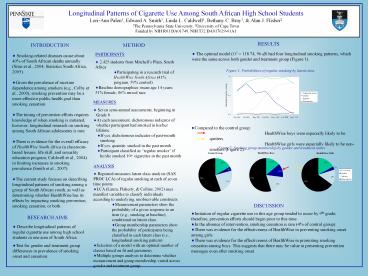
- The optimal model (G2 118.74, 96 df) had four
longitudinal smoking patterns, which were the
same across both gender and treatment group
(Figure 1).
- PARTICIPANTS
- 2,425 students from Mitchells Plain, South
Africa - Participating in a research trial of HealthWise
South Africa (41 program, 59 control) - Baseline demographics mean age 14 years 51
female 86 mixed race
- MEASURES
- Seven semi-annual assessments, beginning in
Grade 8 - At each assessment, dichotomous indicator of
whether participant had smoked in his/her
lifetime - If yes, dichotomous indicator of past-month
smoking - If yes, quantity smoked in the past month
- Participant classified as regular smoker if
he/she smoked 10 cigarettes in the past month
- Compared to the control group
- HealthWise boys were especially likely to be
quitters. - HealthWise girls were especially likely to be
non-smokers (Figure 2).
Figure 2 Smoking group membership by gender and
treatment status
- ANALYSIS
- Repeated-measures latent class analysis (SAS
PROC LCA) of regular smoking at each of seven
time points - LCA (Lanza, Flaherty, Collins, 2002) uses
manifest variables to classify individuals
according to underlying, unobservable constructs.
- Measurement parameters show the probability of a
given response to an item (e.g., smoking at
baseline), conditional on latent class. - Group membership parameters show the probability
of participants being classified in each latent
class (i.e., longitudinal smoking pattern) - Selection of a model with an optimal number of
classes based on fit and parsimony - Multiple groups analysis to determine whether
measurement and group membership varied across
gender and treatment group
DISCUSSION
- Initiation of regular cigarette use in this age
group tended to occur by 9th grade therefore,
prevention efforts should begin prior to this
time. - In the absence of intervention, smoking cessation
is rare (4 of control group). - There was evidence for the effectiveness of
HealthWise in preventing smoking onset among
girls. - There was evidence for the effectiveness of
HealthWise in promoting smoking cessation among
boys. This suggests that there may be value in
presenting prevention messages even after smoking
onset.
Recommended

