

Implementing ASCA in an Urban School Setting PowerPoint PPT Presentation
1 / 76
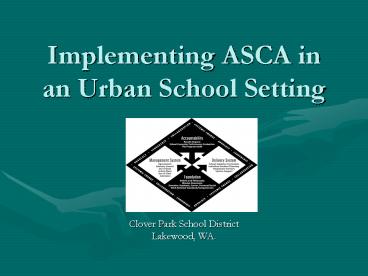
Title: Implementing ASCA in an Urban School Setting
1
Implementing ASCA in an Urban School Setting
- Clover Park School District
- Lakewood, WA.
2
Turning Point Technology ASCA Survey Demo
3
C_U_S_L_R
- O O N E
- E E U V
- U I P U
- I I H A
4
pumpkin pie cool whip lemon pie
- ice cream
- meringue
- crust
- nuts
5
How many years of school counseling experience do
you have?
- 20-30 years
- 15-19 years
- 6-14 years
- 1-5 years
6
Which level do you work with?
- Elementary
- Middle/Jr. High
- High School
- District Office/Admin
7
How familiar are you with the ASCA Model?
- Very Familiar
- Somewhat Familiar
- Not at all Familiar
8
How often do you use data results to determine
the needs of your students?
- Frequently
- Occasionally
- Not at all
9
Have you implemented any aspects of the ASCA
model in your current counseling program?
- YES
- NO
- Planning Stages
10
What is the main barrier you have encountered in
implementing the ASCA model?
- Budget
- Time
- Staff Support
- Management Agreement with Administration
11
Mission Statement
- The mission of Clover Park School District
Counseling Program is to support all students by
addressing the academic, career, and
personal/social skills necessary to achieve
academic success.
12
Demographic Data
- Clover Park School District is the 22nd largest
public school district in Washington State. It
encompasses 26 square miles and serves two major
military installations. It serves an average of
12,000 students
13
Demographics continues
- The ethnic ratios are as follows
- Asian American10.0 percent
- African American.18.3 percent
- Hispanic17.7 percent
- Native American1.6 percent
- White.46.1 percent
- Not provided..1.5 percent
- Multiracial..4.8 percent
14
Demographics continues
- Free /Reduce Lunch... 63 percent
- Mobility Rate... AYP September October 16
percent.
15
Poverty Challenge
16
Five Steps
- The five steps (Framework) necessary for
implementing ASCA in a school district - Planning the Program
- Building your Foundation
- Designing the Delivery System
- Implementing the Program
- Making the Program Accountable
17
Planning The Program
- Asking the essential questions
- How will this program prepare students to be
College, Career and Citizen ready? - How do you change a staff culture of complacency
to a culture of believing in all students? - How do schools provide a more positive climate
for learning? (Lapan, Gysbers, Sun, 1997).
18
Planning the Program
- Planning must first be filtered through three
systemic components before getting started - Securing commitment
- Getting organized
- Assessing your current program
19
Building Foundation
- Beliefs and Philosophical constructs must have
values assigned and measurable outcomes.
20
Designing the Delivery System
- Clover Park School District provides professional
development which addresses the needs of the
population. - Students, parents and teachers work closely to
monitor student learning plans. - Over 41 of our student population is Federally
connected. This contributes to a high transient
population.
21
Designing the Delivery System
- At some schools guidance curriculum is
collaboratively developed and integrated into
core content area for classroom
instructions/groups. - Clover Park School Districts/Schools provides
training that meet the needs of its community. - The district has developed an elaborative system
of support (Supportive Learning Environment)
around educational systems.
22
Implementing the Program
- The Director of Student Services, Elementary and
Secondary School Counselors visited ASCA model
program sites. - Administrators were asked to participate in
implementation process to gain buy in. - Presentations to the School Board and
Superintendents were conducted.
23
Implementing the Program
- Professional development budget was allocated.
- District wide focus for implementing ASCA was
endorsed by Superintendent. - Collection of data and the use of technology are
viewed as essential.
24
Making the Program Accountable
- Data collection
- The district is driven by data and has a belief
and requires measurable results for program
application. - The picture painted by educational indicators
- Attendance
- Discipline
- Academic performance
- Provides counselors a baseline of measurements
for determining program effectiveness
25
District Strategies
- District strategies which may have a direct
correlation to increasing student achievement - Why Try
- Owelus
- Hopeology
- Mentor/tutors
- After School Programs
- Partnerships with city and community
organizations
26
Drop Out Data
27
Graduation Data
28
Discipline Data
29
Discipline Data
30
- How do we align our program to meet our student
needs and what are the schools in Clover Park
School District doing?
31
High School
32
High School Demographics
- Approx. 1200 Students at Clover Park H.S.
Approx. 1500 Students at Lakes H.S. - American Indian/Alaskan Native 1.6
Asian 13.7
Pacific Islander 2.6
Black 25.6
Hispanic17.9
White 37.9
33
Demographics Continued
- 54 Free or Reduced Lunch
- 12 Special Education
- 10 English As Second Language
- Languages spoken 60 (within district)
- 25-30 Military
34
What have CPSD Counselors accomplished to date?
- We have done a lot in 4 years to build our ASCA
foundation
35
2005-06
- ASCA summer training in Bellingham and Pilot
Schools determined by SSC Director - Trish Hatch worked with pilot schools /admin
- CPSD counselors develop Vision and Mission
statements - Pilot counselors created power points based on
their data and action plans and presented results
to peers and school staff
36
2006-07
- All counselors began working towards ASCA
elements - All counselors presented data to their peers on
work they completed - School level teams began writing curriculum
following CPSD curriculum model
37
2007-2008
- A counseling professional development committee
began meeting to set up ASCA related trainings
for all counselors - Trish Hatch returned for follow-up training
- Student Services Director and counselors visit
Arizona and California to see ASCA in ACTION
and learn best strategies - Sharing of information with Superintendent Team
and other counselors
38
2008-2009
- Several Counselors, Administrators, and Student
Services Director attended the ASCA conference in
Atlanta. - H.S. Administrator Purchased 4 sets of Turning
Point Technology for counselors - Student Services Director and all counselors
begin working on a 3 Year Action Plan
39
Step One Planning the Program
- Start with your own building and look at what you
can implement there!
40
Step TwoBuilding your Foundation
- Get Administrative support for the changes you
are implementing in your building - If possible, get your District Administrator on
board so the entire district moves toward ASCA
implementation
41
Step ThreeDesigning the Delivery System
- High school counselors and administration made
big structural changes to improve achievement,
improve attendance, and address behavior concerns - Changes included Small Schools and Pathways,
Student-Led Conferences, Advisory/Leadership
classes, tutoring, summer programs, and mental
health counseling
42
Step FourImplementing the Program
- H.S. Counselors implemented several classroom
guidance lessons and at least one pre/post test
in the classroom - H.S. Counselors worked on addressing building
needs and created Closing the Gap Action Plans - H.S. Counselors targeted at-risk 9th graders and
started mentoring programs
43
Step FiveMaking the Program Accountable
- Lakes Administration believed that students were
not able to access counselors in a consistent
manner - Counseling program was structured so that all
counselors provided same services to each student
in 15 minute meetings. - One counselor position was cut Reduced from
four to three counselors.
44
Step FiveMaking the Program Accountable
- C.P.H.S. Counselors analyzed pre/post test data
and presented results to our Administration - C.P.H.S. Counselors analyzed Closing the Gap
Action Plan and presented results to our
Administration
45
Be PROUD of what you accomplish!
46
Accomplishments
- Dropout rate reduced from 11.5 to 6.1 from 2002
to 2008 - On-time graduation rates improved from 42.5 to
71 from 2002-2008 - Note Negative data is not always bad Use that
information to make changes and be proactive the
next year
47
9th Grade Intervention Results
1st Sem 2nd Sem
- Grade Point Average 13 Increase! 1.42 1.64
- Number of Failing Grades 27 Reduction! 63
46
Students in the counseling intervention group
improved their GPA and reduced their number of
failing grades!
48
Overall Guidance Lesson Results
- 57 of 9th graders in the intervention group had
less F grades 2nd semester - 64 of 9th graders in the intervention group
raised their GPA during 2nd semester
49
Middle School
50
Demographics
- Similar ethnic make up compared to district
- 77 free/reduced
- 75 military
- 40 mobility rate (current)
- School is located in a very isolated community
- Step 3 AYP
51
Implementation Time Line
- 2004-05 2 new counselors, 50 responsive, 50
scheduling - 2005-06 Introduced ASCA to admin, district
pilot group began, explored action plans - 2006-07 Wrote action plans for all guidance
lessons, began collecting and sharing data,
intentional planning for groups based on data - 2007-08 Utilize site council as advisory board,
increased visibility and accountability work,
achievement focused, time/task analysis - 2008-09 Continue district school level work
52
Mapping ASCA for Administration
53
Connecting ASCA, School, and District Goals and
Initiatives
54
Changes in Implementation
- Master calendar created and distributed
- Systematic Guidance curriculum conducted
- New programs developed based on data
- Culture Class
- Ongoing new student orientation class
- Quarterly family orientations
- Meet with advisory board 3x/year
- CTAG groups based on data, results shared
- District 3 year action plan developed
55
Changes in Delivery System
- Time and Task study for 3 quarters
- Committed to regular classroom lessons
- Action plans for department, groups, lessons
- Results data summary
- Ongoing comm. with admin
- Collaborate at school and district levels what
do all students need?
56
Changes in Accountability
- Results and summary reports shared with advisory
board - CTAG group results shared
- Seek out opportunities for prof. dev.
- Data based student interventions
- Seek feedback and trouble shooting from advisory
council - Department brochure created
57
Impact at Woodbrook
- All students receive Culture Class in September
- All new students get 10 hours of Culture Class
- School wide behavior system implemented
- WAC
- New focus on student interventions vs. reactions
- 9 weeks of test management eliminated (Yahoo!)
58
Ah has
- Process is valuable learning.
- On-going are you ever done?
- The needs of my school change every year due to
_____? - we are constantly playing catch up to meet new
needs. - Intentionality of collaboration MAKE time!
- Focus on what you have control of.
- Start where it makes sense to you, they are all
pieces of a whole. - What you find may create discomfort or more work.
59
Elementary School
60
(No Transcript)
61
The three year plan
- Implement one action plan in each of the 3
domains - Career
- Academic
- Personal/Social
- Implement one responsive services small group
62
Focusing on the student achievement data
- Attendance
- Discipline
- Academic performance
63
Personal Behavior Respects Others. Respects
Property.. Obeys School Rules... Accepts
Responsibility.. Demonstrates Self-Control
Work and Study Skills Listens Attentively. Fo
llows Directions. Uses Time
Effectively... Organizational
Skills. Completes Homework on Time.
64
Beginning and beyond
- Initial steps
- advanced
65
baby steps
- Small group example
- Take data (pre and post) focusing on student
achievement - improving attendance
- reducing behavior infractions
- improving academic performance
- i.e. 4th grade WASL scores
66
Academic domain
- Classroom example
- Test taking strategies
- 3rd grade homerooms
- Meet with your instructional leaders
67
Add a pre and post test to an existing lesson
68
Personal/social domain
- EMOTIONAL BINGO
- Vocabulary pre and post test
- of feeling words
- Western Psychological Services
69
More baby steps
- Keep your own quarterly data of interventions
- Cosmeo.com videos that address variety issues
includes pre and post tests - Check out Trish Hatchs site often for ideas
- Review your schools performance on standardized
test choose one and implement a plan for
improvement
70
Refining your program
- S-t-r-e-t-c-h to include all domains
- Publish your schedule/calendar
- Staff, students, families
- Advisory council
- Leadership team
- Principal Agreement
71
Its a work in progress
72
- The time for change is
now
The way we do business must change fundamentally
and immediately. Trish Hatch
73
In closing
- Give yourself permission to make mistakes
- Keep cheerful attitude
- But just DO it!!!
74
All this will not be finished in the first one
hundred days. Nor will it be finished in the
first thousand days, nor in the life of this
administration, nor even perhaps in the lifetime
of this planet. John F. Kennedy
75
- We need to be the change
- we want to see happen.
- We are the leaders
- we have been waiting for.
- Gandhi
76
References American School Counselor Association
(2004). The ASCA National Model Workbook.
Alexandria, VA Author. Hatch, Trish Lapan,
R.T., Gysbers, N.C., Sun, Y. (1997). The impact
of more fully implemented guidance programs on
the school experience of high school students A
statewide evaluation study. Journal of Counseling
and Development 75, 292-302.
77
Contact Info
- Edward Judie, Director of Student Services
253-583-5515, ejudie_at_cloverpark.k12.wa.us - Daniel Million, Clover Park High School
253-583-5524 dmillion_at_cloverpark.k12.wa.us - Angie Swaim, Lakes High School
253-583-5587 aswaim_at_cloverpark.k12.wa.us - Susie Sarachman, Woodbrook Middle School
253-583-5460
ssarachm_at_cloverpark.k12.wa.us - Karen Reynolds, Evergreen Elementary
253-583-5250 kreynolds_at_cloverpark.k12.wa.us
Recommended

