

Central detector for CLAS12: CTOF and Neutron detector PowerPoint PPT Presentation
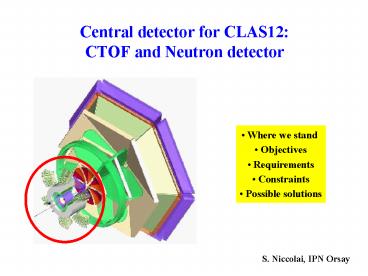
Title: Central detector for CLAS12: CTOF and Neutron detector
1
Central detector for CLAS12CTOF and Neutron
detector
- Where we stand
- Objectives
- Requirements
- Constraints
- Possible solutions
S. Niccolai, IPN Orsay
2
CLAS12 the current design
- Full detector
- Central (CD), 40oltqlt135o
- Forward (FD), 5oltqlt40o
CD exploded view of one sector of FD
3
Central Detector
Main coil
Central tracker
CTOF
Space for calorimeter and/or neutron detector (12
cm radial thickness)
Cryostat vacuum jacket
Magnetic field in the center 5 T
4
Central TOF
- CTOF Measuring TOF for particle ID of charged
particles
- Goal s 50 ps to allow
- p/K separation up to 0.6 GeV/c
- p/p separation up to 1.25 GeV/c
Challenge light collection in the strong
magnetic field (5 T)
5
Solutions studied at Kyoungpook and JLab
1) Long bent light guides and ordinary PMTs
20-30 mTesla
Prototype under construction at JLab (V. Baturine)
6
Solutions studied at Kyoungpook and JLab
2) Straight light guides and magnetic-field-resist
ant PMTs (micro channel, fine mesh)
In-field tests planned at Kyoungpook (S.
Kouznetsov)
0.6-2 Tesla
7
JLabs design (option 1)
50 scintillators 66x2x3 (cm) 100 Light guides
l1.0-1.8 m 100 Photo-multipliers s 72 ps (?)
Measurements have been done without light guides
and with straight LG
8
JLabs prototype
H8500/R2083
What can we do? Studying alternative
solutions SiPM as photodetectors? Can we achieve
50 ps of time resolution with SiPM?
9
Neutron detector
- Goal detection of neutrons with pn 0.2 - 1
GeV, with PID (n or g?) and measurement of angles
q, f
- Challenges
- detection efficiency (15 cm of
- material available, including CTOF)
- g/n separation TOF resolution (or?)
- strong magnetic field (5 T)
- no space for light guides
We need photodetectors that are insensitive to
magnetic field
10
GEANT4 simulation
- estimate and maximize detection efficiency for
neutrons - resolution on TOF to separate neutrons and g
- or find an alternative way to separate neutrons
and g
Realistic geometry, following design for CTOF
solid composed by trapezoids
- Segmentation
- Radial, to determine interaction point
- TOF ? p (5 layers in r, 3 cm thick)
- Azimuthal, to determine f (30 slices)
- q can be obtained via z1/2veff(t1-t2)
- Dimensions
- R 39 cm
- r 24 cm
- l 50 cm
11
Neutron efficiency
- Detector material scintillator
- Generated neutrons with pn0.1-1.0 GeV/c, q90,
f13.5 (center of 6th f slice)
Efficiency Nrec/Ngen Nrec number of events in
6th f slice having EdepgtEthreshold (r first
good hit only)
2 MeV 5 MeV 10 MeV
Light quenching effect taken into account by
reducing Edep for protons by a factor 5
- Efficiency increases
- decreasing the threshold
- Eff 15 for thr. 2 MeV
- and pn500 MeV/c
In agreement with thumb rule 1 efficiency
for 1 cm of scintillator
12
TOF resolution
For each f, r slice TOF (t1t2)/2 t1
tofGEANT tsmear (l/2-z)/veff t2 tofGEANT
tsmear (l/2z)/veff veff16 cm/ns (value used
in GSIM) tofGEANT average of times of all
steps z average of z positions from all
steps tsmear smearing factor Gaussian centered
at 0 with s t0/vEdep (MeV), t0 92 ps (deduced
from Slavas measurement at 6 MeV) for 1st r
layer, for other layers t0 200 ps
- Simulate time distribution of
- the scintillator light
- Introduce spread due to light transmission
- in the bar
- Account for transmission from the
- scintillator to the pmt photocathode
- (different size, lightguide...)
- Account for conversion to photoelectrons
- (q.e. 20)
- Include additional time spread due to PMT
transit time and amplification
13
TOF resolution results
s 70 ps
s 117 ps
s 117 ps
s 118 ps
Neutrons, pn 1 GeV/c
s 80 ps
Threshold 2 MeV
Resolution is worse with smaller threshold
14
TOF resolution results
s 48 ps
s 87 ps
s 83 ps
s 81 ps
Photons, pg1 GeV/c
s 80 ps
n/g separation possible up to pn1 GeV/c
At 3s no overlap between n and g in the first
layer starting to overlap in other layers
15
Hits multiplicity another PID method?
Photon, lead (0.625 cm)
Photon, no lead
Added lead layers, and studied the number of hits
per events with Edepgtthreshold, for neutrons and
photons
16
Neutron, lead 0.625 cm
Neutron, no lead
Photon, lead 0.625 cm
Photon, no lead
17
The spaghetti option KLOE
- Active material
- 1.0 mm diameter scintillating fiber
- Core polystyrene, r1.050 g/cm3, n1.6
- High sampling structure
- 200 layers of 0.5 mm grooved lead foils (95 Pb
and 5 Bi). - LeadFiberGlue volume ratio 424810
Conceived as an electromagnetic calorimeter, it
turned out to be very efficient for neutrons
Could this solution be viable for us? Coud it
work also for measurement of TOF? Timing
resolution with fibers SiPM?
More than twice the efficiency/cm of a
scintillator, measured with neutron beam
(Uppsala) and reproduced by simulation (FLUKA)
18
Summary
- Whichever solution will be chosen for the neutron
detector (layers of scintillators, sandwich
lead-scintillator, spaghetti, etc.), there are
the following issues - limited space upstream and downstream, due to
the presence of the light guides for CTOF - ? no space for additional light guides to
escape from the high magnetic field - light collection in the high magnetic field
BUT, compared to CTOF, the requirement on TOF
resolution is less stringent from preliminary
simulations, a time resolution twice as bad as
the one currently achieved in KNU and Jlab
measurements can still be good enough to
separate photons from neutrons for neutron
momentums up to 1 GeV
Can SiPM be the solution?
We need photodetectors insensitive to magnetic
field, providing decent timing resolution
19
Conclusions and to-do list
- CTOF and Neutron detector could coexist in one
detector, whose first layer can be used - as TOF for charged particles when theres a track
in the central tracker, while the full - system can be used as neutron detector when there
are no tracks in the tracker. - Neutron detection is necessary for the
measurement of nDVCS (Jis sum rule)
- Detection of DVCS recoil neutrons with 15 of
efficiency and n/g separation for - p1 GeV/c seems possible from simulations, using
scintillator as detector material - A sandwich lead-scintillator permits to use hits
multiplicity as PID method, but it - increases photon efficiency
- To do list
- use complete CLAS12 simulation and realistic
event generators for signal (nDVCS) - and backgrounds (ed?enp0(p)) to define needed
resolutions (q,f) - study the spaghetti option, more refined physics
list for low energy neutron (ongoing) - evaluate count rate for signal (n) and
background (g), to understand if high photon
detection - efficiency is a problem or not
- Hardware tests on timing with SiPM planned for
the spring at Orsay, tests with ordinary PMs
already underway
20
n/g separation by TOF
Photons Neutrons pn1 GeV/c
TOFn3.315 ns sn0.139 ns TOFg2.74 ns sg0.055
ns TOFn-3sn2.898 ns TOFg3sg2.905 ns
n/g separation possible up to pn1 GeV/c
21
Neutron efficiency
Energy deposited by neutrons with 1 GeV/c momentum
22
GEANT4 simulation
- estimate and maximize detection efficiency for
neutrons - resolution on TOF to separate neutrons and g
- or find an alternative way to separate neutrons
and g
Realistic geometry, following design for CTOF
solid composed by trapezoids
- Segmentation
- Radial, to determine interaction point
- TOF ? p (5 layers in r)
- Azimuthal, to determine f (30 slices)
- q can be obtained via z1/2veff(t1-t2)
NEW Possible to add layers of another material
Recommended

