

The Southern Cone of South America Experiences and Recent evolution PowerPoint PPT Presentation
1 / 26
Title: The Southern Cone of South America Experiences and Recent evolution
1
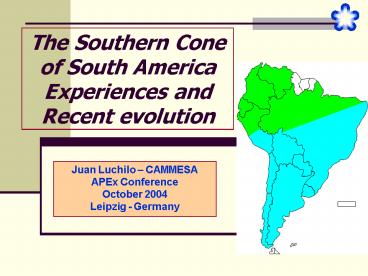
The Southern Cone of South AmericaExperiences
and Recent evolution
- Juan Luchilo CAMMESA
- APEx Conference
- October 2004
- Leipzig - Germany
2
South America - Experiences and Recent evolution
- Global Information Markets and Systems
- Energy integration gas electricity
- Argentina Crisis Impact
- Expectations - Concerns
3
Deregulation of the Electric Sector
BOLIVIA 1996
BRAZIL 1998
PARAGUAY ?
URUGUAY 200?
CHILE 1982
ARGENTINA 1992
4
Regional Market - Basic Data
Regional Market, 6 countries (Argentina,
Bolivia, Brazil, Chile, Paraguay,
Uruguay) Population? about 250 M Installed
Capacity ? 125 TW Annual Energy Consumption ?
500 TWh
5
Energy Consumption
6
Integration - Situation
- Different resources in each country (Brazil,
Uruguay, Paraguay mostly hydro Argentina, Chile,
Bolivia, hydrothermal) and level of deregulation - Long distances between main loads and from
resources to load - Barriers between countries
- natural (mountains, rivers)
- political gt openness to integrate markets
- technical and economical viabilitygt distances,
electrical issues - Opportunities gt complementarity of demand and
hydro availability, gas and electricity
integration
7
Energy Integration - Evolution
- Before 1997 gt Integration related with
binational hydro power plants agreement between
countries - Argentina Uruguay - Salto Grande (1890 MW)
- Brazil Paraguay Itaipú (12600 MW)
- Argentina Paraguay - Yacyreta (1800 MW)
- Only small gas pipelines linking countries
8
Energy Integration - Evolution
- After 1997gt Integration related with market
opportunitiesgt - competitive market, gas availability and new
capacity in Argentina - generation needs at northern Chile
- complementarity with Brazil and Uruguay (firm
capacity for dry hydro years) - Bolivia as a major gas player
9
Energy Integration - Evolution
- Argentina Chile gt new 345 kV link from Salta
to Northern Chile thermal generation built
specifically for that purpose isolated - Argentina - Brazil (2000 MW) 2 back to back DC
converters (50/60 HZ) built firm capacity
contracts - Argentina Uruguay firm capacity contracts
(400 MW) using existing link - Gas pipelines from Argentina to Chile, Brazil and
Uruguay - Gas pipelines from Bolivia to Brazil and
Argentina
10
Electricity or/and Gas?
- As well as electricity, gas has also become a
product exchange in the south cone - Brazil imports from Argentina and Bolivia, and
transform part locally in electricity - Chile imports from Argentina, to fuel its new
generation plants - Uruguay is on the same way soon
- Argentina began to import from Bolivia in 2004
- Theres a competition whether to transport gas
and transform it afterwards in electricity or to
produce electricity and then transport it through
wires economic viability is related with volume
requirement and scale
11
Energy Links Gas Electricity
Electroducto Argentina Chile
Electricity link Argentina-Brazil
Electricity link Argentina-Paraguay
Electricity link Argentina-Uruguay
12
Impacts (Argentina Brazil)
- Resources Optimization
- Share reserves (seasonal, hourly)
- Increase reliability, quality
Some Benefits
It requires adequate technical coordination
between the interconnected systems
13
Macroeconomic Changes
- Austral summer 2002 gt devaluation and political
crisis - Since July 2002 gt conditions begin to stabilize
relative normalization of the behaviour of
economy - 2003/4 gt strong economy recovery
Evolution of exchange rategt Increase of
industrial demand due to greater competitiveness
to export and import substitution Jan02-oct04
Exchange rate gt 200 Inflation gt about 50
14
Electricity Sector Scenario
- Tariffs to end consumers gt social impossibility
to increase tariffs due to economic crisis and
people impoverishment - Pesification of natural gas, energy and capacity
prices on the WEM - Increase of imported fuel and maintenance costs
- Uncertainty related with exchange rate evolution
and expected performance of the generation units - After 2003 gtincrease in demand (8)
15
GDP vs Demand
16
GDP vs Demand
17
Annual Peak Demand
EXP 2200 MW
Local 5700 MW
18
Installed Generation Capacity
- WEM capacity 1992 13267 MW
- 2004 23284 MW ? 70 Increase Gen gt 9700 MW
19
Electricity Sector Scenario
- This scenario led to severe difficulties, as
regards - Lack of gas availability for power plants
- Unusual alternative fuels requirement gt increase
of operative costs - Inability to cover the energy costs with the
defined tariffs - Risk of energy crisis in 2004 gt due mainly to
fuel availability combined with a hydro dry year
20
Crisis - Decisions
- Some decisions
- Additional payments for generators that commit
their availability with natural gas - Agreement with Brazil to import energy during
winter - Agreement with Venezuela to import a large amount
of Fuel Oil to replace the lack of natural gas - Cuts on gas exports (Chile) if needed in order to
avoid restrictions to the local demand - Gas imports from Bolivia
- Gradual increases in gas prices (from 0.4 to 1.0
us/MBtu (may 04-jul05)) - Slight increase in WEM tariffs only to industrial
consumers no increases to residential consumers
21
Results -Argentina Brazil link
Brazil crisis
Argentina crisis
22
ENERGY PRICE EVOLUTION
23
Energy Price Evolution
Competitiveness of the market and efficiency of
generation units provoked a fall in spot prices
of about 50 ? 48.8 /MWh1992 to 23.3/MWh2002
increase in MO costs and use of liquid fuel and
gas costs gt 54.0 /MWh2004
24
Liquid Fuel Consumption
25
Tariffs and Costs - Funds
26
Results
- Winter was managed, operating the system in
fairly good supply conditions .. but winter was
mild and hydrology wasnt so bad - Operation costs soared due to increase of natural
gas price and usage of liquid fuel and imports - Stabilization fund exhausted since jul-03 debt
of the fund with generators of about 1200 M (6
months of payment). - Operative inefficiency due to unavailability of
natural gas - Due to Argentinas role in the region, the
situation affected the operation in Chile and
Uruguay generating stress between governments in
the peak of the crisis (march-may)
27
Expectations - Concerns
- Macroeconomic issues (like devaluation) affect
parties gt requires dynamic adaptation to
maintain in the short term operability and in
long term commercial viability - Increase of tariffs required to gradually
normalize situation. The whole situation seems
very difficult to handle politically - Demand increase along with default of the
stabilization fund may lead to a significant
increase of the deficit of supply risk - Medium and long term viability and the lack of
new investments in generation is then one of the
major concerns, until the regulatory framework
may be adapted and political solutions adopted.
28
Next steps
- From CAMMESAs point of view
- Be flexible enough to implement changes on rules
and keep on running the system and the Market, in
a delicate environment. - Study and analyse scenarios to identify and
anticipate risks, in order to help in the search
of solutions.
29
Quality, Technology Transparency
For an Electrical Market without frontiers
Thanks for your attention!Leipzig, October
2004
Doubts gt jluchilo_at_cammesa.com.ar More info gt
www.cammesa.com.ar
Recommended

