

Extract Available & Unavailable Food Items from USA PowerPoint PPT Presentation
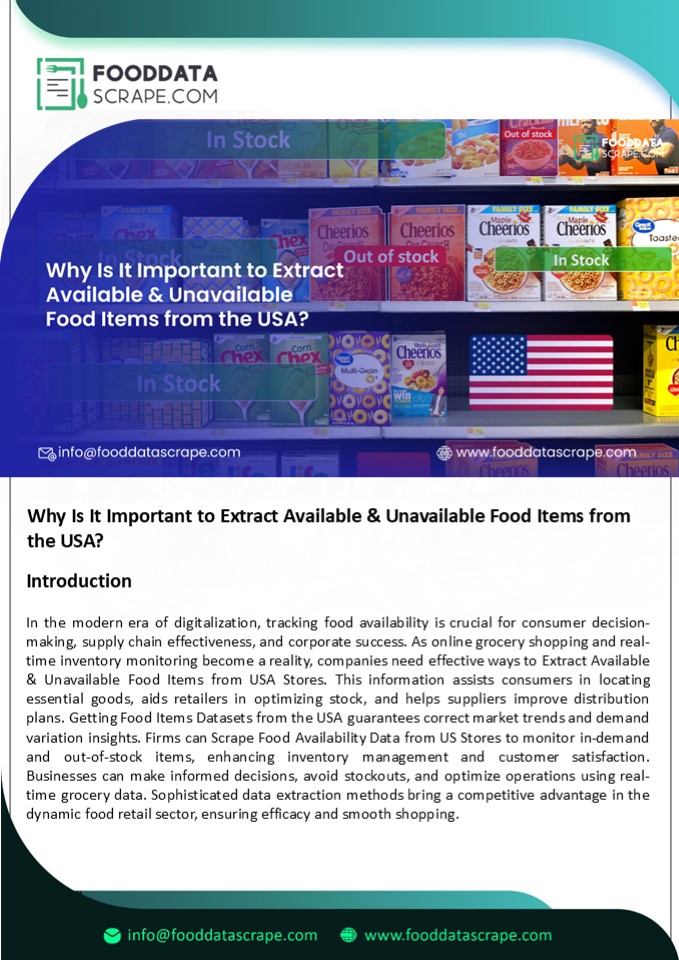
Title: Extract Available & Unavailable Food Items from USA
1
Why Is It Important to Extract Available
Unavailable Food Items from the USA?
Introduction In the modern era of
digitalization, tracking food availability is
crucial for consumer decision-making, supply
chain effectiveness, and corporate success. As
online grocery shopping and real-time inventory
monitoring become a reality, companies need
effective ways to Extract Available Unavailable
Food Items from USA Stores. This information
assists consumers in locating essential goods,
aids retailers in optimizing stock, and helps
suppliers improve distribution plans. Getting
Food Items Datasets from the USA guarantees
correct market trends and demand variation
insights. Firms can Scrape Food Availability Data
from US Stores to monitor in-demand and
out-of-stock items, enhancing inventory
management and customer satisfaction. Businesses
can make informed decisions, avoid stockouts, and
optimize operations using real-time grocery data.
Sophisticated data extraction methods bring a
competitive advantage in the dynamic food retail
sector, ensuring efficacy and smooth shopping.
2
Importance of Extracting Food Availability Data
- Data extraction from food availability from USA
stores is highly beneficial to consumers and
businesses. Through Food Item Availability
Tracking Using Web Scraping, businesses can
collect real-time product stock level
information, facilitating intelligent
decision-making regarding product inventory
control, pricing policies, and demand
forecasting. Some of the main benefits are - Efficient Inventory Management Retailers can
monitor stock levels across multiple locations,
reducing the risk of overstocking or stock
shortages. Access to Food Delivery Datasets helps
businesses maintain optimal inventory levels and
minimize losses. - Enhanced Consumer Experience Shoppers can check
product availability online before visiting
stores, saving time and ensuring they find the
needed items.
3
- Competitive Market Analysis Businesses can
analyze competitors' stock availability to adjust
their product strategies. Food Delivery Scraping
API Services allow retailers to extract real-time
data on pricing and stock trends. - Supply Chain Optimization Suppliers can predict
potential shortages, ensuring timely delivery of
goods and reducing disruptions. Restaurant Data
Intelligence Services assist in analyzing food
supply trends for better decision-making. - Actionable Market Insights Tracking available
and unavailable items helps businesses understand
seasonal demand fluctuations and evolving
consumer preferences, allowing for strategic
planning. - Get precise, real-time food availability
insightsleverage our accurate datasets to
optimize your business today! - Contact us today!
Challenges in Extracting Food Availability Data
4
- While extracting food availability data is
beneficial, it also comes with challenges. Some
of the key obstacles include - Dynamic Inventory Updates Store inventories
change frequently, making real-time data
extraction crucial. - Data Source Variability Different stores use
different inventory management systems, leading
to inconsistencies in data formats. - Access Restrictions Many retailers restrict data
extraction to protect proprietary information. - Data Accuracy Issues Extracted data may contain
errors or outdated information due to delayed
updates. - Legal and Ethical Concerns Businesses must
ensure compliance with data collection
regulations and ethical scraping practices.
Applications of Extracting Food Availability Data
5
- Extracting food availability data plays a crucial
role in various industries, from retail and
e-commerce to supply chain management and
disaster relief. It enables businesses to
optimize inventory, enhance customer experience,
and gain competitive insights, ensuring efficient
operations and informed decision-making. - Retail Industry Retailers can utilize food
availability data to optimize supply chains,
efficiently manage in-store inventory, and
minimize losses due to stock shortages or
overstocking. Large grocery chains and
independent retailers can analyze purchasing
trends to refine restocking strategies, ensuring
customer satisfaction. With Restaurant Menu Data
Scraping , businesses can monitor product
availability in food service establishments,
helping retailers align their offerings with
market demand. - E-Commerce and Online Grocery Platforms Online
grocery platforms rely on real-time availability
data to keep their product listings accurate. By
leveraging Food Delivery Data Scraping Services ,
e-commerce businesses can automate catalog
updates, ensuring customers only see items
currently in stock. This reduces order
cancellations and enhances user trust, improving
conversion rates and customer loyalty. - Food Delivery Services Food delivery platforms
must ensure customers do not order out-of-stock
items. By extracting availability data, these
platforms can prevent discrepancies between
listed and actual stock. Food Delivery
Intelligence Services provide valuable insights
that help delivery businesses optimize their
supply chain, minimize cancellations, and improve
overall customer experience. - Consumer Behavior Analysis Marketers and
analysts can leverage food availability data to
study shopping patterns and demand trends.
Understanding which products frequently go out of
stock allows businesses to tailor promotional
campaigns effectively. A Food Price
Dashboard helps retailers track demand-driven
price fluctuations, enabling competitive pricing
strategies based on real-time availability
insights. - Price Monitoring and Competitive
Intelligence Extracting food availability data
alongside pricing details allows businesses to
track competitors' stock levels and pricing
strategies. By monitoring fluctuations in supply
and demand, retailers can adjust their pricing
models and promotional discounts. A Food Price
Dashboard offers an aggregated view of competitor
trends, helping businesses remain competitive.
6
Food Supply Chain Management Suppliers and
distributors can use availability data to predict
demand spikes, identify inefficiencies in
delivery routes, and optimize distribution
networks. Food Delivery Data Scraping Services
enable businesses to streamline logistics,
ensuring timely restocking and minimizing waste,
leading to a more resilient supply
chain. Emergency and Disaster Management Trackin
g food availability is essential during crises
such as natural disasters or pandemics.
Governments, NGOs, and relief organizations can
use real-time data extraction to ensure the fair
distribution of essential food supplies in
affected regions. With the help of Food delivery
Intelligence services , authorities can make
informed decisions to prevent food shortages and
ensure equitable access to essential goods.
Key Data Points to Extract
When extracting available and unavailable food
items from USA stores, businesses should focus on
collecting the following key data points
7
- Product Name The name of the food item listed in
the store. - Brand Manufacturer or private label information.
- Category Classification of food products (e.g.,
dairy, bakery, frozen foods, fresh produce). - Availability Status Whether the product is in
stock or out of stock. - Price Current selling price and any ongoing
discounts. - Store Location Information on specific stores
where the product is available or unavailable. - Restock Date Estimated date of restocking for
out-of-stock items. - Product Reviews Customer feedback and ratings on
product quality and availability.
Industries Benefiting from Food Availability Data
Extraction
8
- Various industries benefit from food availability
data extraction, including retail, e-commerce,
food delivery, and supply chain management. It
helps businesses optimize inventory, track
competitor strategies, improve customer
experience, and enhance decision-making, ensuring
efficiency and accuracy in product availability
monitoring and demand forecasting. - Grocery Retailers Supermarkets and grocery
chains use extracted data to track product
availability, optimize shelf space, and enhance
customer service by minimizing out-of-stock
scenarios. - Food Manufacturers Food producers monitor store
inventory data to understand which products are
performing well and which need better
distribution strategies. - Logistics and Supply Chain Companies Supply
chain firms analyze food availability trends to
improve transportation efficiency and delivery
timelines for perishable goods. - Restaurant Chains and Food Services Restaurants
rely on food availability data to ensure an
uninterrupted supply of ingredients and minimize
food preparation and delivery disruptions. - Market Research Firms Research agencies use food
availability data to provide insights into
consumer trends, purchasing behavior, and market
demand shifts.
9
The Future of Food Availability Data Extraction
- With technological advancements, extracting food
availability data will become more precise and
efficient. Integrating AI and machine learning in
data extraction will improve accuracy and enable
predictive analytics. Future trends in this field
include - AI-Powered Forecasting Predicting food
availability trends based on historical data. - Real-Time Inventory Tracking Using IoT and smart
sensors for accurate stock monitoring. - Automated Data Collection Implementing robotic
process automation (RPA) for faster and more
efficient data extraction. - API Integration Collaborating with retailers for
direct access to real-time inventory data. - Enhanced Data Visualization Using dashboards and
analytics tools to make sense of extracted data
for better decision-making.
10
- How Food Data Scrape Can Help You?
- Real-Time Data Collection We use advanced web
scraping techniques to gather live data, ensuring
up-to-date and precise information on food
availability. - Multi-Source Validation Our datasets are
cross-verified from multiple reliable sources,
reducing errors and inconsistencies in food
availability tracking. - AI-Powered Data Cleaning We employ machine
learning algorithms to eliminate duplicate,
outdated, or incorrect data, ensuring
high-quality and accurate datasets. - Frequent Updates Monitoring Our systems
continuously track inventory changes, ensuring
that our datasets reflect real-time availability
and pricing fluctuations. - Customizable Industry-Specific We tailor our
datasets to meet industry-specific needs,
providing businesses with highly relevant and
accurate food availability insights.
Conclusion Extracting available and unavailable
food items from USA stores is vital for
retailers, suppliers, e-commerce businesses, and
consumers. The insights gained from this data
enable better inventory management, improved
customer experience, and optimized supply chains.
As data extraction technologies evolve,
businesses harnessing this information
effectively will gain a competitive edge in the
ever-changing food industry. By leveraging food
availability data, companies can ensure smoother
operations, better decision-making, and enhanced
market positioning in the grocery and food retail
sector. If you are seeking for a reliable data
scraping services, Food Data Scrape is at your
service. We hold prominence in Food Data
Aggregator and Mobile Restaurant App
Scraping with impeccable data analysis for
strategic decision-making.
11
(No Transcript)
Recommended

