

Market Refresh: Review of Bottled Water Industry Trends PowerPoint PPT Presentation
Title: Market Refresh: Review of Bottled Water Industry Trends
1
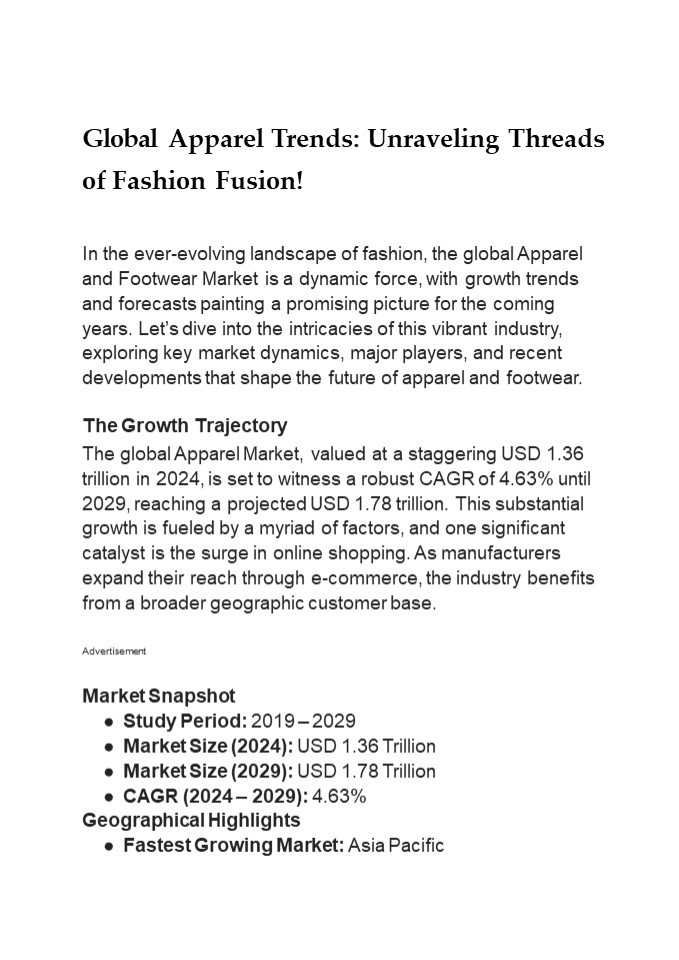
Global Apparel Trends Unraveling Threads of
Fashion Fusion! In the ever-evolving landscape
of fashion, the global Apparel and Footwear
Market is a dynamic force, with growth trends
and forecasts painting a promising picture for
the coming years. Lets dive into the
intricacies of this vibrant industry, exploring
key market dynamics, major players, and recent
developments that shape the future of apparel and
footwear. The Growth Trajectory The global
Apparel Market, valued at a staggering USD 1.36
trillion in 2024, is set to witness a robust CAGR
of 4.63 until 2029, reaching a projected USD
1.78 trillion. This substantial growth is fueled
by a myriad of factors, and one significant
catalyst is the surge in online shopping. As
manufacturers expand their reach through
e-commerce, the industry benefits from a broader
geographic customer base.
Advertisement
- Market Snapshot
- Study Period 2019 2029
- Market Size (2024) USD 1.36 Trillion
- Market Size (2029) USD 1.78 Trillion
- CAGR (2024 2029) 4.63
- Geographical Highlights
- Fastest Growing Market Asia Pacific
2
- Largest Market Europe
- E-Commerce Reshaping Fashion
- E-commerce has emerged as a powerhouse driving
the - Apparel and Footwear Industry. The online
platform has not only expanded the reach of
manufacturers but also heightened fashion
consciousness among consumers. The statistics
speak volumes as of January 2022, 55 of - Canadians engaged in online retail purchases via
mobile devices. The millennial generation, in
particular, is leading the trend, with 47
making at least one weekly online purchase. - Asia-Pacifics Prominence
- The Asia-Pacific region stands as the
fastest-growing market, boasting initiatives
that bolster the textile and apparel - industry. China, a major player, exported USD
170.26 billion worth of garments and accessories
in 2021. The regions growth is further fueled
by Indias rising population, increasing
disposable income, and evolving fashion trends. - Market Size and Growth Rate Dimensions of the
Apparel and Footwear Industry - Understanding the market size and growth rate is
pivotal for stakeholders aiming to gauge the
trajectory of the global - Apparel and Footwear Market. Lets delve into the
dimensions that define the industrys scope and
dynamics. - Market Size A Trillion-Dollar Industry
- The global Apparel and Footwear Market stands as
a colossal economic force, with a market size
projected at USD - 1.36 trillion in 2024. This expansive valuation
underscores the
3
industrys vast reach, influencing fashion
choices across diverse demographics and
geographies. Market Growth Rate A Steady
Ascent The industry exhibits a commendable
apparel and footwear market growth rate, with a
Compound Annual Growth Rate (CAGR) of 4.63
forecasted during the study period from 2024 to
2029. This steady ascent signifies a sustained
demand for apparel and footwear globally, driven
by evolving fashion trends, changing consumer
behaviors, and emerging market
dynamics. Factors Fuelling Market
Growth E-commerce Revolution
Advertisement
The proliferation of e-commerce platforms has
significantly contributed to market growth.
Manufacturers now have an extended reach,
reaching a broader customer base beyond
geographical constraints. The convenience of
online shopping has propelled the industry
forward, influencing how consumers access and
purchase fashion items. Rising Per Capita
Income The growth trajectory is further fueled
by an increase in per capita income globally. As
disposable income rises, so does the demand for
branded products and luxury wear. This shift in
consumer preferences towards premium offerings
propels the overall market forward. Womens
Apparel Segment Surge A noteworthy trend driving
growth is the rapid expansion of the womens
apparel segment. Fueled by an increasing number
of working-class women and changing fashion
4
preferences, this segment emerges as a key
contributor to the industrys success. Regional
Dynamics Shaping Growth Asia-Pacific as the
Epicenter The Asia-Pacific region emerges as the
fastest-growing market, spearheaded by
government initiatives in the textile industry.
Countries like China, with substantial exports
and a rising middle class, contribute
significantly to the regions prominence in the
global market. European Influence Europe,
despite being a mature market, maintains its
stature as the largest market. Renowned for its
luxury fashion and diverse fashion landscape,
Europes influence on global apparel trends
remains substantial. Opportunities for Future
Expansion Sustainable Practices Embracing
sustainability presents an avenue for future
expansion. Brands incorporating eco-friendly
practices and addressing environmental concerns
are likely to resonate with an increasingly
environmentally conscious consumer base. Digital
Integration The ongoing digital transformation
offers opportunities for brands to integrate
technology into their offerings. Augmented
reality, personalized online experiences, and
digital innovations can enhance customer
engagement and foster growth.
5
- Apparel and Footwear Sector
- Key Trends Driving Apparel Industry Evolution
- The Apparel and footwear Market trends is in the
midst of a transformative phase, with several
trends shaping its trajectory. Among these, the
role of e-commerce emerges as a pivotal force,
revolutionizing how consumers engage with
fashion. Lets explore the key trends catalyzed
by - e-commerce and their profound impact on the
apparel industry. - E-Commerce Dominance A Paradigm Shift
- The surge in online shopping marks a definitive
shift in consumer behavior. E-commerce platforms
have become the go-to destination for apparel
purchases, offering convenience, variety, and
accessibility. This shift has significantly
elevated the fashion consciousness of consumers,
expanding their exposure to a diverse range of
styles, high-end brands, and exclusive limited
edition products. - Influence of Innovative Designs and Fast Fashion
6
- Fast Fashion Dynamics The industrys growth is
intricately linked to the rise of fast fashion
trends. Brands are adapting swiftly to changing
consumer preferences, introducing new designs
and styles at an unprecedented pace. This agility
aligns with the demand for fresh, trendy
apparel, fostering a culture of rapid fashion
turnover. - Creative Marketing Strategies and Influencer
Impact Influencer Collaborations The influence
of social media influencers has become a driving
force in how fashion companies market their
products. Collaborations with - influencers bring a personal touch to brands,
creating a direct connection with their
audience. An exemplary instance is - Steve Maddens collaboration with South African
media personality Bonang Matheba, marking a
celebration of cultural diversity and fashion
innovation. - Celebrating Cultural Collaborations The
collaboration between Steve Madden and Bonang
Matheba signifies a celebration of cultural
diversity within the fashion realm. Such
collaborations not only elevate brand visibility
but also contribute to a more inclusive and
globally inspired fashion - landscape.
- Rise of Local Sustainable Startups
- The apparel industry is witnessing a surge in
interest towards sustainable fashion practices.
Local startups with sustainable approaches are
gaining traction worldwide. These startups,
offering a range of styles from formal to casual
and traditional wear, resonate with
environmentally conscious consumers. - Unique designs and concepts set them apart,
attracting a customer base seeking both style
and sustainability. - Mobile Commerce and Millennial Momentum
- Mobile Commerce Boom The growth of online
apparel sales is intertwined with the rise of
mobile commerce. A significant
7
percentage of consumers, particularly in the
millennial generation (ages 18-34), are
comfortable making wardrobe purchases through
their mobile devices. The International Trade
Administration reports a substantial 55 of
Canadians engaging in online retail purchases
via mobile devices, a trend likely to continue
its ascent. Millennials Driving Online Purchases
The millennial demographic, comprising
individuals aged 18 to 34, is at the forefront
of online purchasing trends. A notable 47 of
millennials make at least one weekly online
apparel purchase. This demographics penchant
for online shopping contributes significantly to
the growth of e-commerce sales in the apparel
market. 6. Shaping the Future E-Commerce as a
Growth Catalyst The evolving landscape of the
Apparel and footwear Market is intricately tied
to the transformative power of e-commerce. As
the industry embraces online platforms, consumers
are presented with a dynamic array of choices,
trends, and innovative designs. From sustainable
startups to influencer-driven marketing, the
e-commerce wave is reshaping the very essence of
fashion consumption, propelling the industry
towards a future where accessibility,
creativity, and sustainability converge in the
digital realm. Apparel and Footwear Market
Analysis The Apparel Market exhibits a robust
landscape, with its estimated size reaching USD
1.36 trillion in 2024 and poised to ascend to
USD 1.78 trillion by 2029, manifesting a
noteworthy Compound Annual Growth Rate (CAGR) of
4.63 during the forecast period from 2024 to
2029.
8
- Driving Forces of Growth
- The catalyst propelling the apparel market into a
phase of expansion primarily rests on the surge
in online shopping. Manufacturers, leveraging
the vast reach of e-commerce platforms, can
transcend geographical boundaries, broadening
their customer base and fueling industry growth. - E-Commerce Revolutionizing Sales
- E-commerce portals play a pivotal role in
augmenting traditional garment sales, breaking
geographic constraints that previously limited
producers. An exemplar is Amazons strategic
move in 2022, expanding its luxury offerings from
North America to Europe. This extension
facilitated the availability of high-end fashion
collections in the United - Kingdom, France, Italy, Spain, and Germany,
presenting a paradigm shift in consumer
accessibility. - Luxury Wear and Shifting Consumer Preferences
The projected demand for luxury wear is
intricately linked to the concurrent rise in per
capita income and a discernible shift in
consumer preferences towards branded products.
This evolution is particularly pronounced in the
womens apparel segment, experiencing a rapid
growth trend. The - influx of working-class women into this segment
further propels its upward trajectory. - Dynamics of a Mature Market
- Despite the maturity of the apparel market, its
vibrancy persists due to the interplay of
changing fashion trends and the evolving retail
landscape across brands. The industry grapples
with intense competition, prompting apparel
companies to strategically forge alliances. These
collaborations fortify their market presence,
creating a unified front to address evolving
consumer needs.
9
- 5. Strategic Imperatives for Success
- The competitive milieu necessitates apparel
companies to craft successful advertising
strategies and concentrate on specialized
consumer needs. This strategic approach not only
enhances brand visibility but also acts as a key
driver for generating increased revenue in a
market characterized by its dynamic nature. - Read More- BioArmor Breakthroughs Pioneering
Growth Tactics in Life Sciences Protective Wear - Major Players in the Apparel and Footwear Market
- The global Apparel and Footwear Market Major
Players is an arena where major players
orchestrate trends, introduce - innovations, and command substantial market
shares. Lets explore the key industry giants,
their notable products, - innovations, and their influence on the market
landscape. - PVH Corp. Defining Fashion Forwardness
- Products PVH Corp. is renowned for a diverse
portfolio - including iconic brands like Calvin Klein and
Tommy Hilfiger. These brands offer a wide range
of apparel and footwear, blending sophistication
with contemporary styles. - Innovations PVH Corp. has embraced
sustainability, - introducing eco-friendly practices in its
production processes. The incorporation of
sustainable fabrics and ethical sourcing
reflects a commitment to environmental
consciousness. - Market Share With its global reach and a strong
foothold in both luxury and casual segments, PVH
Corp. commands a significant market share,
catering to diverse consumer preferences. - Kering S.A. Luxury Redefined
- Products Kering S.A. boasts a prestigious
collection of luxury brands, including Gucci,
Yves Saint Laurent, and
10
- Balenciaga. The emphasis is on high-end fashion,
offering apparel and footwear that epitomize
opulence. - Innovations Kering S.A. has been at the
forefront of promoting sustainable practices.
Initiatives like using ethically sourced
materials and reducing environmental impact
showcase a commitment to ethical luxury. - Market Share As a key player in the luxury
segment, Kering - S.A. holds a considerable market share, with its
brands influencing global fashion trends. - LVMH Elevating Elegance
- Products LVMH houses renowned brands like Louis
Vuitton, Dior, and Fendi, offering a spectrum of
apparel and footwear synonymous with luxury and
sophistication. - Innovations LVMH is at the vanguard of combining
tradition with innovation. From incorporating
smart technology into fashion to promoting
craftsmanship, the brand consistently pushes
boundaries. - Market Share With a stronghold in the luxury
market, LVMH holds a substantial market share,
setting benchmarks for premium fashion
worldwide. - Inditex Fast Fashion Revolution
- Products Inditex, the parent company of Zara,
Massimo - Dutti, and Pull Bear, revolutionizes the market
with its fast fashion approach. Trendsetting
apparel and footwear are designed to reach
consumers swiftly. - Innovations The fast fashion model itself is a
- ground-breaking innovation, enabling Inditex to
respond rapidly to changing consumer
preferences. Sustainable practices, like
recycling programs, showcase their commitment to
responsible fashion.
11
Market Share Inditexs fast fashion dominance
translates into a significant market share,
especially among consumers seeking trendy,
affordable clothing. 5. Aditya Birla Group A
Diverse Fashion Portfolio Products The Aditya
Birla Group encompasses a broad spectrum of
apparel and footwear brands, catering to diverse
consumer needs. From casual wear to formal
attire, their portfolio offers a versatile
range. Innovations Innovations within the group
include technological advancements, such as
smart textiles and sustainable fabric
initiatives. Aditya Birla Group consistently
explores ways to marry technology with
fashion. Market Share With a diverse product
range and a presence across different market
segments, Aditya Birla Group commands a notable
market share, adapting to changing market
dynamics. In conclusion, these major players
wield significant influence, shaping the global
Apparel and Footwear Market with their diverse
product offerings, commitment to innovation, and
substantial market shares. Each brings a unique
flavor to the industry, contributing to the
ever-evolving world of fashion.
12
Apparel and Footwear Sector
Apparel Market Segmentation Unveiling Consumer
Preferences The Global Apparel Market intricate
tapestry unfolds through meticulous
segmentation, providing insights into diverse
consumer preferences and market dynamics. Lets
delve into the apparel and footwear market
segmentation facets that shape the industry
landscape. 1. End-User Segmentation Catering to
Varied Demographics Mens Apparel Tailoring
offerings to the discerning preferences of men,
this segment encompasses a spectrum of styles
from formal wear to casual and
sportswear. Womens Apparel Addressing the
diverse fashion needs of women, this segment
witnesses a surge in demand, fueled by evolving
trends and the increasing presence of
working-class women.
13
- Childrens Apparel
- Catering to the youngest fashion enthusiasts,
this segment embraces a range of styles ensuring
comfort, durability, and style for the younger
demographic. - Type-Based Segmentation Defining Style
Categories Formal Wear - The epitome of sophistication, this segment
caters to occasions demanding elegance and a
refined aesthetic. Casual Wear - Catering to the contemporary lifestyle, casual
wear encapsulates comfort without compromising
on style, making it a dominant force in the
market. - Sportswear
- Aligning with the active lifestyles of consumers,
sportswear blends functionality and fashion,
riding the wave of fitness and athleisure
trends. - Nightwear
- Providing comfort and style for bedtime, this
segment offers a diverse range of sleepwear
options to suit varied tastes. - Other Types
- Encompassing an array of niche styles, this
segment caters to specialized preferences,
ensuring a comprehensive market coverage. - Geographic Segmentation Navigating Global
Markets North America - A hub of diverse fashion preferences, North
America represents a substantial market with the
United States, - Canada, and Mexico contributing to the dynamic
landscape. - Europe
- Characterized by its rich fashion heritage,
Europe holds the mantle as the largest market,
with countries like Spain, the
14
- United Kingdom, Germany, France, Italy, and
Russia driving trends. - Asia-Pacific
- Emerging as the fastest-growing market, the
Asia-Pacific region, with key players like
China, Japan, and India, unfolds opportunities
propelled by robust government initiatives. - South America
- Contributing to the global market, South America,
with nations like Brazil and Argentina, reflects
a unique blend of fashion preferences. - Middle East Africa
- Showcasing a diverse fashion mosaic, the Middle
East - Africa region, including Saudi Arabia and South
Africa, adds a distinctive flavor to the global
apparel market. - Recent Developments in the Industry
- In September 2023, HM revealed its expansion
plans in India, inaugurating its third store in
Hyderabad. - August 2023 saw Reliance Retail introducing its
youth-oriented fashion brand Yousta in
Hyderabad, catering to evolving consumer
preferences. - In May 2023, Adidas, in collaboration with
designer Rich Mnisi, unveiled a special apparel
collection for Pride 2023. This collection,
featuring garments crafted partly from recycled
materials, aligns with the industrys commitment
to sustainability. - Future Outlook Opportunities and Challenges in
the Apparel and Footwear Market - As the global Apparel and Footwear Market future
outlook - continues to evolve, the future holds a dynamic
interplay of
15
opportunities and challenges in apparel and
footwear market. Stakeholders in this vibrant
industry must navigate these factors to stay
ahead of the curve. Future Opportunities Sustainab
le Fashion Revolution The growing consumer
consciousness towards sustainability presents a
significant opportunity. Embracing eco-friendly
practices, using recycled materials, and
promoting ethical sourcing can not only meet
consumer demands but also position brands as
champions of responsible fashion. Digital
Transformation The ongoing digital
transformation offers a vast landscape for
innovation. Integrating technology, such as
augmented reality for virtual try-ons or
personalized shopping experiences, can enhance
customer engagement and streamline
operations. Emerging Markets Exploring untapped
markets, especially in regions with a rising
middle class, can open new avenues. Brands
expanding into these markets can tap into
evolving consumer preferences and establish a
foothold in burgeoning economies. Customization
Trends Consumer preferences are increasingly
leaning towards personalized experiences. Brands
that offer customizable apparel and footwear
options, whether in design or sizing, can
capture this trend and build stronger connections
with their customer base.
16
Anticipated Challenges Supply Chain
Disruptions The apparel and footwear industry,
like many others, faces challenges related to
supply chain disruptions. External factors such
as geopolitical tensions, natural disasters, or
global health crises can impact the production
and distribution of fashion goods. Fast Fashion
Sustainability Concerns While fast fashion has
dominated the industry, concerns about its
environmental impact and ethical practices have
surfaced. Balancing the demand for rapid trends
with sustainable and ethical practices poses a
challenge for brands in this space. Evolving
Consumer Behavior Understanding and adapting to
shifting consumer behaviors is an ongoing
challenge. Rapid changes in preferences, influence
d by social, economic, or cultural factors,
require brands to stay agile and
responsive. Intense Market Competition The
industrys competitive landscape is intense, with
numerous players vying for consumer attention.
Brands must continuously innovate, stay on top
of trends, and differentiate themselves to
maintain and grow market share. Strategies for
Success Innovation and Technology
Adoption Brands that invest in innovation,
incorporating new technologies and sustainable
practices, are poised for success. This includes
embracing smart textiles, eco-friendly
materials, and leveraging digital platforms for
enhanced customer experiences.
17
Agile Supply Chain Management To tackle supply
chain challenges in apparel and footwear market,
adopting agile and resilient supply chain
practices is crucial. Diversification of
suppliers, strategic partnerships, and real-time
monitoring can mitigate the impact of
disruptions. Brand Transparency and
Accountability Building trust with consumers
involves transparency and accountability. Brands
that communicate their sustainability initiatives,
ethical sourcing practices, and social
responsibility efforts can establish a positive
brand image. Consumer-Centric Approach Understand
ing and responding to evolving consumer
preferences should be at the core of brand
strategies. A consumer-centric approach, coupled
with data-driven insights, allows brands to
tailor their offerings to meet market
demands. Conclusion A Fashion Forward Future In
conclusion, the global Apparel and Footwear
Market is not just a marketplace its a dynamic
ecosystem fueled by innovation, sustainability,
and evolving consumer preferences. As we stride
into the future, the industrys competitive
landscape and strategic developments ensure an
exciting journey ahead.
Read More- North American Innerwear
Market(2023-2029)
Recommended

