

Swift vs React Native : What’s Better For iOS App Development? PowerPoint PPT Presentation
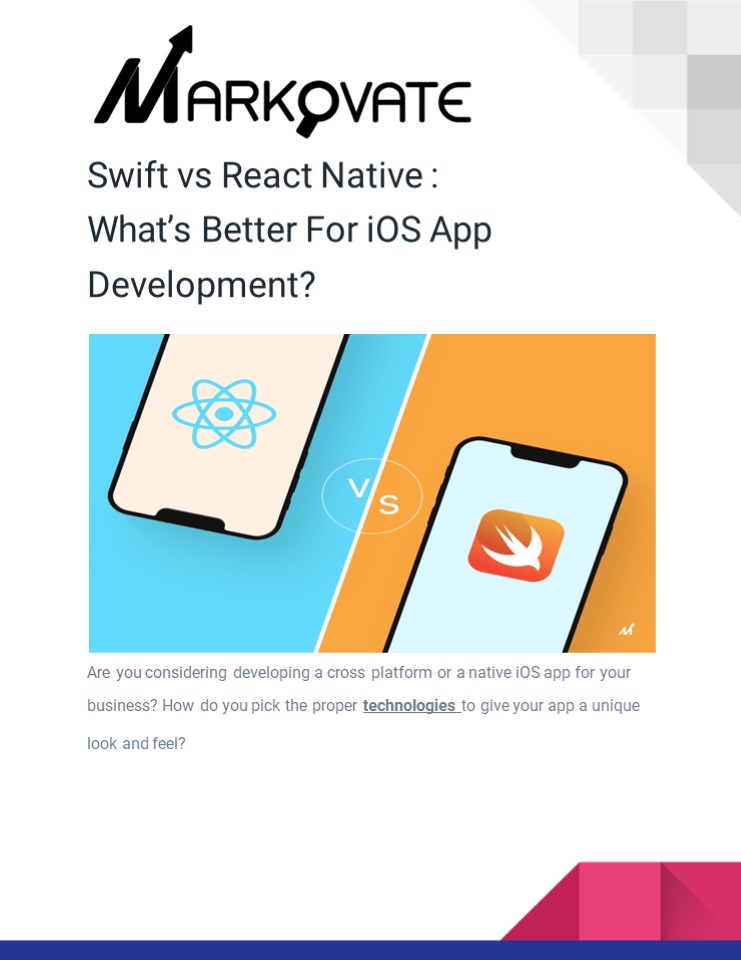
Title: Swift vs React Native : What’s Better For iOS App Development?
1
Swift vs React Native Whats Better For iOS
App Development?
Are you considering developing a cross platform
or a native iOS app for your business? How do you
pick the proper technologies to give your app a
unique look and feel?
2
2 You might believe that selecting a technology
stack for an iOS app is simple. However,
developing native apps isnt always the best
option. What if you need a cross platform
solution for your project? What if React Native
is more cost-effective than Swift? Is it
possible to build iOS native apps using both
React Native and Swift? Lets compare these two
approaches to iOS app development. In the case
of an iOS application with a simple user
interface and no complicated logic, React Native
is a perfect choice. Above all, if you need to
get into the market quickly and save money on the
development, try this framework. If your app is
complex, needs to bene?t from all of the devices
features, and needs to work with all Apple
products, Swift is the way to go. Also, if
your budget isnt too tight, go for Swift. Lets
dive right into the comparison pool to see what
we can learn about both of these
technologies. Key statistics for iOS The iPhone
is unquestionably more than a product it is a
social and cultural phenomenon that sparked the
smartphone revolution in June 2007 when it
3
- 3
- was originally released. Since then, the devices
popularity has soared, with - the brand accounting for 15.2 of global
smartphone unit sales. Even more astonishing
when you consider that Apple is a premium brand,
and these - ?gures include cheap or no-name brands sold in
rapidly growing economies. iOS-powered
smartphones are most popular in the worlds
strongest - economies, including the United States, Canada,
Scandinavia, and Australia. - Over 1 billion people currently use the iPhone.
- In 2021, Apple shipped 206.1 million iPhones.
- Since its introduction, more than 1.9 billion
iPhones have been sold. - iPhones account for 65 percent of smartphone
sales in the United States. - Given that, its no surprise that Apple is
powerful enough to impose its - frameworks and programming languages which is
essentially what Swift is. - What exactly is Swift?
- Swift is an Apple-developed general-purpose
programming language that was initially released
in 2014. It is used to create programs for macOS,
tvOS, watchOS, and other platforms because it is
a multi-paradigm programming
4
4 language. Swift is also more versatile,
trustworthy, expressive, and e?cient because of
the revolutionary software design. The language
is simple to create, read, and maintain and has a
human-friendly syntax. Swift also includes the
Cocoa and Cocoa Touch frameworks from
Apple. Swift-based apps
Image source
- Swift has been used to create some well-known
apps. We have compiled a list - of the ?nest applications for improved
comprehension. - Airbnb
- Swifts interoperability features have been used
extensively in this travel agency app.
5
- 5
- Swift was implemented in the iOS version of this
social networking platform, and it has since
provided a seamless and speedy user experience. - Lyft
- Swift has made this cab booking app lighter,
smaller, responsive, and easier to maintain. - What exactly is React Native?
- React Native is a framework for creating
device-independent mobile apps based on
JavaScript. The open-source framework is
developed in JSX, a JavaScript and XML-like
markup blend. The Facebook-backed React Native
framework allows developers to share many scripts
between apps. As a - result, the overall cross platform software
development time is signi?cantly reduced. - This is why more than half of the app development
community prefers to use React Native.
6
6 React Native-based apps
Image source
- Every business wants to know why they should hire
a React Native developer. - To give you an idea, heres a list of companies
that have gained signi?cant bene?ts from
developing Android and iOS apps with React
Native. - This social media platform used React Native to
implement WebView-based push noti?cations. It
achieved so without putting together a navigation
system.
7
- 7
- The application provides a friendly mobile user
experience and straightforward navigation. - Walmart
- The user experience has been improved, and in-app
animations have been optimized to match the
native functionalities.
Statistics on market usage
Image source
- Some interesting statistics about React Natives
market share - Because of its native tools and libraries, 11.5
of developers favor React Native.
8
- 8
- React Native is expected to be used by 38 of
developers in 2021 for cross platform app
development. - Here are some cool stats for the market usage of
Swift - The Tiobe index May 2022 report ranks it 14th.
- According to the PYPL research, this app
development technique ranks 10th with a 1.91
market share. - On GitHub, it has 9.6K forks and 59.5K stars.
- The bene?ts and drawbacks of using React Native
- Sure, each technology has advantages and
disadvantages to consider before picking between
react native and swift. Lets look at the bene?ts
and drawbacks of using React Native.
9
9 Bene?ts of React Native
Image source
- Native app development may offer a superior user
experience. They usually - offer excellent results. The UX is also improved
because the images are tailored to the
platforms UX design. - Furthermore, among the React Native vs Swift
advantages are the following - More rapid development
- JavaScript is integrated into React Native.
Approximately 90 of the code for your mobile
application may be found in online applications.
React Native - takes 1 to 5 months to build an iOS native app,
which is 33 percent faster than Swift.
10
- 10
- Feature expanding
- You can enhance the functionality of your app by
using pre-existing or new JavaScript modules. - Flawless performance and high speed
- Because they are created for a certain operating
system, a native application - takes full advantage of the devices processing
speed. The apps work well and run smoothly. - Easy to integrate with equipment
- A native app is simple to integrate with device
technology such as touchscreens, GPS, and
cameras. - Higher reliability and safety
- A native mobile app adheres to all operating
system rules and is vetted and authorized by the
App Store, making them secure and dependable.
First-rate features are guaranteed to be
implemented quickly.
11
- 11
- Drawbacks of React Native
- Complex design
- App design rules for Android and iOS differ. As a
result, creating high-quality custom UI for a
React Native app is challenging. - Frequent updates
- React Natives components are updated regularly.
As a result, prepare for more frequent app
updates. - Lack of wrappers
- Developers may need to design bespoke wrappers in
some circumstances to provide the app with
native modules, components, and APIs, which takes
time. - The bene?ts and drawbacks of using Swift
- Also, consider the bene?ts and drawbacks of
choosing Swift vs React Native. Examine them out.
12
12 Bene?ts of Swift
Image source
- Flexible scalability
- Using Swift, you can future-proof your project
and add new features as needed. These types of
programs are usually easy to scale. - Precise error handling
- Swifts robust error handling and typing system
keep code crashes and errors at bay during
production. - Concise coding
- Swift is incredibly concise, which means you
require less code to do the same goal as React
Native.
13
- 13
- Faster coding
- Swift was designed with high performance in mind.
It has a straightforward syntax that allows for
speedier app development. - Drawbacks of Swift
- Poor support for previous iOS versions
- Swift cannot be used for long-term business
projects on older iOS versions. - Lesser talent pool
- Only 5.1 of the 83,053 respondents to a
StackOver?ow developer survey used Swift, making
?nding quali?ed talent di?cult for organizations. - Interoperability issues with third-party software
and IDEs - Developers frequently mention problems with
syntax highlighting, autocomplete, refactoring
tools, and compilers due to rapid upgrades.
14
Swift vs React Native A comparison
14
Image source
- Stability
- While React Native may produce a decent
native-like UI, it lacks Swifts level of
stability. You may take advantage of the devices
features and create a more stable and
feature-rich app by using the native development
language. - Swift stability vs React Native Swift wins
- Performance
- Swift gets the advantage here, too, because
native development nearly always outperforms
cross platform development. Swift is well ahead
of the competition, especially in dynamic and
graphic effects-rich apps.
15
- 15
- Swift performance vs React Native Swift wins
- Talent pool
- Even though its di?cult to compare the two
because React Native is a - framework and Swift is a language, its clear
that React Native has a far larger community. On
the other hand, Swift has shown to be quite
popular and useful in the mobile app development
industry and has been rising in popularity over
time. - Swift talent pool vs React Native React Native
wins - User Interface
- React Native uses native components and APIs to
allow an app developer to create native-like
applications with a similar appearance and feel.
Swift was created speci?cally for iOS
programming, ensuring that the UI elements on iOS
devices are of the highest quality. - Swift UI vs React Native Swift wins
- Coding speed
- Your objectives mostly determine your coding
pace. If youre solely making an iOS app, Swift
is undoubtedly the best option. React Native, on
the other hand,
16
- 16
- will ensure faster results if you want to launch
your solution on both iOS - and Android.
- Swift coding speed vs React Native tied
- Documentation
- Both React Native and Swift have good
documentation, given they were built by
well-known and experienced tech heavyweights
Facebook and Apple. - Swift documentation vs React Native tied
Application architecture React Native vs
Swift React Native overview
Image source
17
17 The main idea is to understand the role React
Native plays as a middleman between native and
JavaScript threads. From there, JavaScript code
communicates with native APIs and
platforms. React Native bundles JavaScript codes
for Android app development. React Native, on
the other hand, uses Javascript to write all of
the code individually in iOS development. Swift
overview
Image source
- When it comes to Swift architecture, the
following are some examples- - MV
18
- 18
- Viper
- MVVM
- Clean
- The Xcode templates are used to generate
components when we talk about choosing clean
architecture. Surprisingly, these Xcodes perform
admirably with time, as the developers ability
to make modi?cations in the future gets easier. - MVC lacks coding, making it di?cult to write and
maintain the program. Finally, Viper with Swift
UI helps developers separate functions, making
testing and managing the application easier.
Viper also makes app development more e?cient. - Conclusion
- Overall, React Native and Swift are excellent
tools for developing iOS applications. Youll
need to take advantage of their differences to
determine which one is best for your project. - React Native allows you to create an iOS app,
Android app, as well as web app from a single
code base. Its a less expensive technology than
Swift, but it still lets you make high-quality
apps. React Natives biggest ?aw is its lack of
19
19 maturity. A lack of documentation as well as
frequent framework upgrades may cause
problems. Swift is a straightforward programming
language. As a result, it is more suited to
large enterprise apps than React Native. Swift is
also faster than React Native for creating iOS
apps. Still, if you want to develop a native
Android app, youll require more time and money.
If you opt to build a Swift app, youll receive
clean code, a rich user experience, and also
seamless performance. The main distinction
between React Native and Swift is that React
Native is better for cross platform development,
whilst Swift is better for iOS app
development. As a result, you could build an
Android app in Java or Kotlin and solely use
Swift and Objective-C for iOS. Contact Markovate
if youre seeking an experienced React Native and
Swift developer. Using our mobile app
development services, business owners can get an
advantage over their competitors. Our mobile
developers are available to help you with your
next app development project.
Recommended

