

Department of Computer Science ANU College of Engineering and Computer Science PowerPoint PPT Presentation
1 / 14
Title: Department of Computer Science ANU College of Engineering and Computer Science
1
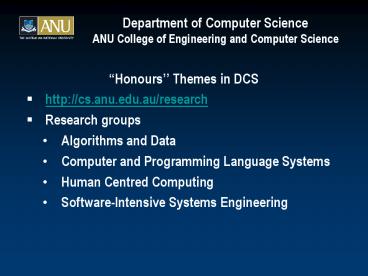
Department of Computer ScienceANU College of
Engineering and Computer Science
- Honours Themes in DCS
- http//cs.anu.edu.au/research
- Research groups
- Algorithms and Data
- Computer and Programming Language Systems
- Human Centred Computing
- Software-Intensive Systems Engineering
2
Energy Efficicent Algorithms in Wireless Sensor
NetworksWeifa.Liang_at_anu.edu.au
- Energy-efficient data gathering
- Latency-energy data dissemination in ad hoc
wireless networks - Energy-efficient skyline query computation and
maintenance
3
Energy Efficicent Algorithms in Wireless Sensor
Networks
- Data gathering is one of major functions of WSNs,
in this project we consider the case where the
message length transmitted by a sensor is
proportional to the sum of the message lengths of
its children and itself. - (Latency-Energy Routing) Telecomm theory says the
transmission time of data is inversely
proportional to the transmission energy
consumption, for different connection requests
with different QoS constraints, we aim to find a
routing path/ multicast tree for transmitting the
source data to their destinations such that the
maximum energy consumption is minimised while the
QoS constraint is met. - Skyline query is an important operator in modern
databases, we consider continous skyline query
computation and maintenance in an
energy-constrained sensor network.
4
Honours projects in data miningand data
linkage/matchingDr Peter Christen
- Large databases are now common in many businesses
and government agencies - Aim of data mining is to detect hidden patterns,
correlations, rules, clusters, classes, etc. - Often records from several databases have to be
linked and aggregated - Many different challenges accuracy of mining and
linking, scalability, parallelisation, and
privacy protection
5
Honours projects in data miningand data
linkage/matching
- Some potential honours research projects
- Why do students fail? Data mining the DCS student
database - Scalable parallelisation of data linkage
techniques - Data linkage of historical UK census data
(1851-1901)? - Privacy-preserving record linkage
- Ideally, a student would have done COMP3420, or
database, machine learning, statistics course - Contact and supervisor Peter Christen (DCS
lecturer) more project details on his Web site
6
Modern Languages,Modern ArchitecturesAssociate
Professor Steve Blackburn
With multi-core, its like were throwing this
Hail Mary pass down the field and now we have to
run down there and see if we can catch it Dave
Ditzel (Transmeta Founder), Feburary 2008
- Work with lead developers of next generation
languages such as X10 (IBM). - How do we efficiently implement these languages
on new architectures? - Work with lead architects (Intel and IBM)
- How can we better support these languages?
- How can we make better use of multi-core?
7
- Challenging?
- Yes. Creativity, drive, excellent problem solving
skills, and ability to write good code all
essential. - Relevant?
- Yes. Helping shape the next generation of
languages and architectures. - Open?
- Yes. Lead maintainers of open source research
infrastructure. - High Impact?
- Yes. We influence industry, write highly cited
publications, and produce widely used software. - Fun?
- Yes! -)
- Interested?
- See Steve Blackburn (N217)
8
(No Transcript)
9
(No Transcript)
10
Face recognition Eye gaze
Prof Tom Gedeon
- 3D Face modeling tool
- caricature, view morphing
- PCA face recognition tool
- Eye gaze inference in game-like task
- Eye gaze for faces, attention, saliency
models, art recognition
11
AI Fuzzy, Neural, Evolutionary
- Generate Art using Evol. algorithms
- 3D art simulator, other abstract art,identikit
faces, analyse esthetics - Exam scheduling!
- Fuzzy logic for information retrieval,subjective
data analysis, diagnosis - Cascade neural net for face recognition
12
Virtual Reality / Brain-Creative Interfaces
13
Contact Henry.Gardner_at_anu.edu.au- specific
project is a system for detecting and using
cognitive load to interact with a musical
accompaniment (c.f. MySong) .. With NICTA
14
Software Engineering Research Projects
- Research areas
- Model-Driven Development
- Aspect-Oriented Thinking (come to COMP3110
lecture next week)? - Computational Science (workflow, model coupling,
re-engineering)? - Ecology (multidisciplinary, modeling, simulation,
clusters)? - Services Science (web services, service-oriented
computing)? - Design Patterns
- Architecture
- Information Retrieval
- Human Aspects of Software Engineering
- Software Engineering Education
- SWEng research projects can be scoped within any
of these subject areas - Full list of subjects and contacts
- http//softeng.anu.edu.au/research.html
Recommended

